


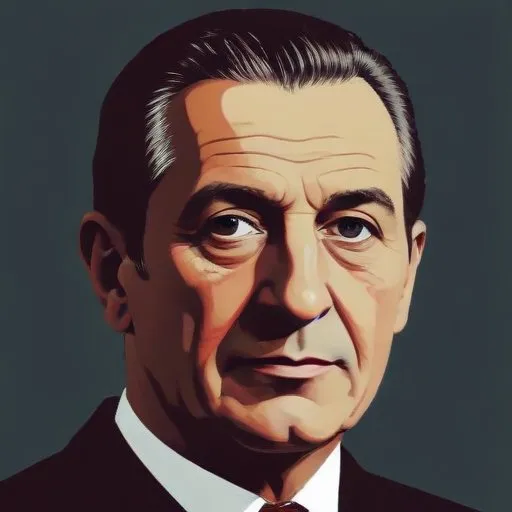
A Serbian philosopher and politician who served as the 6th Prime Minister of Serbia, known for his efforts to reform the country's economy and politics during a tumultuous period. He played a key role in shaping Serbia's transition from socialism to democracy.
Zoran Đinđić, a prominent figure in Serbian politics, is remembered for his remarkable leadership as the Prime Minister of Serbia from 2001 until his assassination in 2003. As a devoted advocate for democracy and human rights, he spearheaded significant reforms to integrate Serbia into European structures.
Born on August 1, 1952, in Bosanski Šamac, Bosnia and Herzegovina, Yugoslavia, Đinđić was raised in a family of modest means. His father, an officer in the Yugoslav People's Army, was stationed in various locations, which led to the family relocating frequently. This upbringing instilled in Đinđić a strong sense of adaptability and dedication to public service.
Đinđić's academic excellence earned him a doctorate in philosophy, which laid the foundation for his future political career. As one of the original thirteen founders of the modern-day Democratic Party, he played a crucial role in shaping the party's ideology. In 1994, he was elected as the party's president, solidifying his position as a key leader in Serbian politics.
During the 1990s, Đinđić fearlessly opposed the authoritarian regime of Slobodan Milošević, earning him widespread recognition as a champion of democracy and human rights. In 1997, he was elected as the mayor of Belgrade, where he implemented significant reforms to revitalize the city.
In 2001, following the overthrow of Milošević, Đinđić became the Prime Minister of Serbia. His government ratified the European Convention on Human Rights and implemented key reforms to align with the Council of Europe's recommendations. This led to Serbia and Montenegro becoming a member state of the Council of Europe in 2003.
Đinđić's government also cooperated closely with the International Criminal Tribunal for the former Yugoslavia (ICTY), resulting in the arrest and extradition of war criminals.
On March 12, 2003, Đinđić's life was brutally cut short by an assassin's bullet. His death sent shockwaves throughout Serbia and the international community, mourned by those who admired his unwavering commitment to democracy and human rights.
Today, Đinđić's legacy lives on as a testament to his tireless efforts to transform Serbia into a democratic, European-oriented state. His contributions to Serbian politics and philosophy continue to inspire generations of leaders and citizens alike.
"Democracy is not a destination, but a journey. And this journey requires constant effort and dedication."
"Human rights are not a luxury, but a necessity for any society that claims to be civilized."
Đinđić's unwavering commitment to democracy and human rights has had a profound impact on modern Serbian society. His reforms paved the way for Serbia's integration into European structures, fostering greater regional cooperation and economic growth.
His legacy serves as a beacon of hope for countries transitioning from authoritarian regimes to democratic systems, inspiring future generations of leaders to emulate his courage and conviction.
Posthumously awarded the Order of the Serbian Flag, 1st class, for his outstanding contributions to the development of democracy and human rights in Serbia.
85 Years Old
The first President of Serbia, a mastermind behind the Yugoslav Wars, and a key figure in the Kosovo conflict, known for his nationalist and authoritarian rule.
68 Years Old
A Serbian psychologist and politician who served as the 16th President of Serbia, known for his efforts to reform the country's education system and promote democratic values. He played a key role in Serbia's transition from a one-party to a multi-party system.
60 Years Old
A Serbian journalist and politician who served as the 95th Prime Minister of Serbia, known for his leadership during a tumultuous period in the country's history. He implemented economic reforms and navigated Serbia's path towards EU membership.
74 Years Old
The 4th President of Serbia, serving from 2012 to 2017, known for his efforts to strengthen Serbia's economy and improve relations with the European Union. He also played a key role in normalizing ties with Kosovo.
72 Years Old
A Serbian lawyer and politician who served as Deputy Prime Minister of Serbia, known for his nationalist and far-right views, as well as his involvement in the Yugoslav Wars.
