


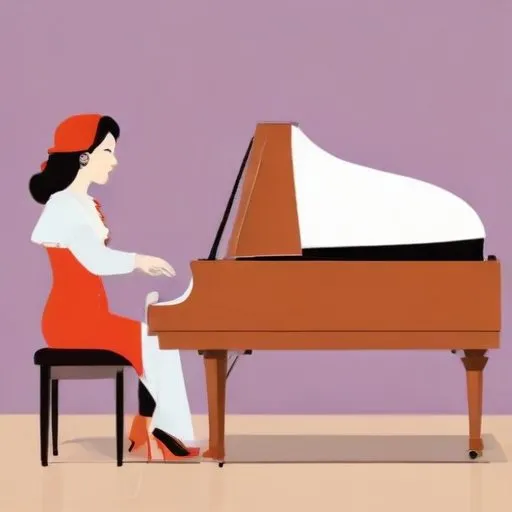
A pioneering female composer of the Baroque period, known for her innovative and expressive harpsichord music that blended French and Italian styles.
Lisabeth Jacquet de La Guerre was a trailblazing French musician, harpsichordist, and composer of the Baroque period, renowned for her exceptional talent, innovative compositions, and remarkable achievements in a male-dominated era. Born into a family of musicians and master instrument makers, Jacquet de La Guerre was destined for greatness, and her life's work would leave an indelible mark on the world of music.
Jacquet de La Guerre was born on March 17, 1665, in the parish of Saint-Louis-en-l'Île, Paris, to a family of skilled craftsmen. Her father, Claude Jacquet, was a harpsichord maker who recognized her musical potential at a young age. At just five years old, she performed at the Palace of Versailles, captivating the attention of Louis XIV, the Sun King, who subsequently became her patron.
Under the king's patronage, Jacquet de La Guerre received extensive musical training, eventually becoming a musician in the royal court. She was one of the few female composers of her time, and her talent was widely recognized. Titon du Tillet, a prominent music critic, praised her exceptional skill, describing her as having a "marvellous facility for playing preludes and fantasies off the cuff."
Jacquet de La Guerre's oeuvre includes a diverse range of works, showcasing her mastery of various musical forms. Her compositions spanned opera, ballet, cantatas, and instrumental pieces, demonstrating her innovative approach to music. Her first published work, Premier livre de pièces de clavecin, was a groundbreaking achievement, solidifying her position as a leading female composer of the era.
In 1684, Jacquet de La Guerre married Marin de La Guerre, an organist, and together they had a son. After her marriage, she continued to teach, compose, and perform, earning widespread acclaim throughout Paris. Her legacy extends beyond her music, as a trailblazer for female composers and musicians, paving the way for future generations.
Jacquet de La Guerre's contributions to music have had a lasting impact on the classical music landscape. Her innovative compositions and performances inspired a new generation of musicians, and her legacy continues to inspire and influence artists to this day.
Lisabeth Jacquet de La Guerre's remarkable life and career serve as a testament to her unwavering dedication to music and her pioneering spirit. Her contributions to the world of music continue to resonate, inspiring generations of musicians and composers. As a female composer of the Baroque period, Jacquet de La Guerre's legacy is a shining example of her innovative talent and perseverance, leaving an indelible mark on the history of classical music.
Born in 1683
A prominent figure in the Baroque period, this composer and theorist revolutionized Western classical music with innovative harmonies and treatises on music theory, shaping the course of classical music.
Born in 1668
A renowned Baroque composer and organist, known for his intricate and expressive harpsichord music that showcased his mastery of counterpoint and ornamentation. His works continue to inspire and influence classical music today.
Born in 1657
A renowned Baroque composer and organist, known for his grand motets and orchestral suites that showcased his mastery of harmony and counterpoint. His works remain a staple of the French Baroque repertoire.
Born in 1925
A renowned French musician who revolutionized classical music with his avant-garde compositions and innovative conducting style, pushing boundaries and redefining the genre.
Born in 1908
A French composer and ornithologist who merged birdsong with avant-garde music, creating a unique and influential sound. His work continues to inspire musicians and bird enthusiasts alike.
65 Years Old
Renowned for his lyrical and nuanced performances, this pianist is celebrated for his interpretations of the Romantic repertoire, particularly the works of Liszt and Ravel.
81 Years Old
A renowned harpsichordist and conductor, he revived interest in Baroque music through his performances and recordings, particularly with his ensemble Les Arts Florissants.
