


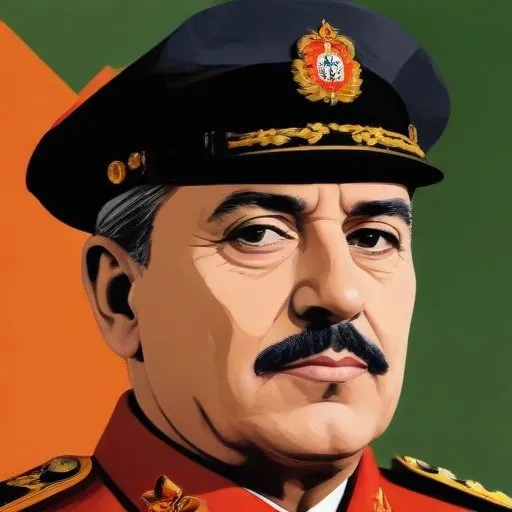
A Portuguese field marshal and politician who served as the 11th President of Portugal, known for his authoritarian rule and nationalistic policies. He led the country through a period of significant economic and social change.
scar Carmona, a prominent Portuguese army officer and politician, is best known for serving as the Prime Minister of Portugal from 1926 to 1928 and later as the 11th President of Portugal from 1926 until his death in 1951. During his tenure, he played a crucial role in shaping the country's political landscape, implementing reforms, and stabilizing the economy.
Carmona was born on November 24, 1869, in Lisbon, Portugal. He came from a republican background and was a freemason, which influenced his political ideology. He supported the proclamation of the Portuguese First Republic on October 5, 1910, but later confessed that he never truly sympathized with the democratic form of government.
In 1923, Carmona briefly served as Minister of War in the cabinet of Antnio Ginestal Machado. Later, in 1926, he played a key role in the 28 May coup dtat that overthrew the First Republic. He became the leader of the most conservative and authoritarian wing of the military regime, which considered the more moderate Gomes da Costa a liability.
In July 1926, Carmona led a countercoup, named himself President and Prime Minister, and assumed dictatorial powers. He was formally elected to the office in 1928 as the only candidate. During his presidency, he appointed Antnio de Oliveira Salazar as Minister of Finance, who later became Prime Minister.
Carmona's personal life was marked by controversy, with some accusing him of being authoritarian and suppressing opposition. However, he was also known for his strong leadership and vision for Portugal's future.
Carmona believed in a strong, centralized government and was critical of democratic principles. He also believed in the importance of maintaining Portugal's independence and sovereignty.
Carmona's legacy is complex and multifaceted. While some view him as a stabilizing force in Portugal's history, others criticize his authoritarian tendencies and suppression of opposition. Nevertheless, his impact on Portuguese politics and society cannot be denied.
Carmona's presidency took place during a tumultuous period in Portuguese history, marked by political instability and economic crisis. His leadership and reforms helped to stabilize the country, paving the way for future growth and development.
Scar Carmona remains a significant figure in Portuguese history, remembered for his leadership, vision, and impact on the country's political landscape.
Born in 1889
A dictator who ruled Portugal from 1933 to 1968, implementing a corporatist authoritarian regime and maintaining a neutral stance during World War II. He's known for his economic reforms and nationalist policies.
Born in 1924
A Portuguese historian, lawyer, and politician who served as the 17th President of Portugal, known for leading the country's transition from authoritarianism to democracy. He played a key role in Portugal's decolonization and European integration.
87 Years Old
The 18th President of Portugal, a lawyer and politician, served from 1996 to 2006 and was a key figure in the country's transition to democracy. He's known for his commitment to social justice and human rights.
87 Years Old
The 19th President of the Portuguese Republic was a prominent economist and politician who served from 2006 to 2016, known for his economic reforms and leadership during the European sovereign-debt crisis. He is also a published author on economics and politics.
62 Years Old
The 118th Prime Minister of Portugal, an economist-turned-politician who led the country from 2011 to 2015, implementing austerity measures to address the European sovereign debt crisis. He's known for his efforts to stabilize Portugal's economy during a tumultuous period.
