


In the sweltering summer of 1939, two visionary physicists, Albert Einstein and Leo Szilard, penned a historic letter to President Franklin D. Roosevelt, warning of a catastrophic threat that could alter the course of human history. Their urgent plea led to the creation of the Manhattan Project, a clandestine research and development effort that would eventually give birth to the atomic bomb.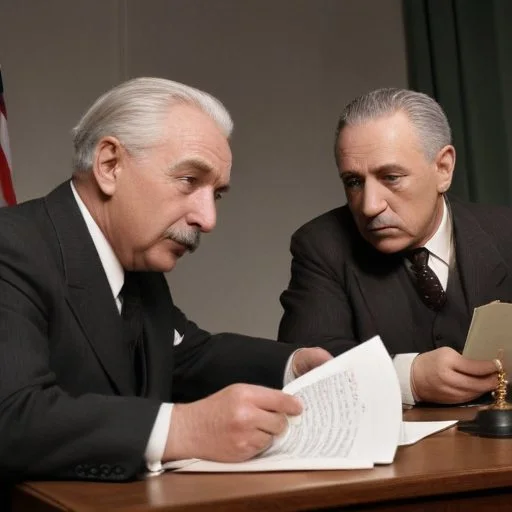
As Nazi Germany's aggressive expansion continued to menace the world, Einstein and Szilard were haunted by the possibility that Adolf Hitler's scientists might be secretly developing an atomic bomb. The duo's worst fears were fueled by the recent discovery of nuclear fission by German physicist Otto Hahn, which sparked a chain reaction of panic among the scientific community.
Szilard, a Hungarian-born physicist who had fled Nazi Germany, was particularly alarmed by the prospect of Nazi scientists harnessing the power of nuclear energy. He confided in Einstein, who shared his concerns, and together they decided to take action. On July 2, 1939, they drafted a letter to President Roosevelt, sounding the alarm and urging him to initiate a program to develop a nuclear weapon of their own.
The letter, signed by Einstein, was delivered to Roosevelt on August 2, 1939, and its impact was immediate. The President convened a meeting with his advisors, and within days, the Briggs Committee was established to explore the possibilities of nuclear energy. This marked the genesis of the Manhattan Project, a clandestine research and development effort that would eventually produce the atomic bomb.
The Einstein-Szilard letter not only altered the course of World War II but also had far-reaching consequences for humanity. The development of nuclear weapons would forever change the global political landscape, introducing an era of nuclear deterrence and casting a long shadow over international relations.
"In the course of the last four months I have had occasion to consider the possibility of atomic bombs..."
The letter, dated August 2, 1939, was a clarion call to action, warning of the dangers of Nazi Germany's nuclear ambitions and urging the US government to take immediate action to develop a nuclear weapon of their own.
The Einstein-Szilard letter's legacy extends far beyond the confines of World War II. The development of nuclear weapons has had a profound impact on global politics, shaping the course of the Cold War, informing deterrence strategies, and influencing international relations to this day.
"I am become Death, destroyer of worlds." - J. Robert Oppenheimer, Director of the Manhattan Project, reflecting on the dawn of the nuclear age.
In the years leading up to World War II, Nazi Germany, under the leadership of Adolf Hitler, had been rapidly expanding its territory through a series of aggressive military campaigns.
This expansionist policy, coupled with Hitler's racist and anti-Semitic ideology, had created a sense of unease among neighboring countries and the international community.
The annexation of Austria in 1938, followed by the invasion of Czechoslovakia, had highlighted the weakness of the appeasement policy adopted by Britain and France.

Born in Budapest, Hungary in 1898, Leo Szilard was a brilliant physicist who had fled Nazi Germany in 1933, sensing the danger that Hitler's regime posed to Jews and intellectuals.
Szilard's experiences in Germany had made him acutely aware of the threat of nuclear proliferation, and he was determined to alert the US government to the danger.
His collaboration with Einstein was instrumental in convincing the US government to take action, and his tireless advocacy for nuclear disarmament continued throughout his life.
The Einstein-Szilard letter, dated August 2, 1939, was written in longhand by Einstein and signed by both physicists.
The letter, which warned of the dangers of nuclear proliferation, was remarkably prescient, predicting that Germany might develop an atomic bomb within a few years.
Today, the original letter is housed at the Library of Congress, a testament to the pivotal role it played in shaping the course of history.
The development of nuclear weapons during World War II was a costly endeavor, with the US government investing billions of dollars in the Manhattan Project.
The project, which employed thousands of scientists, engineers, and technicians, was a major drain on the US economy, diverting resources away from other critical areas.
However, the successful development of the atomic bomb also paved the way for a new era of nuclear power, which would go on to become a significant contributor to the global energy mix.
The Manhattan Project was a technological marvel, pushing the boundaries of scientific knowledge and innovation.
The project led to major breakthroughs in fields such as nuclear physics, materials science, and computer engineering.
Today, the legacy of the Manhattan Project can be seen in the widespread use of nuclear power, as well as in the development of advanced medical treatments and cancer therapies.