In the sweltering summer of 1961, a determined group of civil rights activists known as the Freedom Riders embarked on a perilous journey to test the South's compliance with the Supreme Court's ban on segregated facilities in interstate travel. What they encountered in Jackson, Mississippi, would become a defining moment in the American civil rights movement, as 27 brave souls were arrested for disturbing the peace after disembarking from their bus.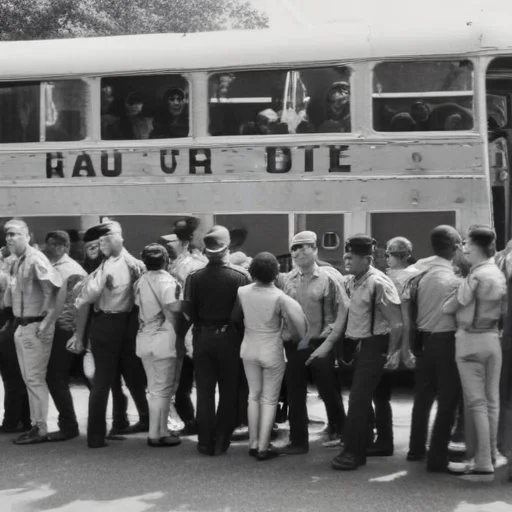
The Freedom Riders, a mix of black and white activists, were met with menacing stares and snarling cops as they stepped off the bus in Jackson. The group, led by figures such as John Lewis, James Farmer, and William Barbee, aimed to challenge the segregationist policies that plagued the South. Their mission was to ride together, Black and White, on buses and trains, using facilities designated for Whites only, thus testing the enforcement of the Supreme Court's ruling in Boynton v. Virginia.
Why Jackson, Mississippi? The city, often referred to as the "Birthplace of America's Music," was a hub for the Civil Rights Movement. Its strategic location made it an ideal testing ground for the Freedom Riders' mission. Jackson's Mayor, Allen Thompson, had vowed to uphold segregationist policies, making it the perfect battleground for the Riders.
"We were not looking for trouble, but we were looking to make our point... We were willing to face whatever came our way." - John Lewis, Freedom Rider
The Freedom Rides were a response to the Supreme Court's ruling in Boynton v. Virginia, which outlawed segregation in interstate travel facilities. However, many Southern states continued to flout the ruling, prompting the need for direct action.
The Freedom Riders' arrests in Jackson, Mississippi, marked a turning point in the Civil Rights Movement, paving the way for further nonviolent direct action protests and eventual desegregation.
This event serves as a testament to the power of collective action and the unyielding spirit of those who dared to challenge the status quo in pursuit of equality and justice.
The historiography of the Freedom Rides is complex and multifaceted, with different scholars offering varying interpretations of the event's significance. Some have argued that the Freedom Rides marked a turning point in the Civil Rights Movement, galvanizing national attention and paving the way for further protests. Others have emphasized the role of the Freedom Rides in highlighting the contradictions between American ideals of freedom and democracy and the reality of racial segregation.
A more recent trend in historiography has been to explore the transnational dimensions of the Freedom Rides, examining how the protests resonated with anti-colonial movements around the world.
, CA