


The echoes of gunfire faded, and an unsettling silence descended upon the Chamdo region. It was October 19, 1950, and the Peoples Liberation Army (PLA) had finally brought an end to the Battle of Chamdo, marking the beginning of Tibet's annexation into the People's Republic of China.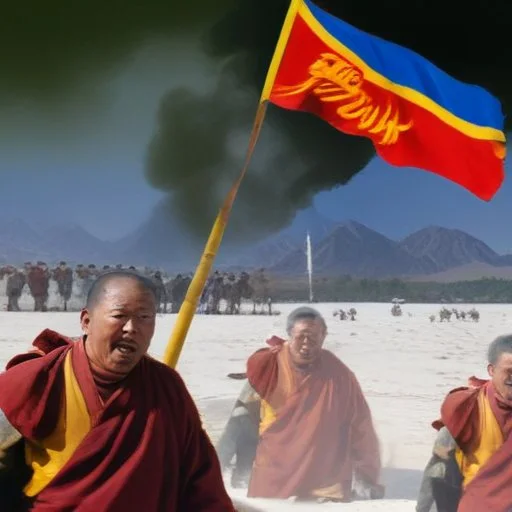
The Battle of Chamdo was more than just a military defeat; it was a turning point in Tibetan history, signaling the end of Tibet's independence and the commencement of a long, arduous journey under Chinese rule. For centuries, Tibet had maintained its sovereignty, despite being nestled in the shadow of its mighty neighbor. However, the winds of change had been blowing since the fall of the Qing dynasty in 1911, and Tibet's fate was about to take a dramatic turn.
At the heart of this tumultuous event were two men: the 14th Dalai Lama, Tenzin Gyatso, and Mao Zedong, the Communist Party of China's (CPC) Chairman. The Dalai Lama, the spiritual leader of Tibet, was faced with the daunting task of protecting his people and their way of life. Meanwhile, Mao, driven by his vision of a unified China, was determined to bring Tibet under the CPC's wing.
The annexation of Tibet had far-reaching consequences. The Tibetan government, led by the Dalai Lama, was forced to relinquish its sovereignty, and Tibetans were subject to the rule of the Chinese Communist Party. The once-independent nation was now split, with many Tibetans forced to flee their homeland or live under the yoke of Chinese occupation.
The annexation of Tibet remains one of the most contentious issues in modern history. Critics argue that the Seventeen Point Agreement was signed under duress, and that Tibet's sovereignty was brutally suppressed. Others contend that the move was necessary to bring stability and development to the region. The debate rages on, with the world still grappling with the implications of this pivotal event.
The annexation of Tibet has left an indelible mark on the world. It has inspired generations of Tibetans to fight for their freedom and has become a beacon of resistance against oppression. As the world continues to grapple with the complexities of international relations, the story of Tibet serves as a poignant reminder of the importance of sovereignty, human rights, and the unyielding quest for freedom.
In the words of the Dalai Lama, "The fate of Tibet is not just a matter of its own people, but of the whole world. If we can solve the Tibetan problem, we can solve many other problems of the world." As we reflect on the annexation of Tibet, we are reminded that even in the darkest of times, there is always hope for a better tomorrow.
The Battle of Chamdo was not an isolated event, but rather the culmination of a series of aggressive moves by the Chinese Communist Party (CPC) to assert its dominance over Tibet. In the years leading up to the battle, the CPC had been steadily increasing its military presence in the region, making incursions into Tibetan territory and engaging in skirmishes with Tibetan forces.
In 1949, the CPC dispatched a delegation to Lhasa, Tibet's capital, to "negotiate" with the Tibetan government. However, the Tibetans were wary of the CPC's intentions, and the talks ultimately failed to produce any meaningful results.
Meanwhile, the Tibetan government, led by the 14th Dalai Lama, was beset by internal conflicts and power struggles, which weakened its ability to respond effectively to the Chinese threat.
The stage was thus set for the dramatic events of October 1950, when the PLA launched its surprise attack on the Tibetan army in the Chamdo region.

Mao Zedong, the chairman of the Communist Party of China, was the mastermind behind the annexation of Tibet. A ruthless and cunning leader, Mao was driven by his vision of a unified China, in which Tibet was seen as a vital component.
Born in 1893, Mao was a founding member of the CPC and rose to power through a combination of ideological zeal and military prowess. By the time of the Tibetan annexation, Mao was at the height of his power, and his authority was unchallenged.
Mao's motivations for annexing Tibet were twofold: to crush the perceived threat of Tibetan independence and to secure China's borders. He was convinced that Tibet was rightfully part of China, and that its incorporation into the People's Republic was essential for national unity and security.
The annexation of Tibet by China in 1950 shares striking parallels with other instances of territorial annexation throughout history. One such example is the annexation of Austria by Nazi Germany in 1938, which, like the Tibetan case, was facilitated by a combination of military coercion and diplomatic pressure.
Another notable example is the annexation of Crimea by Russia in 2014, which similarly involved a powerful neighbor imposing its will on a smaller, weaker state. In both cases, the annexing power exploited internal divisions and weaknesses in the target state to achieve its goals.
These comparisons highlight the broader patterns and motivations underlying territorial annexation, and underscore the importance of examining the Tibetan case within a broader historical and geopolitical context.

Tibet's annexation by China was not solely driven by ideological or nationalist considerations; it was also motivated by strategic and economic factors. Tibet's location in the heart of the Himalayas made it a vital buffer zone between China and India, and its control was seen as essential for China's national security.
Tibet was also rich in natural resources, including copper, gold, and uranium, which made it an attractive prize for the Chinese government. The region's vast plateaus and mountains also offered opportunities for large-scale infrastructure development, including dams, railways, and highways.
The annexation of Tibet by China in 1950 presents a challenging and complex set of issues for educators and pedagogues. How to convey the historical context and nuances of this event to students, while also promoting critical thinking and empathy?
One approach is to focus on the human experiences and personal stories of Tibetans who lived through the annexation, highlighting the emotional and psychological toll of occupation and exile.
Another strategy is to use interactive and multimedia resources, such as documentaries, timelines, and role-playing exercises, to engage students and facilitate a deeper understanding of the event's historical and geopolitical significance.