


At 0256 UTC on July 21, 1969, astronaut Neil Armstrong etched his name into the annals of history as the first person to set foot on the Moon. Just 19 minutes later, Edwin "Buzz" Aldrin joined him, marking a triumphant milestone in the Apollo program's quest to explore the lunar surface.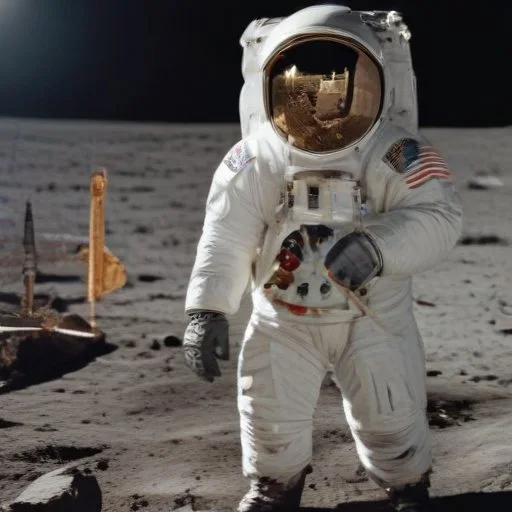
In the aftermath of World War II, the United States and the Soviet Union embarked on a Space Race, a competition to achieve supremacy in space exploration. On May 25, 1961, President John F. Kennedy declared that the United States would put a man on the Moon before the end of the decade. This ambitious goal gave birth to the Apollo program, a NASA mission aimed at landing humans on the Moon and returning them safely to Earth.
The Apollo 11 mission achieved several historic milestones, including:
The Apollo program's success had far-reaching implications, inspiring generations of scientists, engineers, and explorers. It also marked a significant achievement in the United States' space exploration efforts, demonstrating the nation's technological capabilities and commitment to pushing the boundaries of human knowledge.
The Apollo 11 mission captured the world's imagination, transcending national boundaries and inspiring a global audience. The mission's success was celebrated with parades, parties, and special events, cementing its place in popular culture.
"That's one small step for man, one giant leap for mankind." – Neil Armstrong, upon setting foot on the Moon
"Beautiful view!" – Edwin "Buzz" Aldrin, upon joining Armstrong on the lunar surface
In his autobiography, First Man: The Life of Neil A. Armstrong, Armstrong recalled the intense training and preparation that preceded the mission. He also shared the sense of wonder and awe he felt upon gazing at the Moon's surface.
The Apollo program paved the way for future space exploration initiatives, including the Skylab space station, the Space Shuttle program, and the International Space Station. It also sparked a new era of cooperation in space exploration, as evidenced by the Apollo-Soyuz Test Project in 1975.
The Apollo 11 astronauts received numerous accolades, including the Presidential Medal of Freedom, the Congressional Space Medal of Honor, and the NASA Distinguished Service Medal.
The Apollo 11 mission was marked by several visual milestones, including the iconic image of Armstrong's footprint on the Moon's surface and the photograph of the Apollo 11 astronauts in their spacesuits.
The Apollo 11 astronauts had to overcome several challenges, including a computer error that threatened to abort the lunar landing and a lack of sleep that left them exhausted.
The Apollo program's success was a testament to American ingenuity, determination, and teamwork. As the world looks to the stars, the Apollo 11 mission remains an enduring symbol of human achievement and exploration.
Wernher von Braun, the director of the Marshall Space Flight Center, was a German-born engineer who played a crucial role in the development of the Saturn V rocket. Born in 1912, von Braun was fascinated by space travel from an early age and began experimenting with rocketry as a teenager. He became a member of the Nazi party in the 1930s and was involved in the development of the V-2 rocket during World War II. After the war, von Braun was recruited by the United States and worked on the development of the Jupiter-C rocket, which was used to launch the first American satellite, Explorer 1, into space.
Von Braun's expertise was instrumental in the success of the Apollo program, as he oversaw the development of the Saturn V rocket that carried the Apollo 11 astronauts to the Moon. His legacy extends beyond the Apollo program, as he continued to work on space exploration initiatives until his death in 1977.

The Apollo 11 mission marked a significant milestone in the development of spacecraft technology. The command module Columbia and the lunar module Eagle were designed to operate in space for extended periods, and their successful deployment paved the way for future space exploration missions.
The lunar module's descent engine, which was used to land on the Moon's surface, was a particularly innovative piece of technology. It used a combination of rocket propulsion and computer-controlled navigation to achieve a safe and precise landing.
The success of the Apollo 11 mission also spurred the development of new technologies, including improvements to rocket propulsion systems, life support systems, and communication systems. These advancements have had a lasting impact on the space industry, enabling future missions to push the boundaries of space exploration.
The Apollo 11 mission captured the imagination of people around the world, inspiring a new generation of scientists, engineers, and explorers. The mission's success was celebrated in popular culture, with songs, films, and literature referencing the historic event.
The Apollo 11 astronauts became overnight sensations, with Neil Armstrong and Edwin "Buzz" Aldrin appearing on the cover of Life magazine and being showered with parades and celebrations upon their return to Earth.
The mission's impact on popular culture extends beyond the 1960s, with references to the Apollo 11 mission appearing in films, television shows, and literature to this day.

The Apollo 11 mission marked a significant scientific achievement, with the return of lunar samples providing valuable insights into the Moon's composition, geology, and history. The samples, which were analyzed by scientists around the world, revealed the Moon's surface to be composed of a variety of rock types, including basalts, anorthosites, and breccias.
The mission's scientific discoveries extended beyond the lunar samples, with the deployment of seismometers, laser ranging reflectors, and other scientific instruments on the Moon's surface. These instruments provided valuable data on the Moon's internal structure, composition, and atmosphere, greatly expanding our understanding of the Moon and its place in the solar system.
Historians have differing perspectives on the significance of the Apollo 11 mission, with some viewing it as a triumph of American exceptionalism and others seeing it as a symbol of Cold War competition.
One interpretation is that the Apollo 11 mission was a demonstration of American technological superiority, showcasing the nation's capabilities in space exploration and cementing its status as a global leader.
Alternatively, the mission can be seen as a response to Soviet Union's space program, with the United States engaging in a space race to demonstrate its technological prowess and political ideology.