


In the wee hours of April 24, 1915, Istanbul awoke to an eerie silence. It was a night that would forever be etched in the annals of history as the beginning of the Armenian genocide, a brutal campaign that would claim the lives of over 1.5 million innocent people. In a single, meticulously planned operation, 250 prominent Armenian intellectuals and community leaders vanished from the streets of Istanbul, never to be seen again.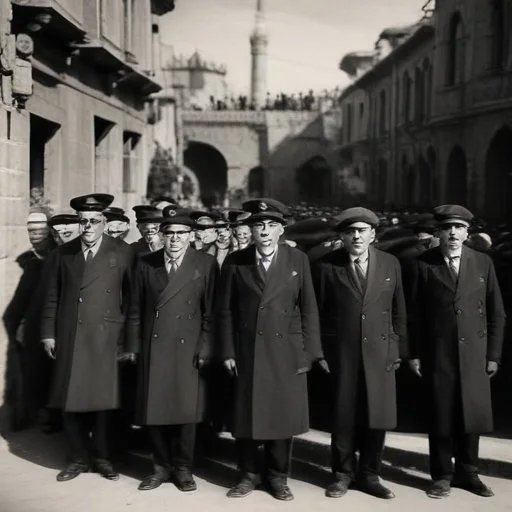
The victims included writers, poets, politicians, and religious leaders – the cream of Armenian society. They were rounded up and taken away in the dead of night, leaving behind a trail of confusion, fear, and uncertainty. The Ottoman authorities had masterminded a sinister operation to silence the Armenian community, and it marked the beginning of a dark chapter in human history.
The seeds of discord were sown decades earlier, when the Ottoman Empire began to crumble under the weight of its own internal contradictions. The Armenian population, which had thrived under Ottoman rule for centuries, began to demand greater autonomy and recognition. As tensions escalated, the Young Turk government, which had seized power in 1908, began to view the Armenian population as a threat to its authority.
Three men stood at the helm of the operation: Mehmed Talat Pasha, Ismail Enver Pasha, and Ahmed Djemal Pasha. They were the triumvirate of the Young Turk government, and their radical ideology had convinced them that the Armenian population was a liability that needed to be eliminated. Talat Pasha, in particular, was the mastermind behind the operation, and his sinister machinations would prove devastating for the Armenian people.
The Armenian genocide would leave an indelible mark on human history. The world watched in silence as the Ottoman Empire unleashed its brutal campaign, and the international community's inaction set a dangerous precedent for future atrocities.
The Armenian genocide struck at the heart of the Armenian community, silencing its brightest minds and extinguishing its cultural flame. The loss of intellectuals, artists, and leaders would have a profound impact on the Armenian diaspora, leaving a void that would take generations to fill.
"I accuse the Turkish government before the world of the deliberate and systematic annihilation of the Armenian population." – Ambassador Henry Morgenthau, United States Ambassador to the Ottoman Empire (1913-1916)
In the end, the Armenian genocide would leave a scar that would take generations to heal. The world would eventually acknowledge the atrocities committed, but the victims would remain forever silenced. The night of April 24, 1915, would always be remembered as the darkest dawn in human history.
The Armenian genocide was not an isolated event, but rather the culmination of centuries of tensions between the Armenian population and the Ottoman Empire. The seeds of discord were sown during the 19th century, when the Ottoman Empire began to decline and the Armenian population started to demand greater autonomy and recognition. This led to a series of massacres and persecutions, including the Hamidian massacres of 1894-1896, which claimed the lives of over 200,000 Armenians.
In the years leading up to the genocide, the Ottoman Empire was torn apart by internal conflicts and external pressures. The Young Turk government, which had seized power in 1908, was determined to modernize and centralize the empire, but its radical ideology and nationalist policies alienated many of its minority populations, including the Armenians.
The Armenian genocide was also fueled by a sense of paranoia and xenophobia within the Ottoman government, which viewed the Armenian population as a threat to its authority and a potential fifth column for the enemy. This paranoia was further fueled by the outbreak of World War I, which led to a sense of siege mentality within the Ottoman government.

Mehmed Talat Pasha, one of the architects of the Armenian genocide, was a complex and enigmatic figure. Born in 1874 in Edirne, Turkey, Talat was a member of the Young Turk movement, a group of reform-minded intellectuals who sought to modernize and centralize the Ottoman Empire.
Talat was a skilled politician and strategist, who rose to power through a combination of charm, intelligence, and ruthlessness. He was known for his ability to manipulate and deceive, often using his charm to lull his opponents into a false sense of security.
Despite his sinister reputation, Talat was also a charismatic figure, who was able to inspire loyalty and devotion in his followers. However, his radical ideology and nationalist policies ultimately led to the downfall of the Ottoman Empire and the perpetuation of one of the worst atrocities of the 20th century.
The Armenian genocide had a profound impact on Armenian culture and identity. The loss of intellectuals, artists, and leaders caused a cultural void that would take generations to fill. The genocide also led to a sense of dislocation and displacement, as Armenians were forced to flee their homeland and seek refuge in other parts of the world.
The Armenian diaspora, which was already significant before the genocide, grew exponentially in the aftermath of the event. Armenian communities sprang up in cities around the world, from Paris to New York, and from Beirut to Buenos Aires. These communities preserved and promoted Armenian culture, language, and traditions, but they also struggled to come to terms with the trauma and loss of the genocide.
The Armenian genocide also had a profound impact on Western culture and literature. The event inspired a new wave of writers and intellectuals, including Franz Werfel, who wrote the classic novel "The Forty Days of Musa Dagh," and rakian Sarian, who wrote the powerful poem "The Dead and the Living."

The Armenian genocide had a devastating impact on the Ottoman economy. The loss of Armenian businessmen, entrepreneurs, and artisans led to a significant decline in economic activity, particularly in the areas of trade, commerce, and industry.
The genocide also led to a significant decline in agricultural production, as Armenians were forced to abandon their farms and flee their villages. This led to food shortages and famine, which further exacerbated the humanitarian crisis.
The Armenian genocide also had a long-term impact on the Turkish economy, as the country struggled to recover from the loss of human capital and infrastructure. The event led to a significant decline in economic growth and development, which was only reversed in the 1950s and 1960s, when Turkey began to pursue rapid industrialization and modernization.
The Armenian genocide was not an isolated event, but rather part of a broader pattern of ethnic and religious violence that swept across the Middle East during World War I. The war saw the rise of nationalist and supremacist ideologies, which often led to the persecution and extermination of minority populations.
The genocide was also linked to the rise of the modern nation-state, which often led to the marginalization and exclusion of minority populations. The Ottoman Empire's decision to pursue a policy of Turkish nationalism and centralization led to the exclusion and persecution of Armenians, Greeks, and other minority populations.
The Armenian genocide also had a profound impact on the international community, which failed to act decisively to prevent the atrocities. The event set a dangerous precedent for future genocides and massacres, and it led to a re-evaluation of the international community's response to humanitarian crises.