


On the streets of Paris, a sense of unease hung heavy in the air as the French Revolution reached its boiling point. For five days, from September 2 to 6, 1792, the City of Light was plunged into darkness, as rioting mobs besieged the prisons, massacring three Roman Catholic bishops, over two hundred priests, and scores of prisoners suspected of harboring royalist sympathies.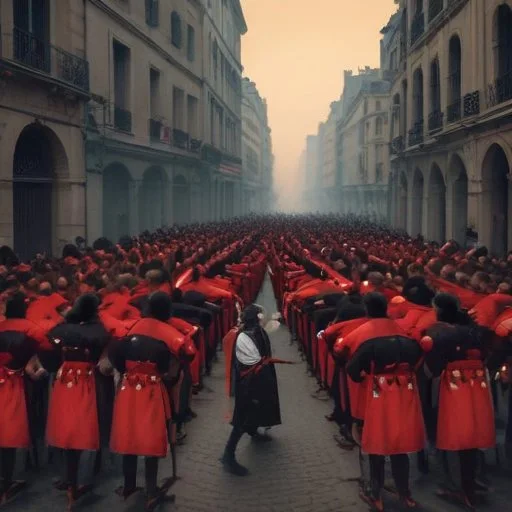
The September Massacres, as they came to be known, marked a pivotal moment in the Reign of Terror, a period of unbridled violence and bloodshed that would stain the Revolution's ideals of liberté, égalité, fraternité. As the National Convention, the ruling body of the Revolution, struggled to consolidate power, the streets became a battleground, with radical sans-culottes and extremist Jacobins fueling the carnage.
| Date | Event |
|---|---|
| September 2, 1792 | Mobs storm the Abbaye prison, massacring 24 priests and nobles. |
| September 3, 1792 | Prisoners at the Carmes prison are slaughtered, including three bishops and over a hundred priests. |
| September 4, 1792 | The bloodshed spreads to the Bicêtre and Salpêtrière prisons, claiming hundreds of lives. |
| September 6, 1792 | The massacres finally subside, but the Reign of Terror continues unabated. |
The September Massacres sent shockwaves throughout Europe, cementing the French Revolution's reputation for brutality and extremism. The event would forever be etched in the public consciousness, serving as a cautionary tale about the dangers of unchecked mob rule and the darker aspects of human nature.
The massacres sparked heated debates among revolutionaries, with many moderates denouncing the violence and calling for greater restraint. The event would ultimately contribute to the downfall of the monarchy and the rise of Napoleon Bonaparte, who promised to restore order and stability to a nation torn apart by violence and chaos.
As the streets of Paris dried of the blood of the innocent, the world was left to ponder the true cost of revolutionary fervor, and the darkness that lurked in the hearts of men.
Georges Danton, the Minister of Justice during the September Massacres, remains an enigmatic figure in French history. While his inaction and inflammatory rhetoric are often seen as tacit approval of the massacres, some historians argue that Danton was a pragmatist who believed that the ends justified the means.
Despite his role in the Reign of Terror, Danton's early life was marked by a passion for liberal ideals and a desire to reform the French justice system. As a young lawyer, he was known for his eloquence and his ability to rally the masses.
However, as the Revolution gained momentum, Danton's actions became increasingly contradictory. He advocated for the execution of King Louis XVI, yet he was also known to have secretly negotiated with royalist sympathizers.
Danton's contradictions have led some historians to question his true motives during the September Massacres. Was he a mastermind behind the violence, or was he simply a product of the chaotic times in which he lived?
The September Massacres had a profound impact on French art, with many artists responding to the violence and bloodshed through their work.
One of the most famous examples is Jacques-Louis David's painting, "The Death of Marat," which depicts the assassination of Jean-Paul Marat, a radical journalist and politician who was killed in his bathtub during the Reign of Terror.
The painting is a masterpiece of neoclassicism, with its stark colors and dramatic composition capturing the chaos and upheaval of the times.
Other artists, such as François Gérard and Pierre-Narcisse Guérin, also responded to the September Massacres through their art, depicting scenes of violence and bloodshed in vivid detail.
The September Massacres thus became a cultural touchstone, influencing the development of French art and literature for generations to come.
Historians have long debated the significance of the September Massacres, with some viewing the event as a pivotal moment in the French Revolution, while others see it as a brutal and senseless act of violence.
In recent years, however, historians have begun to reevaluate the September Massacres, placing the event within the broader context of the Revolution and its ideals.
Some have argued that the massacres were a necessary evil, a brutal but effective way to purge France of its royalist sympathizers and pave the way for the rise of Napoleon Bonaparte.
Others have seen the massacres as a symptom of a deeper problem, a reflection of the Reign of Terror's inherent contradictions and flaws.
Regardless of one's perspective, the September Massacres remain a complex and fascinating topic, one that continues to capture the imagination of historians and scholars today.
The September Massacres marked a turning point in the French Revolution, with the event's brutal violence and bloodshed setting the tone for the Reign of Terror.
Politically, the massacres had a profound impact, paving the way for the rise of radical Jacobins and sans-culottes who advocated for the execution of King Louis XVI and the establishment of a radical new government.
The event also marked a shift in the rhetoric of the Revolution, with politicians and journalists increasingly using inflammatory language to whip up anti-royalist sentiment and justify the violence.
Jean-Paul Marat, in particular, became a master of this rhetoric, using his newspaper, L'Ami du peuple, to incite the mobs and fuel the bloodshed.
The September Massacres thus became a defining moment in French politics, shaping the course of the Revolution and influencing the development of French democracy.
The September Massacres sent shockwaves throughout Europe, with many governments and monarchs viewing the event as a brutal and senseless act of violence.
In response, many European powers began to distance themselves from the French Revolution, viewing it as a dangerous and destabilizing force.
Britain, in particular, was outraged by the massacres, with Prime Minister William Pitt the Younger condemning the violence and calling for international action to stop the French Revolution.
Other European powers, such as Austria and Prussia, were more ambivalent, viewing the French Revolution as a convenient excuse to expand their own territories and influence.
The September Massacres thus became a geopolitical flashpoint, shaping the course of European politics and diplomacy for generations to come.