


In the midst of a sweltering summer, on August 22, 1642, King Charles I of England stood defiantly in Nottingham, raising his standard to signal the commencement of a conflict that would irreparably alter the course of English history – the English Civil War.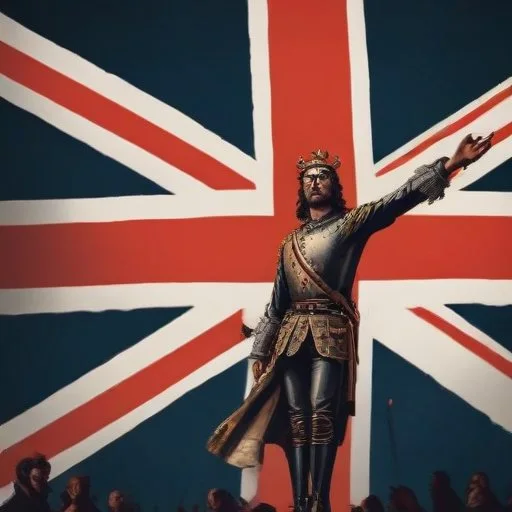
The seeds of discontent had been sown for years, as the king's authoritarian rule and perceived Catholic sympathies had increasingly alienated the English Parliament. The tensions had been simmering, waiting for a spark to ignite the flames of rebellion. Charles I's bold move in Nottingham provided the catalyst, as he sought to reassert his authority and quash the growing opposition.
The standard, emblazoned with the royal coat of arms, was more than a mere symbol of the monarchy – it represented the king's unwavering commitment to his vision of absolute power. By raising it in Nottingham, Charles I effectively declared war on the Parliamentarian forces, which had been gathering strength and momentum in opposition to his rule.
The English Civil War was fought between the Royalist forces, loyal to King Charles I, and the Parliamentarian forces, which sought to limit the monarch's power and establish a more representative government. Notable figures involved in the conflict included:
The English Civil War was a complex and multifaceted conflict, spanning several years and numerous battles. Key milestones include:
The English Civil War had far-reaching consequences, shaping the course of English history and beyond:
The war resulted in the establishment of the Commonwealth of England, a republican government that would last until the Restoration of the monarchy in 1660.
The conflict led to the execution of King Charles I, marking the first time a ruling monarch had been put to death in England.
The war paved the way for the Glorious Revolution of 1688, which established the supremacy of Parliament and the Bill of Rights.
The English Civil War had a profound impact on English society and culture:
The war fueled the growth of Puritanism, which emphasized the importance of individual conscience and moral virtue.
The conflict led to the development of new forms of art and literature, as writers and artists sought to express the turmoil and upheaval of the era.
The war contributed to the emergence of modern democracy, as the concept of representative government gained traction.
The English Civil War remains a pivotal moment in English history, continuing to shape our understanding of power, governance, and the complex relationships between rulers and their subjects. As we reflect on the tumultuous events of 1642, we are reminded of the enduring importance of negotiation, compromise, and the pursuit of peace in the face of conflict.
Prince Rupert of the Rhine, King Charles I's nephew, was a skilled military commander and a key figure in the English Civil War. Born in 1619, Rupert was a dashing cavalier, known for his bravery, tactical genius, and charismatic leadership.
Rupert's military career began at a young age, fighting in the Thirty Years' War in Europe. He soon gained a reputation as a cunning and resourceful commander, earning the respect of his enemies and the admiration of his allies.
In 1642, Rupert joined his uncle's cause, fighting for the Royalist forces in the English Civil War. He played a crucial role in several battles, including the First Battle of Edgehill, where he led a daring cavalry charge that nearly turned the tide of the battle in favor of the Royalists.
The English Civil War was, at its core, a struggle for power between the monarchy and Parliament. King Charles I, who believed in the divine right of kings, sought to assert his authority over the legislature, while Parliamentarians fought for constitutional limits on the monarch's power.
The roots of this conflict lay in the Norman Conquest of 1066, which established the concept of absolute monarchy in England. Over time, however, Parliament's influence grew, and by the 17th century, it was demanding greater liberties and representation.
Charles I's failure to address these demands, combined with his autocratic tendencies and perceived Catholic sympathies, created a perfect storm of discontent that ultimately led to the outbreak of war.
The English Civil War had a profound impact on English culture, particularly in the rise of Puritanism. This religious and cultural movement, which emphasized individual conscience and moral virtue, gained popular support during the war years.
Puritan writers, such as John Milton and John Bunyan, produced influential works that reflected the turmoil and upheaval of the era. Their writings emphasized the importance of individual liberty, moral responsibility, and the need for spiritual reform.
The Puritan movement also shaped English art and architecture, as seen in the simplicity and austerity of Puritan-inspired buildings and decorative arts.
The Battle of Naseby, fought on June 14, 1645, was a decisive victory for the Parliamentarian forces and marked a turning point in the English Civil War. Led by Oliver Cromwell and Sir Thomas Fairfax, the Parliamentarian army defeated the Royalist forces, led by King Charles I and Prince Rupert of the Rhine.
The battle was a brutal and bloody affair, with heavy casualties on both sides. However, the Parliamentarian forces' superior discipline and training ultimately gave them the upper hand.
The defeat at Naseby was a crushing blow to the Royalist cause, and King Charles I was forced to flee the battlefield, leaving behind his private papers and correspondence.
Historians have long debated the causes and consequences of the English Civil War. While some views hold that the war was a necessary step towards the development of modern democracy, others argue that it was a destructive and unnecessary conflict.
The Whig interpretation, popularized in the 19th century, sees the war as a heroic struggle for liberty and democracy against the forces of tyranny and absolutism. In contrast, the Revisionist school, which emerged in the 20th century, emphasizes the complexity and nuance of the conflict, highlighting the flaws and weaknesses of both the Royalist and Parliamentarian causes.
More recently, historians have begun to explore the English Civil War within a broader European context, highlighting its connections to the Thirty Years' War and the rise of modern nation-states.