


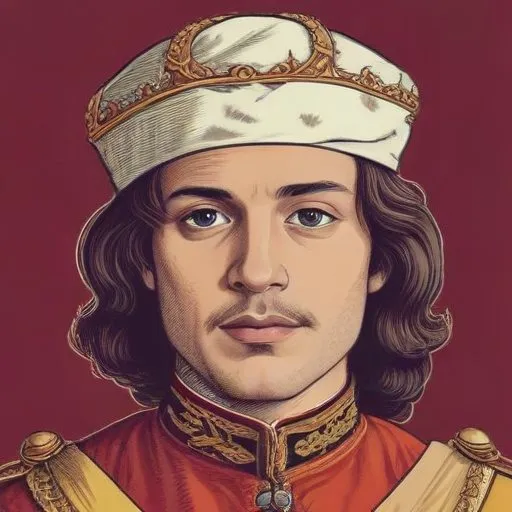
A dashing military leader and cunning strategist, known for his bravery and innovative tactics during the English Civil War. He's also famous for introducing the poodle breed to England.
Prince Rupert of the Rhine, Duke of Cumberland, is best known for his bravery and military prowess as a Royalist cavalry commander during the English Civil War, earning him the reputation as the archetypal Cavalier of the war. He was a multifaceted figure, serving not only as a soldier but also as an admiral, scientist, and colonial governor, making a lasting impact on the shaping of modern Canada.
Born on December 27, 1619, in Prague, Bohemia, Prince Rupert was the third son of Prince Frederick V of the Palatinate and Elizabeth, the eldest daughter of King James VI and I of England and Scotland. His early life was marked by conflict, fighting alongside Dutch forces against Habsburg Spain during the Eighty Years War and against the Holy Roman Emperor in Germany during the Thirty Years War.
At the age of 23, Prince Rupert was appointed commander of the Royalist cavalry, where he proved himself to be a quick-thinking and energetic leader. Despite his youthful impatience, which often led to disagreements with his peers, he played a significant role in the war, ultimately becoming the senior Royalist general. However, after the fall of Bristol, he was forced to surrender and was banished from England.
During his exile, Prince Rupert served under King Louis XIV of France against Spain and later became a Royalist privateer in the Caribbean Sea. This period of his life was marked by persistence and resilience in the face of adversity, as he continued to fight against Parliament by sea.
Following the Restoration, Prince Rupert returned to England and was appointed as a senior English naval commander during the Second Anglo-Dutch War and Third Anglo-Dutch War. He also served as the first governor of the Hudson's Bay Company, playing a significant role in shaping the political geography of modern Canada. Ruperts Land, a vast territory in modern-day Canada, was named in his honor.
Prince Rupert's legacy is complex and multifaceted. While he was known for his bravery and military prowess, his impatience and youthful energy often led to conflicts with his peers. However, as the head of the Royal Navy in his later years, he demonstrated greater maturity and made significant contributions to the development of the Royal Navy's doctrine.
Prince Rupert's legacy continues to have an impact on modern society, particularly in Canada. Ruperts Land, the vast territory named in his honor, remains an important part of Canadian history and identity. Additionally, his contributions to the development of the Royal Navy's doctrine continue to influence naval warfare to this day.
In conclusion, Prince Rupert of the Rhine was a complex and multifaceted figure, whose bravery, military prowess, and contributions to the development of the Royal Navy's doctrine continue to shape our understanding of modern history.
Born in 1599
Leader of the Parliamentarian forces during the English Civil War, who later ruled England, Scotland, and Ireland as a republican dictator, known for his military victories and radical reforms.
92 Years Old
A veteran actor, producer, and screenwriter with a career spanning over 60 years, best known for his iconic roles in TV series "Baretta" and films like "In Cold Blood".
