Western occupying powers establish Federal Republic of Germany
After years of post-war uncertainty, the Western occupying powers, led by the United States, Great Britain, and France, took a monumental step towards re-establishing Germany as a sovereign nation. On May 23, 1949, they approved the Basic Law, effectively establishing the Federal Republic of Germany, a new democratic state that would go on to become a beacon of economic prosperity and stability in a divided Europe. This pivotal moment marked a significant shift away from the defeated Nazi regime and towards a brighter, more peaceful future for the German people.
A New Dawn for Germany: The Birth of the Federal Republic
In the aftermath of World War II, Germany lay in ruins, both physically and politically. But on May 23, 1949, a new chapter in German history unfolded as the Western occupying powers approved the Basic Law, paving the way for the establishment of the Federal Republic of Germany, a beacon of democracy and freedom in a divided Europe.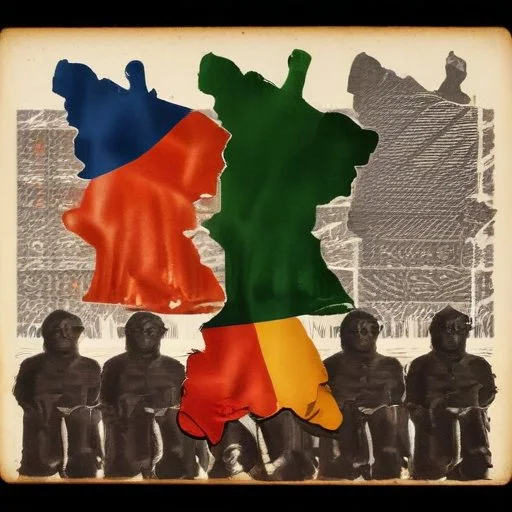
A Nation Reborn
The Federal Republic of Germany, also known as West Germany, marked a significant departure from the defeated Nazi regime. This new state was built on the principles of democracy, freedom, and human rights, and would go on to become a shining example of economic prosperity and stability in post-war Europe.
- Konrad Adenauer, the first Chancellor of the Federal Republic of Germany, played a crucial role in shaping the country's future.
- General Lucius D. Clay, the American Military Governor of Germany, was instrumental in drafting the Basic Law.
- Robert Schuman, the French Foreign Minister, worked tirelessly to promote European integration and cooperation.
Here's a brief overview of the key events leading up to the establishment of the Federal Republic of Germany:
- 1945: The Allied Powers defeat Nazi Germany, and the country is divided into four occupation zones controlled by the United States, Great Britain, France, and the Soviet Union.
- 1947: The Western powers merge their zones to form Bizonia, and later, Trizonia, paving the way for a unified German state.
- 1948: The London Conference establishes the framework for a new German state.
- May 23, 1949: The Basic Law is approved, marking the birth of the Federal Republic of Germany.
The establishment of the Federal Republic of Germany had far-reaching consequences:
- It marked a significant shift away from the defeated Nazi regime and towards a democratic, federal system.
- It created a stable and prosperous economy, which would go on to become a driving force behind European integration.
- It paved the way for Germany's eventual reunification in 1990.
The Federal Republic of Germany's establishment had a profound impact on German culture and society:
- It enabled the emergence of a new German identity, distinct from the Nazi past.
- It fostered a culture of freedom, democracy, and human rights.
- It promoted European integration and cooperation, paving the way for the European Union.
The establishment of the Federal Republic of Germany was not without controversy:
- Soviet opposition to the new state led to the Berlin Blockade and Airlift (1948-1949).
- Some Germans saw the new state as an American puppet regime.
- Critics argued that the Basic Law did not adequately address the Nazi past.
Despite these challenges, the Federal Republic of Germany emerged as a beacon of hope and freedom in post-war Europe, and its establishment remains a pivotal moment in modern German history.
Character Analysis
Konrad Adenauer: The Architect of West Germany
Konrad Adenauer, the first Chancellor of the Federal Republic of Germany, was a pivotal figure in shaping the country's post-war future.
Adenauer's commitment to democracy and human rights was unwavering, having experienced the brutal suppression of the Nazi regime firsthand.
His leadership not only stabilized the young republic but also paved the way for Germany's integration into the European community.

Full Cultural Impact Analysis
The Rebirth of German Culture
The establishment of the Federal Republic of Germany marked a new era in German culture, as the country began to distance itself from its troubled past.
The Gruppe 47, a collective of writers and intellectuals, played a significant role in shaping the country's literary landscape and promoting a culture of freedom and democracy.
The Berliner Ensemble, a world-renowned theater company, was also founded during this period, further solidifying Germany's cultural rebirth.
Rich Political Insight
A Delicate Balance of Power
The creation of the Federal Republic of Germany was a delicate balancing act, as the Western occupying powers sought to establish a stable and democratic government.
The so-called "Adenauer Era" was marked by a complex web of alliances and rivalries, as the United States, Great Britain, and France vied for influence over the young republic.
Meanwhile, the Soviet Union's opposition to the new state led to the Berlin Blockade and Airlift, further complicating the geopolitical landscape.
In-Depth Economic Examination
Economic Miracle: The Rise of West Germany
The Federal Republic of Germany's economic miracle, known as the Wirtschaftswunder, was a remarkable phenomenon that transformed the country into a major economic power.
The introduction of the Deutsche Mark in 1948, coupled with the Marshall Plan, provided the necessary stimulus for economic growth and development.
By the 1950s, West Germany had become a driving force behind European integration, with its economic prosperity serving as a beacon of hope for the entire continent.
Comprehensive Geopolitical Review
The Cold War Landscape
The establishment of the Federal Republic of Germany took place against the backdrop of the Cold War, as the world was divided into two competing ideologies.
The Soviet Union's Eastern European sphere of influence stood in stark contrast to the United States' vision for a democratic and capitalist Europe.
In this precarious environment, the Federal Republic of Germany emerged as a crucial strategic partner for the Western powers, further solidifying the East-West divide.


