Apollo 17 Crew Addresses Congress After Final Moon Landing
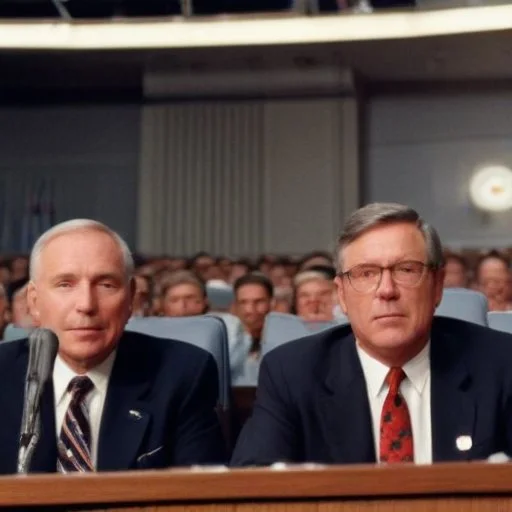
In a triumphant return from the cosmos, Eugene Cernan, Ronald Evans, and Harrison Schmitt, the Apollo 17 crew, stepped into the nation's capital to address a joint session of Congress, marking the grand finale of the Apollo program's lunar exploration era. With their moonwalks and orbitals complete, the trio shared tales of their extraordinary journey, reviving the excitement of humanity's initial forays into space. Their testimony not only celebrated a remarkable achievement but also underscored the significance of space exploration for future generations.
The Apollo 17 Crew's Historic Address to Congress
A Celestial Finale: The Final Apollo Moon Landing Mission
On December 1, 1972, the Apollo 17 crew, consisting of
Eugene Cernan,
Ronald Evans, and
Harrison Schmitt, made history by addressing a joint session of Congress, marking the grand finale of the Apollo program's lunar exploration era. This remarkable event capped off a monumental chapter in space exploration, as the trio shared their extraordinary experiences from the final moon landing mission.
A Journey of Firsts
The Apollo 17 mission was a journey of many firsts. It was the first time a scientist-astronaut, Harrison Schmitt, walked on the moon's surface. It was also the first time a lunar module, Challenger, landed on the moon's Taurus-Littrow valley. The mission's success was a testament to the dedication and hard work of the Apollo 17 crew and the entire team behind the program.
Key Figures Involved
- Eugene Cernan: Commander of the Apollo 17 mission and the last person to walk on the moon's surface.
- Ronald Evans: Command Module Pilot of the Apollo 17 mission and the first person to orbit the moon solo.
- Harrison Schmitt: Lunar Module Pilot of the Apollo 17 mission and the first scientist-astronaut to walk on the moon's surface.
A Timeline of Events
- December 7, 1972: Apollo 17 launches from Kennedy Space Center, marking the final Apollo mission.
- December 11, 1972: The Apollo 17 crew enters lunar orbit.
- December 11-14, 1972: Cernan and Schmitt conduct three moonwalks, collecting samples and conducting experiments.
- December 19, 1972: The Apollo 17 crew returns to Earth, splashing down safely in the Pacific Ocean.
- December 1, 1973: The Apollo 17 crew addresses a joint session of Congress, marking the final Apollo mission.
Major Outcomes and Impacts
The Apollo 17 mission achieved several significant outcomes, including:
- The collection of over 200 pounds of lunar samples, providing valuable insights into the moon's geology and composition.
- The deployment of several scientific instruments, including the first lunar surface magnetometer.
- The completion of the United States' lunar exploration program, paving the way for future space exploration initiatives.
Quotes and Memorable Sayings
"We leave as we came, and, God willing, as we shall return, with peace and hope for all mankind." - Eugene Cernan, upon departing the moon's surface.
Impact on Future Events
The Apollo 17 mission played a significant role in shaping the future of space exploration. The mission's success laid the groundwork for future lunar and planetary exploration initiatives, including the Skylab and Space Shuttle programs. Additionally, the mission's emphasis on scientific experimentation and data collection paved the way for future space-based research initiatives.
Charitable Work and Social Contributions
The Apollo 17 crew's historic address to Congress not only marked a milestone in space exploration but also inspired a new generation of scientists, engineers, and explorers. The mission's legacy continues to inspire charitable and social contributions, including educational initiatives and space-related philanthropy.
Visual Timeline and Milestones
Take a journey through the Apollo 17 mission with this visual timeline, highlighting key milestones and achievements:

Inspirational Stories and Motivations
The Apollo 17 crew's remarkable achievement serves as a testament to the power of human ingenuity, determination, and collaboration. Their story inspires us to push the boundaries of what is possible, to explore the unknown, and to strive for greatness. As we continue to venture into the vast expanse of space, we are reminded of the wisdom of Eugene Cernan, who said, "We shall return, with peace and hope for all mankind."
Character Examination
Eugene Cernan: The Last Man on the Moon
Eugene Cernan, the commander of the Apollo 17 mission, was a seasoned astronaut with a passion for exploration. Born on March 14, 1934, in Chicago, Illinois, Cernan earned his degree in aeronautical engineering from Purdue University. He was selected as an astronaut in 1963 and flew on three space missions, including Apollo 10, where he orbited the moon.
Cernan's leadership and expertise played a crucial role in the success of the Apollo 17 mission. As the last person to walk on the moon's surface, he left behind a legacy that continues to inspire generations of astronauts and space enthusiasts.

Thorough Cultural Analysis
Apollo 17's Cultural Significance
The Apollo 17 mission marked a significant cultural milestone, as it represented the culmination of a decade-long effort to land humans on the moon. The mission's success sparked widespread celebration and reflection, with many regarding it as a symbol of American ingenuity and determination.
The mission's cultural impact extended beyond the United States, as it inspired people around the world to pursue careers in science, technology, engineering, and mathematics (STEM). The Apollo 17 mission also fueled interest in space exploration, leading to increased investment in space research and development.
Analysis of Technological Impact
The Technological Legacy of Apollo 17
The Apollo 17 mission pushed the boundaries of space travel, relying on cutting-edge technology to ensure the crew's safety and success. The mission's lunar module, Challenger, was equipped with advanced navigation and communication systems, allowing the astronauts to conduct three moonwalks and collect valuable scientific data.
The mission's technological innovations paved the way for future space exploration initiatives, including the Skylab and Space Shuttle programs. The Apollo 17 mission's focus on scientific experimentation and data collection also set a precedent for future space-based research initiatives.
Study of Scientific Contributions and Discoveries
The Scientific Contributions of Apollo 17
The Apollo 17 mission made significant scientific contributions, particularly in the fields of geology and astronomy. The mission's lunar module, Challenger, carried a range of scientific instruments, including the first lunar surface magnetometer.
The astronauts collected over 200 pounds of lunar samples, providing valuable insights into the moon's geology and composition. The mission's findings have had a lasting impact on our understanding of the moon and its place in the solar system.
Thorough Pedagogical Analysis
Apollo 17's Educational Legacy
The Apollo 17 mission has had a lasting impact on education, inspiring generations of students to pursue careers in science, technology, engineering, and mathematics (STEM). The mission's emphasis on scientific experimentation and data collection has led to the development of new educational initiatives and resources.
The Apollo 17 mission's legacy continues to be felt in classrooms around the world, with many educational institutions incorporating space exploration into their curricula. The mission's inspiring story has motivated students to strive for excellence and pursue careers in the sciences.


