


The once-mighty Warsaw Pact, a symbol of Soviet dominance in Eastern Europe, came to an end on a fateful day in Budapest, as its remaining members gathered to officially disband the military alliance. This historic meeting, held in 1991, marked a triumph for democracy and freedom in the region, signaling the end of an era and the beginning of a new, uncertain chapter in international relations.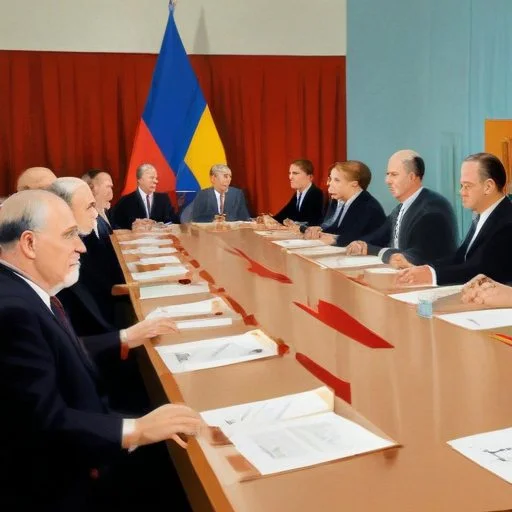
The Warsaw Pact, formed in 1955, had bound eight Eastern European nations under the Soviet Union's grip. However, as the Cold War's embers began to die out, the alliance began to show signs of fatigue. The pact's members, once united in their opposition to NATO, began to diverge in their interests and ideologies. The Soviet Union's grip on its satellite states began to loosen, and the once-monolithic alliance began to fracture.
The disbandment of the Warsaw Pact had far-reaching consequences, marking a significant shift in the global balance of power. The end of the Cold War and the dissolution of the Soviet Union paved the way for a new era of international relations, characterized by increased cooperation and diplomacy.
The disbandment also led to a wave of democratization across Eastern Europe, as former communist states began to transition towards democracy and market-oriented economies. The removal of Soviet influence allowed for greater autonomy and self-determination among Eastern European nations, leading to a more diverse and multipolar world.
The disbandment of the Warsaw Pact had a profound impact on the cultural and social landscape of Eastern Europe. With the collapse of communism, a new era of freedom and creativity dawned, as artists, writers, and musicians began to express themselves without the constraints of censorship and repression.
The disbandment also led to a surge in cultural exchange and collaboration between East and West, as artists and intellectuals began to engage with their counterparts across the former Iron Curtain.
"I remember the day the Warsaw Pact was disbanded like it was yesterday," recalls Andrzej Wajda, the renowned Polish filmmaker. "It was a moment of great hope and uncertainty, as we set out to build a new future for ourselves and our nations."
"The disbandment of the Warsaw Pact was a moment of liberation," says Václav Havel, the Czech playwright and dissident. "It marked the beginning of a new era of freedom and democracy in Eastern Europe, and paved the way for the reunification of our continent."
The disbandment of the Warsaw Pact had a profound impact on future events, shaping the course of international relations and global politics. The end of the Cold War paved the way for a new era of cooperation and multilateralism, as nations began to work together to address global challenges and promote peace and stability.
The disbandment also led to a shift in global power dynamics, as the United States emerged as the sole superpower, and new centers of power began to emerge in Asia and Europe.
The disbandment of the Warsaw Pact remains a landmark event in modern history, marking a triumph for democracy and freedom in the face of authoritarianism and oppression. As we reflect on the past, we are reminded of the power of human ingenuity and the importance of cooperation in shaping a better future for all.
The legacy of the Warsaw Pact's disbandment continues to inspire and inform our understanding of international relations, reminding us of the importance of diplomacy, dialogue, and cooperation in promoting peace and stability in an increasingly complex and interconnected world.
Mikhail Gorbachev, the last Soviet leader, was a complex and multifaceted figure who played a crucial role in the disbandment of the Warsaw Pact. Born in 1931, Gorbachev rose through the ranks of the Communist Party to become General Secretary in 1985. He introduced policies of glasnost (openness) and perestroika (restructuring), which aimed to democratize the Soviet system and introduce market-oriented reforms.
Gorbachev's reforms were initially intended to revitalize the Soviet economy and increase its competitiveness. However, they ultimately led to a loss of control and a weakening of the Soviet grip on Eastern Europe. As the Soviet Union's grip on its satellite states began to loosen, Gorbachev found himself caught between the demands of reformers and the resistance of hardliners.
The disbandment of the Warsaw Pact marked a cultural renaissance in Eastern Europe, as artists, writers, and musicians began to express themselves without the constraints of censorship and repression.
In Poland, the award-winning film director Andrzej Wajda produced a series of films that explored the complexities of Polish history and identity. In Czechoslovakia, the playwright and dissident Václav Havel became a leading voice for democracy and freedom.
The disbandment of the Warsaw Pact also led to a surge in cultural exchange and collaboration between East and West, as artists and intellectuals began to engage with their counterparts across the former Iron Curtain.The disbandment of the Warsaw Pact was a complex and multifaceted process that involved a range of political actors and interests.
At the heart of the process was a struggle between reformers and hardliners, as different factions within the Soviet Union and its satellite states debated the future of the alliance.
The Hungarian Prime Minister József Antall played a key role in facilitating the disbandment, while the Polish leader Wojciech Jaruzelski initially opposed the move but eventually came to accept the inevitable.
The disbandment of the Warsaw Pact took place against the backdrop of a rapidly changing geopolitical landscape, as the Cold War drew to a close.
The Soviet Union's declining economic and military power, combined with the growing strength of the United States and its allies, created a new set of relationships and rivalries that shaping the international system.
In this context, the disbandment of the Warsaw Pact marked a significant shift in the global balance of power, as the United States emerged as the sole superpower and new centers of power began to emerge in Asia and Europe.Historians have debated the significance and meaning of the Warsaw Pact's disbandment, with some viewing it as a triumph for democracy and freedom, while others see it as a product of Soviet weakness and decline.
Some historians argue that the disbandment marked a turning point in the Cold War, as the Soviet Union's grip on Eastern Europe began to loosen and the United States emerged as the dominant global power.
Others contend that the disbandment was a consequence of the Soviet Union's failed economic and military policies, which had weakened its ability to maintain control over its satellite states.