


On a crisp winter morning in 1559, England and Ireland welcomed a new era of prosperity and peace as Elizabeth I, the 25-year-old daughter of Henry VIII and Anne Boleyn, was crowned Queen in Westminster Abbey, London. This historic event marked the beginning of a golden age of cultural flourishing, and Elizabeth's ascension to the throne brought hope and relief to a nation exhausted by the turmoil of her predecessors' reigns.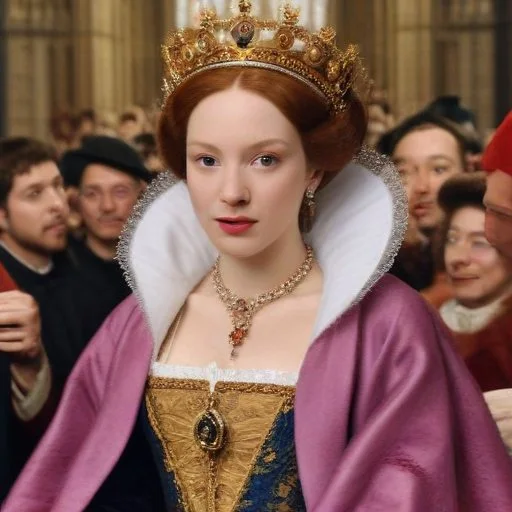
England had been plagued by religious upheaval, economic instability, and conflict during the reigns of Elizabeth's half-sister, Mary I, and her half-brother, Edward VI. The country was desperate for stability and leadership, and Elizabeth's coronation marked a turning point in English history.
The coronation ceremony was a grand affair, with Elizabeth processing through the streets of London, surrounded by cheering crowds, to Westminster Abbey. The event was attended by the who's who of English nobility and clergy, all gathered to witness the anointing and crowning of the new queen.
Elizabeth's coronation brought a sense of hope and renewal to England and Ireland. Her sharp wit, intelligence, and charismatic presence inspired confidence in her ability to lead the nation towards a brighter future. During her reign, Elizabeth would go on to become one of England's most beloved and successful monarchs, earning the title "The Virgin Queen."
Several key figures played crucial roles in Elizabeth's coronation and subsequent reign, including:
Elizabeth's coronation marked the beginning of a long period of peace and prosperity in England and Ireland, characterized by:
Elizabeth I was known for her sharp wit and eloquence, leaving behind a legacy of memorable quotes and sayings, including:
Elizabeth I's coronation and subsequent reign had a profound impact on English history, shaping the nation's identity, culture, and politics for centuries to come. Her legacy continues to inspire and fascinate to this day, cementing her place as one of England's greatest monarchs.
William Cecil, 1st Baron Burghley, was a pivotal figure in Elizabeth I's coronation and subsequent reign. As her trusted advisor and chief minister, Cecil played a crucial role in shaping Elizabeth's policies and decisions.
Cecil's experience and wisdom earned him the respect and admiration of Elizabeth, who relied heavily on his counsel. He was instrumental in guiding her through the complexities of statecraft and diplomacy, helping her to navigate the treacherous waters of European politics.
Cecil's influence extended beyond politics, as he was also a patron of the arts and a strong advocate for education. He recognized the importance of fostering a cultural Renaissance in England, and his support helped to lay the foundations for the country's cultural flourishing during Elizabeth's reign.

The coronation of Elizabeth I marked the beginning of a cultural Renaissance in England, as the country experienced a surge in artistic and literary innovation.
Theatre, in particular, flourished during Elizabeth's reign, with playwrights such as William Shakespeare and Christopher Marlowe producing some of their most iconic works. The Queen herself was a patron of the arts, and her love of drama and music helped to fuel the country's cultural awakening.
The cultural Renaissance of Elizabethan England was characterized by a sense of optimism and patriotism, as the country rediscovered its sense of identity and purpose. This cultural flowering had a profound impact on English history, shaping the nation's identity and influencing its artistic and literary output for centuries to come.
Elizabeth I's coronation marked the beginning of a new era of political stability in England, as she demonstrated a mastery of the political game that would come to define her reign.
Elizabeth's ability to navigate the complex web of alliances and rivalries between European powers was unmatched, and her cunning and diplomacy helped to secure England's position on the international stage.
Her political acumen was matched by her strategic thinking, as she recognized the importance of building a strong and modern navy to protect England's interests. This decision would prove pivotal in shaping the country's future and cementing Elizabeth's legacy as one of England's greatest monarchs.

The coronation of Elizabeth I took place during a time of great turmoil in Europe, as the continent was torn apart by religious and political conflict.
The Protestant Reformation had sparked a wave of violence and instability, as Catholic and Protestant powers vied for dominance. England, with its fragile Tudor monarchy, was vulnerable to the machinations of its powerful neighbors.
Elizabeth's coronation, therefore, took place against a backdrop of uncertainty and danger, as she faced the daunting task of navigating the treacherous waters of European politics to secure England's survival and prosperity.
Historians have long debated the significance of Elizabeth I's coronation, with some viewing it as a turning point in English history and others seeing it as a continuation of existing trends.
Some have argued that Elizabeth's coronation marked a decisive shift towards Protestantism, while others have seen it as a pragmatic compromise between competing religious factions.
Despite these differing interpretations, most historians agree that Elizabeth's coronation was a pivotal moment in English history, one that set the tone for her remarkable reign and cemented her legacy as one of England's greatest monarchs.