


On a fateful day in August 1756, Frederick the Great, King of Prussia, launched a surprise attack on Saxony, a seemingly tranquil German state. This daring move would ignite the flames of the Seven Years War, a global conflict that would shake the foundations of Europe and beyond.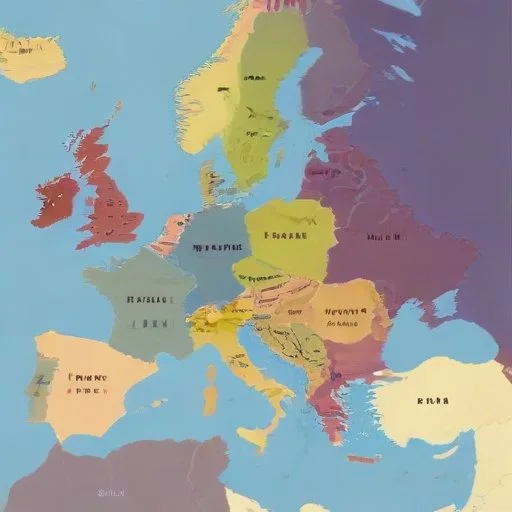
Frederick the Great, a military genius and cunning statesman, had been secretly mobilizing his army of 60,000 troops along the Saxon border. Under the guise of a routine military exercise, Frederick lulled the Saxon rulers into a false sense of security, allowing him to catch them off guard.
The vastly outnumbered Saxon forces, led by King Augustus III, were quickly overwhelmed by the Prussian onslaught. In a matter of days, the Saxon army was routed, and its king fled to Warsaw, leaving Frederick the Great to claim victory.
As the war escalated, other European powers began to take sides. Austria, Russia, and Britain would eventually join the fray, entangling the continent in a complex web of alliances and rivalries. The war would spread beyond Europe's borders, drawing in colonial powers and native populations from the Americas to India.
The Seven Years War would ultimately leave a lasting impact on global politics, redrawing the map of Europe and cementing Prussia's position as a major power. The war would also set the stage for future conflicts, including the American and French Revolutions.
The Seven Years War would leave a lasting impact on European politics, setting the stage for future conflicts and cementing Prussia's position as a major power. Frederick the Great's lightning strike on Saxony would be remembered as a masterstroke of diplomacy and deception, a testament to his military genius and cunning statesmanship.
In the months leading up to the invasion of Saxony, Frederick the Great carefully planned and executed a series of decoy maneuvers to distract the Saxon rulers. He ordered his troops to engage in a series of mock battles and military exercises along the border, creating the illusion of a routine training exercise. Meanwhile, he secretly mobilized his main army, consisting of 60,000 troops, and positioned them along the Saxon border, ready to strike at a moment's notice.
The element of surprise was crucial to Frederick's plan. He knew that the Saxon army was ill-prepared to respond to a sudden attack, and that the element of surprise would give him a significant advantage. By the time the Saxon rulers realized what was happening, it was too late, and their army was already in disarray.
Maria Theresa, Empress of Austria, was a formidable leader who played a key role in the Seven Years War. Born in 1717, she was the only female ruler of the Habsburg Empire and one of the most powerful women of her time. She was known for her intelligence, cunning, and determination, earning her the respect and admiration of her contemporaries.
Maria Theresa was a strong opponent of Frederick the Great and his Prussian ambitions. She saw him as a threat to the balance of power in Europe and was determined to stop him. Throughout the war, she played a crucial role in marshaling the opposition against Prussia, forming alliances with other European powers and rallying her own troops.
The Seven Years War was fought against the backdrop of a complex and rapidly changing geopolitical landscape. The rise of Prussia as a major power had disrupted the traditional balance of power in Europe, creating tensions and rivalries with other major powers, including Austria, Britain, and France.
The war was also influenced by the ongoing struggle for colonial supremacy between European powers. The British and French were vying for control of North America, while the Austrians and Prussians were competing for influence in Eastern Europe.
The Seven Years War was characterized by intense diplomatic maneuvering, as European powers sought to form alliances and negotiate treaties to further their interests. The British government, in particular, played a key role in the war, switching sides several times in an effort to maintain the balance of power in Europe.
Frederick the Great was a master of diplomacy, using his charm and cunning to negotiate favorable treaties and alliances. He was able to persuade the British to sign the Treaty of London in 1758, which marked a significant turning point in the war.
The Seven Years War had a profound impact on European culture, influencing the development of art, literature, and music. The war inspired a wave of patriotic art and literature, as artists and writers sought to capture the spirit of nationalism and militarism.
The war also had a significant impact on the development of classical music. Composers such as Haydn and Mozart were inspired by the war, writing music that reflected the mood and atmosphere of the time.