


In the midst of 16th-century France's devastating Wars of Religion, a bold attempt at reconciliation took place. The marriage of Henry of Navarre, the dashing Huguenot king, to Margaret of Valois, the beautiful Catholic princess, was hailed as a symbol of unity between the Protestant and Catholic factions.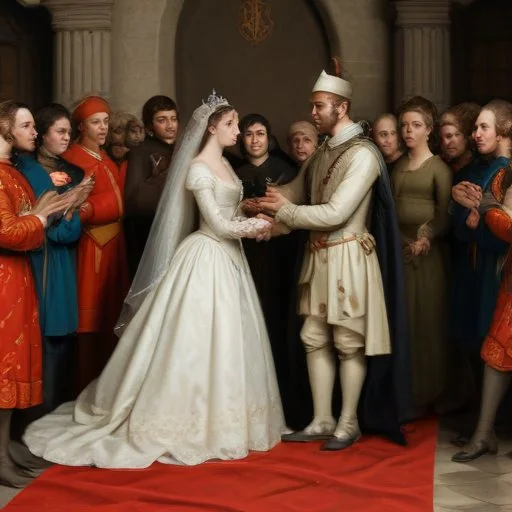
By the mid-16th century, France was torn apart by religious strife. The Protestant Reformation had taken hold, and the Catholic Church was determined to suppress it. The result was a series of brutal conflicts that would claim thousands of lives and leave deep scars on the nation.
Henry of Navarre, a Protestant, was a charismatic leader with a reputation for military prowess. Margaret of Valois, a Catholic, was a stunning beauty with a sharp mind and a penchant for intrigue. Their union was orchestrated by Catherine de' Medici, the cunning Queen Mother of France, who hoped to reconcile the warring factions through this strategic marriage.
The lavish ceremony took place on August 18, 1572, in Notre-Dame Cathedral, Paris. The event was a spectacle of opulence, with the crème de la crème of French society in attendance. The atmosphere was tense, however, as Protestant and Catholic guests eyed each other warily, their animosity simmering just beneath the surface.
Initially, the marriage seemed to bring a degree of calm to the troubled nation. However, the fragile peace was short-lived. Tensions between the Protestant and Catholic factions continued to escalate, culminating in the horrific Massacre of St. Bartholomew's Eve just six days later.
Though the marriage failed to achieve its intended purpose, it remains an intriguing footnote in French history. The tumultuous events surrounding the union served as a catalyst for Henry's eventual conversion to Catholicism in 1593, paving the way for his ascension to the French throne as Henry IV.
The failed experiment in reconciliation had a profound impact on French society. The Wars of Religion continued for another three decades, ultimately resulting in the Edict of Nantes (1598), which granted limited tolerance to Protestants. Though imperfect, this edict marked a significant step towards religious coexistence in France.
In the end, the marriage of Henry of Navarre and Margaret of Valois serves as a poignant reminder of the power of hope and the fragility of peace in the face of deep-seated conflict.
The royal wedding of Henry of Navarre and Margaret of Valois was not an isolated incident in the history of religiously motivated marriages. In fact, it was part of a larger trend in 16th-century Europe, where strategic marriages were used to forge alliances and resolve conflicts between Catholic and Protestant factions. For instance, the marriage of Mary Queen of Scots to Lord Darnley in 1565 was an attempt to unite the Catholic and Protestant Scottish nobility. Similarly, the marriage of William of Orange to Louise de Coligny in 1583 was meant to strengthen the Protestant alliance against Spanish Catholic rule.
Despite these similarities, the marriage of Henry and Margaret stood out for its high stakes and dramatic consequences. While other religiously motivated marriages may have had significant local or regional impacts, the marriage of the French king and queen had far-reaching consequences for the entire country, leading to the Massacre of St. Bartholomew's Eve and ultimately shaping the course of French history.
In this sense, the wedding of Henry and Margaret serves as a powerful example of the complexities and challenges of religiously motivated marriages in 16th-century Europe. It highlights the difficulties of reconciling deeply entrenched religious differences and the often devastating consequences of failure.

Behind the dazzling beauty and sharp mind of Margaret of Valois lay a complex and intriguing personality. The Catholic princess was known for her cunning and political savvy, often using her charm to manipulate those around her. As the daughter of Catherine de' Medici, Margaret was well-versed in the art of court politics and was not afraid to use her wits to advance her own interests.
Despite her Catholic upbringing, Margaret was not afraid to challenge traditional religious norms. She was known to have had multiple affairs, including with prominent Protestant leaders, which further complicated her already tumultuous relationship with Henry of Navarre.
Margaret's intriguing character has captivated historians and fiction writers alike, inspiring numerous literary and artistic works, including Alexandre Dumas' novel Queen Margot.
The geopolitical context of the royal wedding was marked by intense rivalry and competition between European powers. The Catholic Spanish monarchy, led by Philip II, was determined to crush the Protestant Reformation and maintain its dominance over Europe. Meanwhile, the Protestant English monarchy, led by Elizabeth I, was seeking to expand its influence and counterbalance Spanish power.
In this complex web of alliances and rivalries, the marriage of Henry of Navarre and Margaret of Valois was seen as a strategic move by the French monarchy to strengthen its position and counterbalance the influence of Spain and England. However, the fragile peace brokered by the marriage ultimately failed to hold, plunging France back into religious turmoil.
The geopolitical implications of the royal wedding continue to resonate in modern times, highlighting the enduring importance of religious and cultural diplomacy in international relations.
The cultural impact of the royal wedding was profound and far-reaching, inspiring a wave of artistic and literary works that continue to captivate audiences to this day. The elaborate ceremony, with its opulent decorations and lavish festivities, set a new standard for royal weddings and inspired subsequent monarchs to emulate its grandeur.
The wedding also had a significant impact on French art and architecture, with the construction of grandiose buildings and monuments, such as the Palace of Fontainebleau, which was renovated in honor of the royal couple.
The cultural legacy of the royal wedding continues to be felt in modern times, with the event remaining a powerful symbol of French history and heritage.
The historiographical perspective on the royal wedding has evolved significantly over time, with different historians offering competing interpretations of the event's significance. Traditional historians, such as Jules Michelet, viewed the marriage as a tragic failure, highlighting the deep-seated religious divisions that ultimately led to its downfall.
In contrast, more recent historians, such as Nancy L. Roelker, have reevaluated the wedding as a brave attempt at reconciliation, emphasizing the agency and determination of the royal couple in the face of overwhelming odds.
This diverse range of perspectives highlights the ongoing relevance and controversy of the royal wedding, which continues to inspire lively debates among historians and scholars today.