


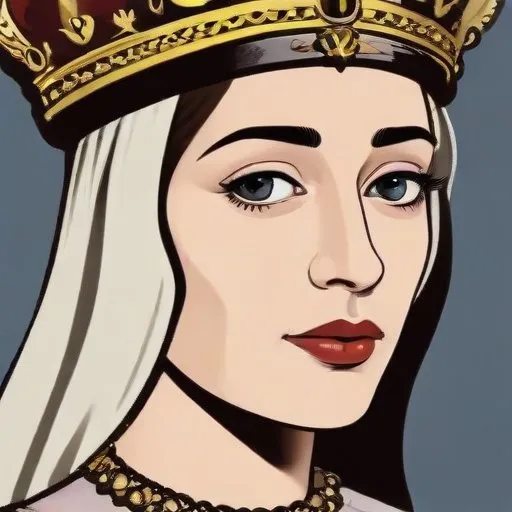
The Queen of France who brokered peace between Catholics and Protestants through her marriage, but her lavish lifestyle and scandals sparked the St. Bartholomew's Day massacre.
Margaret of Valois, popularly known as La Reine Margot, is famously recognized as the Queen of Navarre by marriage to Henry III of Navarre and subsequently Queen of France at her husband's accession to the throne as Henry IV in 1589.
Born on May 14, 1553, Margaret was the daughter of King Henry II of France and Catherine de Medici, making her a part of the esteemed Valois dynasty. She was also the sister of three French monarchs: Francis II, Charles IX, and Henry III.
Margaret's marriage to Henry III of Navarre was intended to reconcile the Catholics and Huguenots in France. However, just six days after the ceremony, the St. Bartholomew's Day massacre occurred, marking the resumption of the French Wars of Religion. Despite the tumultuous circumstances, Margaret took on a pacifying role, seeking to maintain a balance between her husband's court and the French monarchy.
Margaret was an advocate for platonic love, believing it to be superior to physical love. During her imprisonment, she utilized the time to write her Memoirs, which showcased her enlightened perspective on relationships.
Margaret's life was marked by turmoil and conflict, yet she remained a symbol of hope and reconciliation. Her efforts to pacify the warring factions in France, as well as her advocacy for platonic love, have left an indelible mark on French history.
Though not much of her direct quotes have survived, Margaret's writings and memoirs demonstrate her strong convictions and progressive ideas, which continue to inspire and motivate scholars and historians today.
Margaret of Valois's emphasis on platonic love and her own experiences as a queen have contributed significantly to the understanding of the cultural and social dynamics of 16th-century France. Her story has inspired numerous literary and artistic works, cementing her place in the annals of history.
Margaret's Memoirs, written during her imprisonment, are her most notable literary achievement. This work provides valuable insights into the life of a Renaissance queen, offering a unique perspective on the complexities of royal politics and personal relationships.
Margaret of Valois's legacy extends beyond the boundaries of 16th-century France. Her story has been adapted into numerous literary, film, and stage productions, captivating audiences worldwide. Her advocacy for platonic love and her struggle for reconciliation continue to inspire contemporary discussions on relationships, politics, and society.
| 1553 | Birth of Margaret of Valois |
| 1572 | Marriage to Henry III of Navarre |
| 1585 | Exile in Auvergne |
| 1599 | Royal divorce and annulment of marriage |
| 1605 | Return from exile and active participation in court life |
| 1615 | Death of Margaret of Valois |
Margaret of Valois's remarkable life, marked by perseverance, advocacy, and literary achievements, continues to captivate and inspire generations. Her legacy serves as a testament to the power of reconciliation, platonic love, and the indomitable spirit of a Renaissance queen.
Born in 1519
King of France from 1547 to 1559, known for his cultural and artistic patronage, and his role in the Italian Wars.
Born in 1575
The Queen of France who commissioned the Luxembourg Palace and was the subject of Peter Paul Rubens' famous cycle of paintings, known for her extravagant lifestyle and political influence.
Born in 1785
The last king of the French monarchy before the French Revolution, known for his tragic and mysterious life, including his imprisonment and disputed death.
Born in 1585
A powerful and cunning statesman who dominated French politics during the 17th century, known for his ruthless suppression of dissent and centralization of power. He was a master strategist and diplomat who shaped the course of European history.
Born in 1519
The Italian-French queen who married into the French monarchy and wielded significant power behind the scenes, known for her cunning politics and lavish court festivities. She sponsored the arts and architecture, leaving a lasting legacy on French culture.
Born in 1542
The last Scottish monarch of the House of Stuart, she was a Catholic queen who faced Protestant rebellion and was eventually beheaded, sparking a centuries-long rivalry with England. She's known for her tumultuous reign and tragic fate.
