


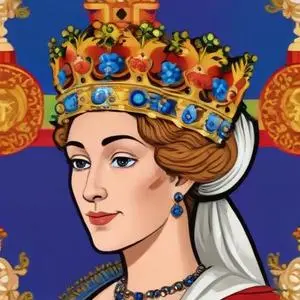
The Queen of France who commissioned the Luxembourg Palace and was the subject of Peter Paul Rubens' famous cycle of paintings, known for her extravagant lifestyle and political influence.
Marie de Medici, the second wife of King Henry IV of France and Navarre, is renowned for her prominent role as regent of France between 1610 and 1617, during the minority of her son Louis XIII. As a member of the powerful House of Medici, her marriage to Henry IV was a strategic union that brought immense wealth and influence to the French monarchy.
Born on April 26, 1575, at the Palazzo Pitti in Florence, Italy, Marie was the sixth daughter of Francesco I de Medici, Grand Duke of Tuscany, and Archduchess Joanna of Austria. As a descendant of Lorenzo the Elder, she was part of the cadet branch of the Medici family, and her mother's lineage connected her to the Habsburg dynasty.
Marie's marriage to Henry IV in 1600 marked the beginning of her rise to power. Following the king's assassination in 1610, she became regent of France during her son's minority. Although her mandate legally expired in 1614, when Louis XIII reached the age of majority, Marie refused to relinquish her position and continued to wield significant influence as head of the Conseil du Roi.
Marie was a fervent patron of the arts, commissioning works from prominent artists and architects. Her favorites, Concino Concini and Leonora Dori, played significant roles in her court, with Concini serving as her chief advisor and Dori as her lady-in-waiting.
Marie's ceaseless political intrigues and manipulations eventually led to her downfall. In 1617, she was removed from power by her son Louis XIII, who had grown weary of her influence. Banished from the French court, Marie spent the remainder of her life in exile, eventually dying in Cologne, in the Holy Roman Empire, on July 3, 1642.
Marie de Medici's legacy is multifaceted, marked by her significant contributions to the arts and her unyielding determination to maintain power. Although her reign was marked by controversy, her influence on the French monarchy and her role as a female leader in a patriarchal society are undeniable.
Marie de Medici's life and reign can be juxtaposed with that of her contemporaries, such as Queen Elizabeth I of England and Empress Maria Theresa of Austria. Like these women, Marie navigated the complexities of patriarchal societies, employing strategic alliances, patronage, and intrigue to maintain power and influence.
In conclusion, Marie de Medici's life and reign serve as a testament to the complexities of female leadership in early modern Europe. Her unwavering determination, artistic patronage, and unrelenting pursuit of power continue to fascinate and inspire, cementing her place as one of the most intriguing figures of the French monarchy.
Born in 1519
King of France from 1547 to 1559, known for his cultural and artistic patronage, and his role in the Italian Wars.
Born in 1757
The last Bourbon king of France, ruling from 1824 to 1830, known for his ultra-royalist views and attempts to restore absolute monarchy, leading to the July Revolution.
Born in 1519
King of France from 1547 to 1559, known for his cultural and artistic patronage, and his role in the Italian Wars.
Born in 1536
Led the Catholic Church during a tumultuous period, issuing papal bulls and playing a key role in the Counter-Reformation. He's also famous for his coffee habit, being the first Pope to try and approve of it.
Born in 1585
A powerful and cunning statesman who dominated French politics during the 17th century, known for his ruthless suppression of dissent and centralization of power. He was a master strategist and diplomat who shaped the course of European history.
