


The fall of Baghdad to American forces on April 9, 2003, marked a pivotal moment in the Iraq War, symbolizing the end of Saddam Hussein's regime and the beginning of a new era for the country. The iconic images of jubilant Iraqis toppling Saddam's statue in Firdos Square will forever be etched in history, serving as a powerful symbol of liberation and freedom.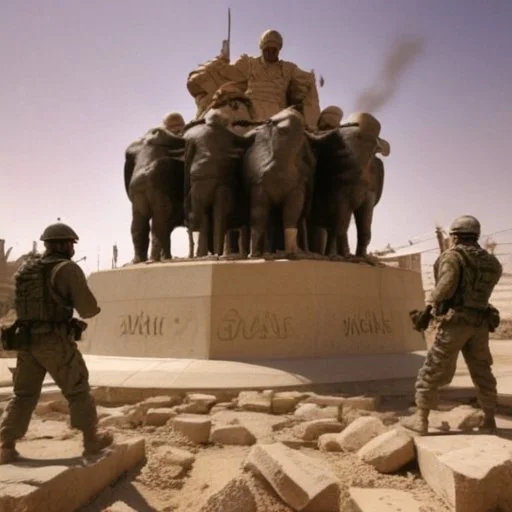
In the aftermath of the 9/11 attacks, the United States launched Operation Iraqi Freedom, aimed at removing Saddam Hussein from power and dismantling his alleged weapons of mass destruction. The campaign began on March 20, 2003, with a series of airstrikes and ground invasions, led by General Tommy Franks, the Commander of the United States Central Command.
After a three-week campaign, American forces, supported by Coalition troops, pushed deep into Baghdad, encountering limited resistance from Iraqi forces. The decisive battle took place on April 5, 2003, when the 1st Marine Division and the 3rd Infantry Division launched a simultaneous assault on the city, securing key objectives and paving the way for the eventual fall of Baghdad.
As American forces entered the city, Iraqi forces began to surrender or flee, marking the effective end of Saddam Hussein's regime. The Iraqi capital was soon flooded with Coalition troops, as the once-feared regime crumbled under the weight of superior military might.
The fall of Baghdad had a profound impact on Iraqi society, as the removal of Saddam Hussein's regime brought an end to decades of authoritarian rule and repression. The event marked a new era of freedom and democracy for the Iraqi people, allowing them to express themselves and participate in the country's political process.
One of the most enduring images from the fall of Baghdad is that of a young Iraqi boy, Ahmed Hassan, who was photographed waving an American flag in celebration of the city's liberation. The photo, taken by AP photographer Jerome Delay, has become an iconic symbol of the Iraq War, capturing the joy and hope of a liberated people.
The fall of Baghdad serves as a powerful reminder of the human spirit's capacity for resilience and hope. The bravery and determination of the Iraqi people, combined with the sacrifice and dedication of Coalition forces, inspire us to strive for freedom, democracy, and human rights.
The lead-up to the fall of Baghdad was marked by a series of intense battles and skirmishes between Coalition forces and Iraqi troops. One of the most significant battles took place on April 3, 2003, when the 1st Marine Division clashed with Iraqi forces at the Al Aziziyah Bridge, a crucial crossing point over the Tigris River. The battle was fierce, with both sides suffering heavy casualties, but ultimately, the Marines emerged victorious, securing a vital foothold in the approach to Baghdad.
As Coalition forces pushed deeper into the city, they encountered pockets of resistance from die-hard Saddam loyalists. However, the Iraqi forces were largely disorganized and demoralized, and many surrendered or fled rather than fight. The rapid collapse of Iraqi resistance was a testament to the superior training and firepower of the Coalition forces, as well as the effective use of psychological operations to demoralize the enemy.
The rapid advance of Coalition forces into Baghdad was also facilitated by the use of advanced surveillance and reconnaissance technology, including unmanned aerial vehicles (UAVs) and satellite imaging. These assets provided critical real-time intelligence on Iraqi troop movements and allowed Coalition commanders to adjust their tactics accordingly.
Major General Jassim Mohammed Saleh al-Dulaimi was a senior Iraqi military officer who played a key role in the defense of Baghdad. Despite being vastly outnumbered and outgunned, al-Dulaimi rallied his troops and led a fierce resistance against the Coalition forces. However, as the city fell, al-Dulaimi realized the futility of further resistance and ordered his troops to stand down, surrendering to Coalition forces on April 9, 2003.
Al-Dulaimi's decision to surrender was likely influenced by the collapse of Iraqi command and control structures, as well as the rapid advance of Coalition forces into the city. Despite his valiant efforts to defend Baghdad, al-Dulaimi was ultimately powerless to stem the tide of defeat.
After the war, al-Dulaimi was detained by Coalition forces and later released. He went on to become a vocal critic of the occupation and the subsequent Iraqi government, calling for greater autonomy and representation for Sunni Arabs in Iraq.
The fall of Baghdad in 2003 bears striking similarities to the fall of Berlin in 1945. In both cases, a powerful authoritarian regime was toppled by a coalition of Allied forces, marking a significant turning point in the war. Both battles were characterized by intense urban warfare, with troops fighting block-by-block to secure key objectives.
However, there are also significant differences between the two battles. The fall of Berlin was a far more brutal and devastating affair, with thousands of civilian casualties and widespread destruction. In contrast, the fall of Baghdad was relativelybloodless, with Coalition forces taking care to minimize civilian casualties and preserve infrastructure.
Despite these differences, both battles share a common significance as key milestones in their respective wars, marking the beginning of the end of oppressive regimes and the dawn of a new era for the liberated populations.
The fall of Baghdad had a profound impact on Iraqi culture, marking the beginning of a new era of freedom and self-expression. With the removal of Saddam Hussein's regime, Iraqis were finally able to express themselves freely, without fear of repression or persecution.
One of the most significant cultural developments in the aftermath of the war was the emergence of a vibrant Iraqi art scene. Artists, writers, and musicians were finally able to express themselves freely, producing a flurry of creative works that reflected the hopes and aspirations of the Iraqi people.
The fall of Baghdad also marked a significant shift in Iraqi identity, as Iraqis began to reimagine their national identity and their place in the world. This process of self-discovery and redefinition continues to this day, as Iraqis continue to navigate the complexities of post-war reconstruction and nation-building.
The fall of Baghdad was not just a military victory, but also a significant geopolitical event with far-reaching implications for the Middle East. The removal of Saddam Hussein's regime marked a major shift in the regional balance of power, with the United States emerging as a dominant force in the region.
The fall of Baghdad also had significant implications for the global war on terror, as it marked a major defeat for jihadist groups and a significant blow to Al-Qaeda's prestige and influence. The subsequent insurgency and terrorist campaigns in Iraq would later become a major focus of US counter-terrorism efforts.
The fall of Baghdad also marked a significant turning point in the history of the Middle East, as it marked the beginning of a new era of US engagement and intervention in the region. This era of intervention would have far-reaching consequences, shaping the course of regional politics and global events for years to come.