


The Korean War's most notorious conflicts, the Battles of the Chongchon River and Chosin Reservoir, etched themselves into history as a testament to human resilience and the unforgiving brutality of war. These clashes, fought amidst the unforgiving Korean winter, saw Communist Chinese troops launch a series of surprise counterattacks against United Nations and South Korean forces, forever changing the trajectory of the war.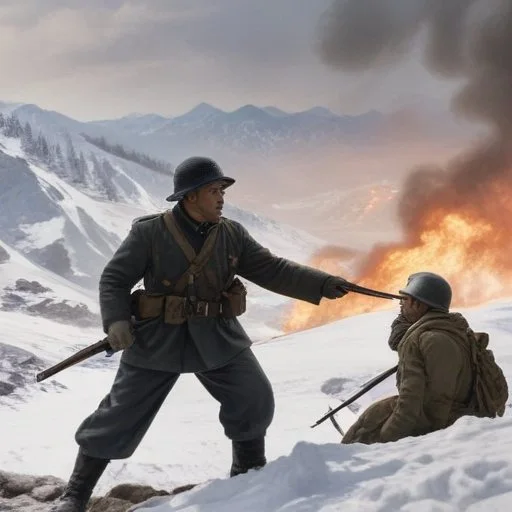
In the aftermath of World War II, the Korean Peninsula was divided along the 38th parallel, separating the Soviet-backed North from the US-backed South. The Cold War's proxy battleground was set, and the stage was primed for a conflict that would engulf the region. As the war raged on, the People's Republic of China, committed to the Communist ideals of their North Korean allies, prepared to enter the fray.
The winter of 1950 brought with it subzero temperatures, heavy snowfall, and an eerie silence that belied the impending storm. The United Nations and South Korean forces, spearheaded by General Douglas MacArthur, had advanced northward, confident in their ability to crush the North Korean army. Meanwhile, Chinese forces, led by General Peng Dehuai, secretly amassed troops along the border, awaiting the perfect moment to strike.
On November 25, 1950, the Chinese counterattack unfolded like a thunderbolt. Thousands of troops, clad in white camouflage, emerged from the treeline, catching the United Nations and South Korean forces off guard. The surprise was total, and the ensuing battles would be marked by intense fighting, hand-to-hand combat, and a desperate struggle for survival.
The Battle of the Chongchon River saw Chinese forces cleverly exploit the United Nations' overextension, while American and South Korean troops were caught in a pincer movement, forcing a hurried retreat. Meanwhile, at the Chosin Reservoir, the 1st Marine Division, surrounded by an overwhelming enemy force, waged a heroic defense, buying time for their comrades to regroup and establish a new defensive line.
Temperatures plummeted to -35°C (-31°F), rendering guns and equipment inoperable, and turning the frozen terrain into a battleground akin to a medieval wasteland. Frostbite, exposure, and the biting cold claimed as many lives as the bullets and artillery that pierced the air.
As the Battles of the Chongchon River and Chosin Reservoir raged on, the United Nations and South Korean forces adapted, regrouped, and counterattacked, slowly pushing the Chinese back. The war would drag on for two more years, but the Communist Chinese had suffered significant losses, and the balance of power had shifted irrevocably.
The Battles of the Chongchon River and Chosin Reservoir serve as a testament to the indomitable human spirit, forged in the crucible of war. They remind us that even in the face of overwhelming odds, courage, determination, and tactical brilliance can turn the tide of battle. As the world continues to navigate the complexities of international relations, these conflicts stand as a poignant reminder of the devastating consequences of ideological zealotry and the unyielding importance of diplomacy.
The Battles of the Chongchon River and Chosin Reservoir serve as a chilling reminder of the human cost of war, a testament to the bravery and resilience of those who fought, and a poignant warning to the world of the devastating consequences of ideological conflict.
The Battle of Chongchon River was a pivotal moment in the Korean War, marking a significant shift in the war's momentum. The surprise Chinese counterattack caught the United Nations and South Korean forces off guard, forcing a hasty retreat and surrender of key territories. The battle was marked by intense fighting, with both sides suffering heavy casualties. Despite being vastly outnumbered, the 1st Cavalry Division's bravery and determination prevented a complete collapse of the UN forces.
The battle's aftermath saw a re-evaluation of military strategy, with General Douglas MacArthur's leadership being called into question. The failure to anticipate the Chinese counterattack led to a re-assessment of intelligence gathering and dissemination. Meanwhile, the bravery of the 1st Cavalry Division's soldiers earned them a revered place in the annals of military history.

General Peng Dehuai: The Architect of the Chinese Counterattack
General Peng Dehuai, a seasoned military strategist, played a crucial role in the Chinese counterattack during the Battle of Chongchon River. With over three decades of military experience, Peng was well-versed in guerrilla warfare and was instrumental in mobilizing Chinese forces along the border. His clever use of decoy troops and clever exploitation of UN forces' weaknesses caught the enemy off guard, earning him both praise and admiration from his superiors.
Peng's leadership and tactical brilliance were instrumental in changing the war's trajectory, forcing the UN forces to regroup and re-strategize. His actions during the battle cemented his position as a respected military leader, earning him a place alongside the most revered military minds in Chinese history.
The Battle of Chongchon River: A Comparative Analysis
A comparative analysis of the Battle of Chongchon River and the Battle of Stalingrad during World War II reveals striking similarities. Both battles saw a vastly outnumbered and outgunned force, fighting against overwhelming odds, yet ultimately achieving a decisive victory. Both battles showcased the importance of adaptable tactics, clever use of terrain, and the perseverance of soldiers in the face of overwhelming adversity.
Furthermore, both battles highlighted the importance of strategic planning, intelligence gathering, and effective communication. The Chinese forces' ability to exploit UN forces' weaknesses, coupled with their clever use of deception and misdirection, echoes the Soviet Union's successful tactics during the Battle of Stalingrad.

The Geopolitical Context of the Korean War
The Korean War was a complex and multifaceted conflict, shaped by the tumultuous geopolitics of the post-World War II era. The war was fought amidst the backdrop of the Cold War, with the United States and the Soviet Union vying for global influence. The partitioning of Korea along the 38th parallel, following Japan's defeat in WWII, created a power vacuum that both superpowers sought to fill.
The war was, in essence, a proxy conflict between the two superpowers, with the United States and its allies supporting the South, while the Soviet Union and China backed the North. The war's outcome would have far-reaching implications, shaping the global balance of power and cementing the divide between East and West.
The Cultural Impact of the Korean War
The Korean War had a profound impact on popular culture, inspiring a wave of films, literature, and music that continue to resonate with audiences today. The war's themes of patriotism, sacrifice, and the human cost of conflict have been explored in classics like The Bridge on the River Kwai and M*A*S*H*.
The war also had a significant impact on the music industry, with songs like "Korea Blues" and "Soldier's Last Letter" becoming anthems for a generation of Americans. The war's influence can be seen in the works of writers like James Salter and Richard Hooker, who drew upon their own experiences during the conflict to craft powerful and poignant narratives.