


In a bold and unprecedented move, Pope Paul III drew up a papal bull of excommunication, formally expelling English King Henry VIII from the Catholic Church in 1538. This daring act, marked by the historic document beginning with the Latin phrase "Eius qui immobilis," would forever alter the course of European history.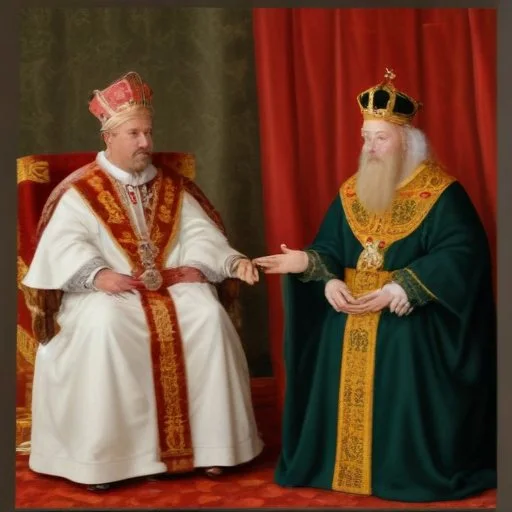
The seeds of this monumental event were sown in the tumultuous marriage of King Henry VIII to his first wife, Catherine of Aragon. The couple's inability to produce a male heir, coupled with the King's growing infatuation with Anne Boleyn, led to a bitter dispute over the annulment of the marriage. Pope Paul III, steadfast in his refusal to annul the marriage, unwittingly ignited a firestorm of defiance from the English monarch.
In response to the Pope's refusal, Henry VIII broke away from the Church of Rome, establishing the Church of England with himself as its head. This radical move marked the beginning of the English Reformation, a period of intense religious upheaval that would reshape the very fabric of English society.
The papal bull, "Eius qui immobilis," was a formal declaration of excommunication, stripping King Henry VIII of his rights and privileges as a member of the Catholic Church. This powerful document, issued on December 17, 1538, served as a testament to the Pope's unwavering commitment to the teachings of the Church.
The excommunication of King Henry VIII had far-reaching consequences, including:
The English Reformation, sparked by the excommunication of King Henry VIII, had a profound impact on English culture and society. The creation of the Church of England led to a new era of artistic and literary expression, as well as a renewed sense of national identity.
The excommunication of King Henry VIII shares similarities with other notable instances of papal authority being challenged, such as the Protestant Reformation led by Martin Luther. Both events demonstrate the complexities and nuances of religious authority and its relationship with secular power.
The courage and conviction displayed by Pope Paul III in the face of defiance from a powerful monarch serves as a powerful inspiration to individuals who stand up for their beliefs in the face of adversity.
In conclusion, the excommunication of King Henry VIII by Pope Paul III marks a pivotal moment in European history, one that continues to shape our understanding of religious authority, secular power, and the complexities of human relationships.
Pope Paul III, born Alessandro Farnese, was a vocal champion of Catholic orthodoxy. His unwavering commitment to the Church's teachings earned him the respect of his contemporaries and the admiration of future generations. As the Bishop of Rome, he saw it as his duty to defend the Church against the growing threat of Protestantism and secularism.
Despite his strong stance against King Henry VIII, Pope Paul III was not immune to the intrigues of politics. He was known for his diplomatic finesse, often using his charms to navigate the treacherous waters of European politics.

The English Reformation, sparked by King Henry VIII's break from Rome, had a profound impact on the country's artistic and architectural landscape. The destruction of monasteries and the seizure of Church property led to a shift in patronage, with the monarch becoming the primary supporter of the arts.
The creation of the Church of England also led to a new wave of architectural innovation, as churches and cathedrals were adapted to suit the new Protestant sensibilities. The resulting buildings, such as St. Paul's Cathedral in London, would go on to become iconic symbols of English culture.
The path to King Henry VIII's excommunication was paved with a series of escalating confrontations between the English monarch and the Catholic Church. The dispute began with Henry's request for an annulment, which was denied by Pope Clement VII.
As tensions rose, Henry VIII began to assert his authority over the Church in England, leading to a string of provocative moves, including the appointment of Thomas Cranmer as Archbishop of Canterbury. The final straw came when Henry VIII declared himself the Supreme Head of the Church of England, a move that ultimately led to his excommunication.

The papal bull "Eius qui immobilis" is a remarkable document, offering a unique insight into the workings of the papacy during the Renaissance. The bull's ornate language and careful phrasing reveal a deep understanding of Church doctrine and canon law.
Analysis of the document's structure and composition also provides valuable insights into the bureaucratic machinery of the Church. The use of specific formulas and phrases, for example, highlights the importance of tradition and precedent in Church decision-making.
The excommunication of King Henry VIII must be seen within the broader geopolitical context of 16th-century Europe. The English monarch's defiance of papal authority was not an isolated incident, but rather part of a larger struggle for power and influence between the Church, the Holy Roman Empire, and the emerging nation-states of Europe.
The English Reformation, in particular, was closely tied to the rise of Protestantism in Germany and the Low Countries, which further complicated the already delicate balance of power in Europe.