


In the aftermath of World War II, the world was plunged into a new era of nuclear uncertainty. On January 31, 1950, President Harry Truman made a decision that would shake the foundations of international relations and propel the world into an arms race like no other – he ordered the development of thermonuclear weapons, marking the beginning of the hydrogen bomb era.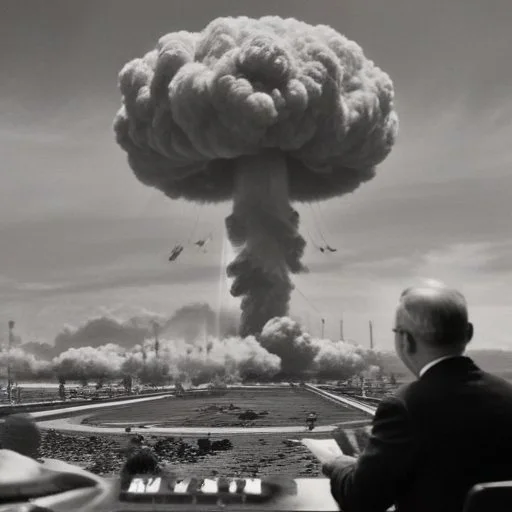
The catalyst for this decision came in the form of the Soviet Union's first atomic bomb test in August 1949, which caught the United States off guard. This sudden shift in the nuclear balance of power compelled Truman to reassess America's nuclear strategy and respond with a show of technological prowess. By pushing for the creation of hydrogen bombs, Truman aimed to reassert American dominance and deter potential Soviet aggression.
Behind the scenes, a cast of influential figures played a crucial role in shaping Truman's decision. Notable among them was General Leslie Groves, the director of the Manhattan Project, who advocated for the development of thermonuclear weapons as a means to maintain America's nuclear lead. Additionally, physicist Edward Teller, a fierce proponent of hydrogen bomb development, exerted significant influence on Truman's decision-making process.
The development of thermonuclear weapons had far-reaching consequences, fueling the nuclear arms race and intensifying the Cold War rivalry between the United States and the Soviet Union. This decision also accelerated the arms race, leading to a significant increase in nuclear stockpiles and a heightened sense of tension between the two superpowers.
The advent of the hydrogen bomb era had a profound impact on popular culture, with the specter of nuclear annihilation dominating the psyche of the American public. The development of thermonuclear weapons sparked widespread fears of nuclear war, influencing literature, film, and art of the time.
Truman's decision to develop thermonuclear weapons was met with widespread controversy, as many scientists, politicians, and members of the public expressed grave concerns about the morality and implications of these weapons. The debate surrounding the development of hydrogen bombs sparked intense discussion about the ethics of nuclear warfare and the responsible management of atomic power.
"We are here to make a choice between right and wrong, and not to see which way the cat jumps." – President Harry Truman, speaking about the decision to develop thermonuclear weapons
"The hydrogen bomb is a scourge, a peril, and a terror." – Lewis Strauss, Chairman of the Atomic Energy Commission
According to Truman's biographer, David McCullough, the President was deeply troubled by the implications of his decision, often expressing concerns about the devastating consequences of a nuclear war.
The development of thermonuclear weapons set the stage for a new era of nuclear deterrence, shaping the course of international relations and influencing the trajectory of the Cold War. This decision also had significant implications for the development of military strategy and the conduct of international diplomacy.
Today, President Truman's decision to develop thermonuclear weapons is recognized as a pivotal moment in the history of nuclear deterrence, serving as a testament to the enduring legacy of his leadership during a critical period in world history.
The enigmatic General Leslie Groves, a crucial figure in the development of the hydrogen bomb, was a man of stark contrasts. On one hand, he was a brilliant military strategist and administrator who played a pivotal role in the success of the Manhattan Project. On the other hand, he was known for his abrasive personality and questionable judgment, which often put him at odds with other influential figures of the time. Despite his controversial nature, Groves' advocacy for the development of thermonuclear weapons was instrumental in shaping President Truman's decision.
Groves' unwavering commitment to scientific progress and national security often led him to push boundaries and challenge conventional thinking. His unrelenting drive, however, also led to allegations of recklessness and a disregard for the long-term consequences of his actions. As the director of the Manhattan Project, Groves' influence extended far beyond the realm of science, delving into the intricacies of politics and international relations.
Despite the controversy that often surrounded him, Groves remains an enigmatic figure in American history, remembered both for his groundbreaking contributions to the development of nuclear weapons and his complex, multifaceted personality.

The advent of the hydrogen bomb era had a profound impact on popular culture, as the specter of nuclear annihilation dominated the psyche of the American public. The development of thermonuclear weapons sparked widespread fears of nuclear war, influencing literature, film, and art of the time.
In the realm of literature, authors such as Ray Bradbury and Philip K. Dick explored the themes of nuclear war and its consequences, creating a new wave of dystopian fiction that resonated with the anxieties of the era. In film, classics such as Dr. Strangelove and captured the sense of unease and paranoia that pervaded the American psyche.
The hydrogen bomb era also saw a rise in anti-war movements and activism, as people began to question the morality and implications of nuclear warfare. This cultural shift had a profound impact on American society, shaping the nation's perspective on science, technology, and international relations.
The development of thermonuclear weapons marked a significant milestone in the history of scientific discovery, pushing the boundaries of human knowledge and technological innovation.
The creation of the hydrogen bomb required groundbreaking advances in fields such as plasma physics, materials science, and nuclear engineering. The development of new materials and technologies, such as the invention of the radiation implosion mechanism, enabled scientists to harness the immense power of nuclear fusion.
The technological innovations spawned by the hydrogen bomb project had far-reaching consequences, influencing fields as diverse as medicine, energy production, and space exploration. The development of thermonuclear weapons also spurred significant advances in computer simulations, cryptography, and other areas of scientific inquiry.
Historians have long debated the motivations behind President Truman's decision to develop the hydrogen bomb, with some arguing that it was a response to Soviet aggression, while others see it as a manifestation of American exceptionalism.
Revisionist historians, such as Gar Alperovitz, have challenged the traditional view of Truman's decision, arguing that it was driven by a desire to maintain American hegemony and prevent the Soviet Union from gaining a nuclear advantage.
Other historians, such as Herbert York, have emphasized the role of bureaucratic politics in shaping Truman's decision, highlighting the influence of key advisors and the military-industrial complex.
The development of thermonuclear weapons had significant implications for the global balance of power, as the hydrogen bomb era marked the beginning of a new era of nuclear deterrence.
The possession of hydrogen bombs by both the United States and the Soviet Union created a state of mutual assured destruction, where the use of these weapons would result in catastrophic consequences for both parties. This led to a period of détente, as both nations sought to avoid direct conflict and instead pursued a strategy of brinksmanship and diplomatic maneuvering.
The hydrogen bomb era also saw the emergence of a multipolar world, as other nations such as France, China, and the United Kingdom developed their own nuclear capabilities. This led to a complex web of alliances and rivalries, as nations sought to navigate the intricacies of nuclear diplomacy and prevent the spread of nuclear weapons.