


On a fateful day in October 1913, U.S. President Woodrow Wilson stood at the helm of history, triggering the explosion of the Gamboa Dike, thereby completing the major construction milestone of the Panama Canal. This monumental achievement marked the culmination of decades of perseverance, innovation, and collaboration, forever changing the course of global commerce and diplomacy.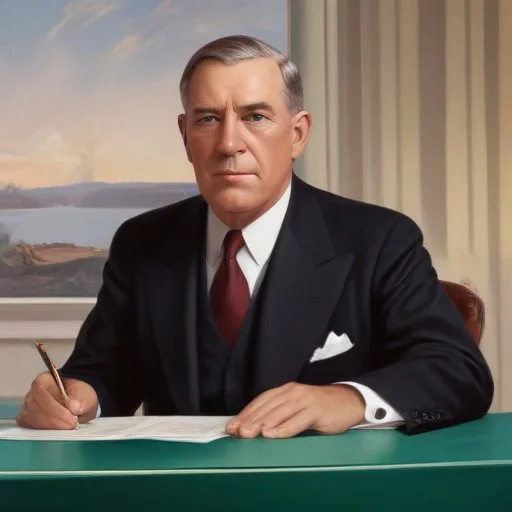
The Panama Canal, often referred to as the "Eighth Wonder of the World," was first conceptualized in the 16th century. However, it wasn't until the late 19th century that the French, led by Ferdinand de Lesseps, attempted to build the canal. Despite their valiant efforts, the project was plagued by engineering challenges, tropical diseases, and financial woes, ultimately leading to its abandonment.
Enter the United States, which took over the project in 1904, with President Theodore Roosevelt at the helm. The U.S. Army Corps of Engineers, led by Colonel George W. Goethals, was tasked with completing the canal. Over the next decade, the team overcame incredible obstacles, including treacherous landscapes, torrential rainfall, and the constant threat of malaria and yellow fever.
On October 10, 1913, President Woodrow Wilson, flanked by esteemed guests and dignitaries, triggered the explosion of the Gamboa Dike, flooding the canal and marking the completion of its major construction phase. This momentous occasion was more than just a celebration of engineering prowess – it symbolized a new era of international cooperation and global connectivity.
In his address, President Wilson eloquently stated, "The canal is to be a bond of unity and a symbol of the friendship that exists between the nations of the world." This sentiment echoed the sentiments of the thousands of laborers, engineers, and technicians who had toiled tirelessly to bring this vision to life.
The Panama Canal's impact on global trade and commerce was immediate and profound. The canal reduced travel time between the Atlantic and Pacific Oceans by approximately 8,000 miles, slashing journey times and fuel costs for merchant vessels. The canal also played a significant role in the Allied victory during World War I, facilitating the rapid transportation of troops and supplies.
Beyond its economic and strategic importance, the Panama Canal has inspired generations of engineers, scientists, and innovators. It has also fostered a sense of international cooperation, demonstrating that even the most seemingly insurmountable challenges can be overcome through collective effort and determination.
In his memoirs, Col. George W. Goethals recalled the moment President Wilson triggered the explosion of the Gamboa Dike: "The President stood calm and dignified, his eyes fixed on the distant hills... As the ground shook beneath our feet, he turned to me and smiled, saying, 'Well, Colonel, it looks as though we've made it!'"
This poignant moment captures the essence of the Panama Canal's construction – a testament to human ingenuity, perseverance, and collaboration.
The Panama Canal's completion paved the way for future mega-projects, demonstrating that even the most complex and ambitious endeavors could be achieved through human determination and ingenuity. The canal's legacy continues to inspire innovation and cooperation, shaping the course of global development and progress.
"The canal is to be a bond of unity and a symbol of the friendship that exists between the nations of the world." – Woodrow Wilson
"The Isthmus of Panama is to be the great highway of international commerce." – Theodore Roosevelt
The Panama Canal is often referred to as the "Eighth Wonder of the World," but how does it compare to other maritime marvels? The Suez Canal, for instance, is another critical waterway that connects the Mediterranean Sea to the Red Sea. While the Suez Canal is longer, the Panama Canal is wider and deeper, allowing for larger ships to pass through. The Corinth Canal in Greece, on the other hand, is a much smaller but equally impressive feat of engineering, saving ships around 400 miles of travel time.
Comparison Table:| Canal | Length (km) | Width (m) | Depth (m) |
|---|---|---|---|
| Panama Canal | 77 | 160 | 15.2 |
| Suez Canal | 193 | 205 | 20 |
| Corinth Canal | 6.3 | 25 | 8 |

Ferdinand de Lesseps, the French entrepreneur, is often credited with conceptualizing the Panama Canal. However, his true claim to fame lies in the construction of the Suez Canal. De Lesseps was a man of unwavering determination and vision, who fought tirelessly to bring his canal to life. Despite facing numerous setbacks, including financial woes and engineering challenges, de Lesseps remained committed to his project.
De Lesseps' experience with the Suez Canal served as a valuable lesson for the Panama Canal project. His expertise and guidance played a significant role in shaping the Panama Canal's early stages.
"Perseverance is not a long race, it is many short races, one after another." - Ferdinand de LessepsThe Panama Canal's economic impact was swift and profound. By reducing travel time between the Atlantic and Pacific Oceans, shipping costs plummeted, making international trade more efficient and cost-effective. The canal's opening also led to a surge in global trade, as businesses capitalized on the new shortcut.
The canal's revenue has consistently grown over the years, with tolls generating billions of dollars in revenue annually. The Panama Canal Authority has invested heavily in expanding and modernizing the canal, ensuring its continued relevance in the global economy.
The canal's economic benefits extend beyond the shipping industry, with benefits felt in sectors such as manufacturing, agriculture, and finance.
Economic Impact Statistics:
The Panama Canal's construction was a testament to human ingenuity and technological innovation. The project required the development of new machinery, tools, and techniques, many of which were groundbreaking for their time.
The construction of the canal's locks, in particular, was a remarkable achievement. The locks' innovative design allowed for the lifting of ships between the two oceans, a feat that had never been attempted before.
The canal's excavation also relied on the use of steam shovels, which greatly increased the speed and efficiency of the digging process.
The Panama Canal's technological innovations paved the way for future infrastructure projects, inspiring generations of engineers and innovators.
"The canal is a triumph of human ingenuity, a testament to our ability to push beyond the boundaries of what is thought possible."Historians have long debated the significance of the Panama Canal, with some viewing it as a symbol of American imperialism, while others see it as a testament to human cooperation and ingenuity.
Some historians argue that the canal's construction was a reflection of the United States' growing influence on the global stage, with the project serving as a demonstration of American power and expertise.
Others view the canal as a symbol of international cooperation, highlighting the collaboration between nations and individuals that made the project possible.
The Panama Canal's historiography serves as a reminder of the complexities of historical interpretation, with different perspectives offering unique insights into the canal's significance and impact.