


The Russian Army's audacious crossing of the Prut River into the Danubian Principalities of Moldavia and Wallachia on a summer day in 1853 marked a pivotal moment in modern history, precipitating the devastating Crimean War that would engulf Europe and claim thousands of lives. This bold move into the Ottoman Empire's sphere of influence ignited a powder keg of tensions, drawing the major European powers into a brutal conflict that would reshape the continent's balance of power.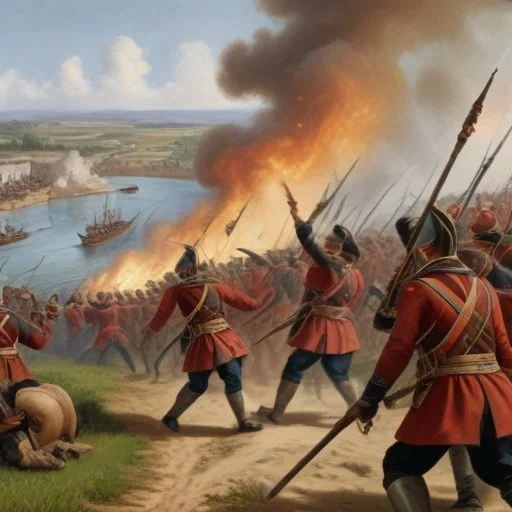
In the mid-19th century, the Russian Empire, fueled by imperial ambitions, sought to expand its influence in the region. The Danubian Principalities, strategically located at the confluence of the Ottoman and Russian empires, were a prized possession, offering control of the Danube River and access to the Black Sea. Russia's hunger for territorial expansion and desire to spread Orthodox Christianity created a rivalry with the Ottoman Empire, which had long dominated the region.
Two powerful leaders played crucial roles in the events leading up to the Crimean War. Tsar Nicholas I, known for his assertive and expansionist policies, was determined to expand Russia's influence in the region. Sultan Abdulmejid I, ruler of the Ottoman Empire, was equally resolute in protecting his empire's territorial integrity.
The Prut River crossing had far-reaching consequences, leading to the Crimean War, one of the most devastating conflicts of the 19th century. The war resulted in:
The Crimean War had a profound impact on European culture and society. The war inspired a new wave of literary and artistic works, including Alfred, Lord Tennyson's famous poem "The Charge of the Light Brigade." It also led to significant reforms in military medicine, with the pioneering work of Florence Nightingale.
One of the most poignant accounts of the war comes from Leo Tolstoy, who served as a young officer in the Russian Army. In his memoir, "Sevastopol Sketches," Tolstoy recounts the brutal realities of war and the devastating impact on soldiers and civilians alike.
Tsar Nicholas I was known for his assertive and expansionist policies, which often put him at odds with other European leaders. Born in 1796, Nicholas was the son of Tsar Paul I and was educated in the military traditions of the Russian Empire. He ascended to the throne in 1825 and quickly set about modernizing and expanding Russia's borders.
Despite his strong leadership, Nicholas was also known for his rigid and authoritarian style, which often led to friction with his advisors and foreign leaders. His determination to expand Russia's influence in the region ultimately led to the Crimean War, which would prove to be a costly and devastating conflict.
The Danubian Principalities of Moldavia and Wallachia held a strategic position at the confluence of the Ottoman and Russian empires. Control of the region offered access to the Danube River and the Black Sea, making it a prized possession for both empires.
The region's unique geography, with the Carpathian Mountains and the Danube River forming a natural border, made it a natural hub for trade and commerce. The Principalities were also home to a diverse population, with Orthodox Christians, Muslims, and Jews living alongside one another in a fragile balance of power.
The Crimean War was one of the most costly conflicts of the 19th century, with estimates suggesting that the war cost the Russian Empire alone over 1 billion rubles. The war disrupted trade and commerce in the region, leading to widespread economic instability and inflation.
The war also led to a significant increase in government debt, with both the Russian and Ottoman empires relying on foreign loans to finance their military efforts. The economic burden of the war would be felt for decades to come, leading to widespread poverty and economic stagnation in the region.

The Crimean War had a profound impact on European culture, inspiring a new wave of literary and artistic works. The war's devastating effects on soldiers and civilians alike were immortalized in the works of writers such as Leo Tolstoy and Alfred, Lord Tennyson.
The war also led to significant reforms in military medicine, with the pioneering work of Florence Nightingale paving the way for modern nursing practices. The war's impact on European culture was felt for generations to come, shaping the way people thought about war, empire, and humanity.
The Crimean War was the result of years of diplomatic tensions between Russia and the Ottoman Empire. The two empires had long vied for control of the region, with the Prut River crossing marking a major escalation in the conflict.
The war was also fueled by the rivalries between the European great powers, with Britain and France seeking to limit Russian expansion in the region. The complex web of alliances and rivalries that led to the war would ultimately lead to a major reordering of the European balance of power.