


The Spanish Civil War was a brutal and convulsive conflict that ravaged the Iberian Peninsula from 1936 to 1939, leaving in its wake a scarred nation, a trail of devastation, and an indelible mark on modern history. This protracted struggle, sparked by an armed insurrection against the democratically elected government, would claim the lives of hundreds of thousands, shatter the country's fabric, and become a testing ground for the ideologies of fascism, communism, and democracy.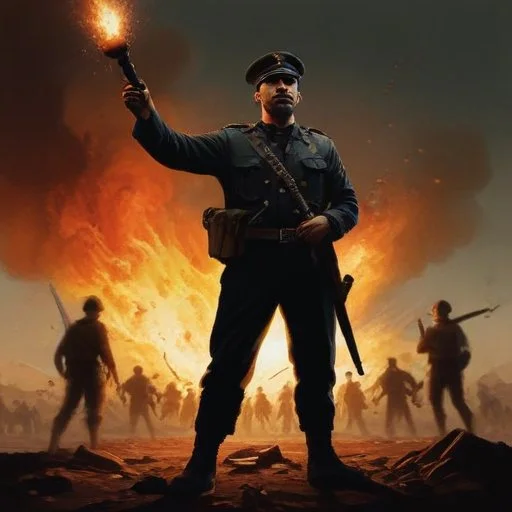
In the aftermath of the First World War, Spain was plagued by economic stagnation, social unrest, and political instability. The monarchy, restored in 1874, had struggled to maintain power amidst growing discontent among the working class, intellectuals, and regional nationalists. The election of the leftist Popular Front government in 1936, led by President Manuel Azaña, further polarized the country, as conservatives, monarchists, and fascists viewed the government as a threat to their privileges and way of life.
General Emilio Mola, a seasoned military officer, emerged as the mastermind behind the rebellion. Backed by conservative factions, he orchestrated the armed insurrection from the north. Meanwhile, General Francisco Franco, a young and ambitious officer, would eventually become the face of the Nationalist forces, aligning himself with fascist Italy and Nazi Germany. On the Republican side, President Azaña, an erudite intellectual, struggled to maintain control as the country descended into chaos.
The Spanish Civil War claimed an estimated 500,000 lives, left over a million refugees, and devastated the country's economy and infrastructure. The conflict also led to the establishment of a fascist dictatorship under General Franco, which would last until his death in 1975. The war served as a precursor to World War II, as fascist Italy and Nazi Germany tested their military strategies and ideologies on Spanish soil.
The Spanish Civil War inspired some of the most iconic works of 20th-century art and literature, including Pablo Picasso's "Guernica," George Orwell's "Homage to Catalonia," and Ernest Hemingway's "For Whom the Bell Tolls." The conflict also witnessed the emergence of revolutionary art forms, such as the posters and murals of the Republican forces, which became symbols of resistance and defiance.
Historical debates surrounding the Spanish Civil War continue to simmer, with some viewing the conflict as a struggle between democracy and fascism, while others see it as a fight between communism and Catholicism. The war's legacy remains contentious, with Spain only recently coming to terms with its traumatic past through initiatives such as the "Law of Historical Memory."
Amidst the devastation, stories of courage, solidarity, and resistance emerged, such as the bravery of the International Brigades, composed of volunteers from around the world who fought alongside the Republicans. The war also witnessed acts of humanitarian heroism, as individuals and organizations risked their lives to rescue civilians and provide aid to the displaced.
As the Spanish Civil War fades into history, its lessons and legacy continue to resonate, serving as a powerful reminder of the dangers of extremism, the importance of democratic values, and the indomitable strength of the human spirit in the face of adversity.
The Spanish Civil War was a complex and multifaceted conflict that involved various regions and groups within Spain. One of the lesser-known aspects of the war was the role of the Basque Region, an autonomous region in northern Spain. The Basque people, with their unique culture and language, played a significant role in the war, with many Basque nationalists fighting on both sides of the conflict. The region was also the site of some of the war's most brutal fighting, including the infamous bombing of the town of Guernica.
The war in the Basque Region was marked by intense fighting and brutal repression. The Nationalist forces, led by General Franco, sought to crush the Basque nationalist movement, which they saw as a threat to Spanish unity. The Basque people, on the other hand, saw the war as an opportunity to assert their independence and autonomy. The conflict in the region was marked by atrocities committed by both sides, including the massacre of civilians and prisoners.
General Manuel Goded Llopis: A Forgotten General
General Manuel Goded Llopis was a Spanish general who played a crucial role in the early stages of the Spanish Civil War. A conservative and a monarchist, Goded was a strong opponent of the Republican government and was one of the first generals to join the rebellion. He was appointed commander of the Nationalist forces in Catalonia, but his ineptitude and lack of strategic thinking led to a series of defeats.
Despite his failures, Goded remains an interesting figure in the history of the Spanish Civil War. A complex and enigmatic character, he was known for his arrogance and his disdain for democracy. His legacy, however, is one of defeat and failure, and he is largely forgotten in the annals of history.
The Spanish Civil War had a profound impact on the arts, inspiring some of the most iconic works of the 20th century. The war not only influenced the work of Spanish artists, writers, and intellectuals but also drew in creatives from around the world. The conflict became a rallying cry for many on the left, who saw it as a fight against fascism and oppression.
The war inspired a new generation of artists, including the Mexican muralist David Alfaro Siqueiros, who traveled to Spain to fight alongside the Republicans. Siqueiros' powerful and provocative murals, which depicted the horrors of war and the struggle for democracy, became iconic symbols of the conflict.
The Spanish Civil War had a devastating impact on the Spanish economy, which was already reeling from the effects of the Great Depression. The conflict led to a sharp decline in industrial production, a rise in inflation, and a massive increase in unemployment.
The war also led to a significant decline in Spain's agricultural sector, which had long been the backbone of the economy. The conflict disrupted trade and led to a shortage of food, which had a devastating impact on the civilian population.
The economic costs of the war were staggering, with estimates suggesting that the conflict resulted in losses of over 10 billion pesetas. The war also led to a significant increase in Spain's national debt, which would take decades to pay off.
The Spanish Civil War was a conflict that was deeply rooted in politics and ideology. The war was sparked by a military uprising against the democratically elected government of the Second Spanish Republic, which was seen as a threat to the power and privileges of the conservative elite.
The conflict was also fueled by the rise of fascist and nationalist movements in Europe, which saw Spain as a key battleground in the struggle against communism and democracy. The war was, in many ways, a proxy war between these competing ideologies, with the Nationalist forces backed by fascist Italy and Nazi Germany, and the Republican forces receiving support from the Soviet Union.