


On a fateful day in October 1993, the world witnessed a surreal scene unfolding in the heart of Moscow – tanks, armed to the teeth, besieging the Russian parliament building, while demonstrators, fueled by defiance and determination, clashed with security forces outside. This dramatic standoff would forever be etched in the annals of Russian history as the infamous "October Crisis."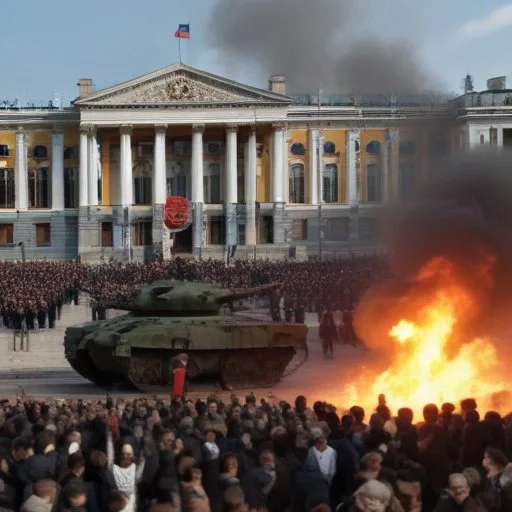
In the months leading up to the October Crisis, tensions between President Boris Yeltsin and the Russian parliament had been simmering. The parliament, led by Speaker Ruslan Khasbulatov, vehemently opposed Yeltsin's proposed constitutional reforms, which they saw as a power grab. As the stalemate deepened, both sides dug in their heels, refusing to budge.
On October 3, 1993, Yeltsin, fed up with the parliament's intransigence, ordered tanks to surround the parliament building. The move was meant to intimidate the lawmakers into submission, but it only galvanized their resolve. Defiant, the parliamentarians barricaded themselves inside, vowing to resist what they saw as a coup.
As the standoff continued, Yeltsin's patience wore thin. On October 4, he gave the order to storm the parliament building. Tanks rumbled into action, pounding the structure with cannon fire, leaving a trail of destruction and chaos in their wake. The building, once the symbol of Russian democracy, was now a smoldering, bombed-out husk.
Outside, protesters, mostly communists and nationalists, clashed with security forces. The streets of Moscow were awash with chaos, as riot police and Interior Ministry troops battled to restore order. The violence was brutal, with reports of civilian casualties and widespread property damage.
In the end, Yeltsin emerged victorious, but at a terrible cost. The parliament building lay in ruins, and the country was left reeling from the violence. The October Crisis marked a low point in Russia's post-Soviet transition, casting a long shadow over the country's fragile democracy.
The October Crisis had far-reaching consequences for Russia's political landscape. Yeltsin's victory solidified his grip on power, but at the cost of democratic legitimacy. The event marked a turning point in Russia's transition from communism, towards a more authoritarian system.
The October Crisis left an indelible mark on Russia's collective psyche. The event sparked a national dialogue on the role of power and democracy, and the limits of executive authority.
The use of force against the parliament building sparked heated debate about the limits of presidential power and the role of the military in politics. The event remains a point of contention in Russian politics, with many seeing it as a tragic example of state violence.
I recall speaking to a Moscow resident who lived through the crisis. She described the sound of tank fire and the acrid smell of smoke hanging over the city. "It was a day of shame," she said, "a day when our democracy was torn apart."
The October Crisis set a precedent for Russia's future political trajectory. It marked a shift towards a more centralized, authoritarian system, paving the way for Vladimir Putin's eventual rise to power.
The October Crisis of 1993 remains a pivotal moment in Russian history, a stark reminder of the fragility of democracy and the dangers of unchecked power. As we reflect on that fateful day, we are reminded of the importance of vigilance and the need to protect the institutions that underpin our freedoms.
The October Crisis of 1993 has been the subject of much historiographical debate, with scholars differing on its significance and implications for Russian democracy. While some have portrayed the event as a necessary evil to prevent a communist resurgence, others have seen it as a brutal suppression of democratic opposition. Recent historiographical trends have sought to contextualize the crisis within the broader framework of post-Soviet transition, highlighting the complexities and ambiguities of the period.
A key area of contention among historians has been the role of Boris Yeltsin, with some viewing him as a champion of democratic reform and others as a power-hungry leader willing to trample democratic norms. The crisis has also been seen as a turning point in the development of Russia's political institutions, with some arguing that it marked a decisive shift towards authoritarianism.
Further research is needed to fully explicate the historiographical implications of the October Crisis, yet it is clear that this pivotal event has had a profound impact on our understanding of Russian history and politics.
The October Crisis has left an indelible mark on Russian cultural consciousness, influencing artistic expression, literature, and popular media. The event has been the subject of numerous films, novels, and plays, with many creatives seeking to capture the drama and complexity of the crisis.
In the realm of music, the October Crisis has inspired a range of genres, from rock and punk to folk and classical. The event has also influenced visual art, with many artists drawing on the crisis as a symbol of resistance and defiance.
The cultural legacy of the October Crisis continues to evolve, with new generations of artists and creatives engaging with the event in innovative and thought-provoking ways.
The October Crisis had far-reaching political consequences, solidifying Boris Yeltsin's grip on power and paving the way for his eventual reelection in 1996. The event also marked a significant shift in Russia's political landscape, as the country moved away from democratic pluralism towards a more centralized, authoritarian system.
The crisis led to a crackdown on opposition parties and civil society groups, with many activists and dissidents facing persecution and harassment. The event also had significant implications for Russia's international relations, with the country's image suffering a significant blow in the eyes of the global community.
The October Crisis marked a critical juncture in Russia's political development, setting the stage for the eventual rise of Vladimir Putin and the country's current political trajectory.
Ruslan Khasbulatov, the Speaker of the Russian parliament during the October Crisis, remains a controversial figure in Russian politics. A staunch defender of democratic principles, Khasbulatov was unyielding in his opposition to Boris Yeltsin's proposed constitutional reforms, even in the face of overwhelming force.
Khasbulatov's bravery and defiance have become legendary in Russian political circles, with many seeing him as a hero of democracy. Yet, others have criticized his intransigence, arguing that it contributed to the escalation of the crisis.
Ruslan Khasbulatov's legacy continues to inspire debate and discussion, as Russians and scholars around the world seek to understand the complexities of this pivotal figure.
The October Crisis took place against a backdrop of tumultuous global politics, with the collapse of the Soviet Union and the end of the Cold War sending shockwaves around the world. The event was closely watched by international leaders, who feared the potential consequences of a failed democratic transition in Russia.
The crisis also had significant implications for international relations, as Western powers grappled with the implications of a more assertive Russia. The event marked a turning point in the development of Russian foreign policy, as the country began to reassert its influence on the global stage.
The October Crisis was a critical moment in the evolution of Russia's geopolitical position, with far-reaching consequences for international relations and global politics.