


In February 1972, United States President Richard Nixon embarked on a groundbreaking journey to Communist China, becoming the first U.S. president to set foot on Chinese soil. This unprecedented visit marked a monumental shift in Sino-American relations, paving the way for a new era of diplomacy and cooperation between the two nations.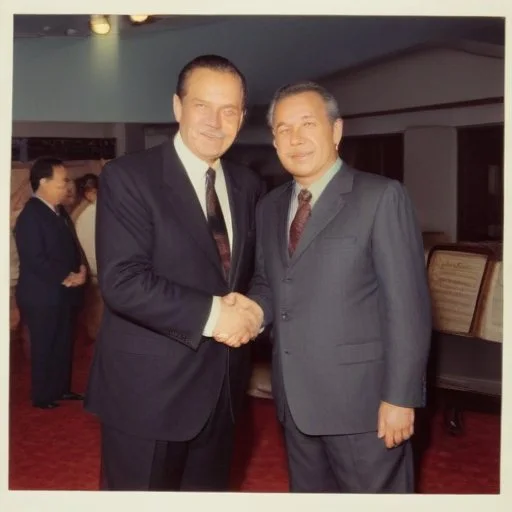
The early 1970s were marked by heightened tensions between the United States and China, fueled by decades of ideological differences and conflicting interests. The Chinese Communist Party, led by Mao Zedong, had long been viewed as a threat by the U.S. government, which had supported Taiwan as the legitimate Chinese government. However, in the late 1960s, both nations began to reassess their positions, driven by a desire to counterbalance the Soviet Union's growing influence.
Richard Nixon, the 37th President of the United States, was a seasoned diplomat with a strong anti-communist ideology. His National Security Adviser, Henry Kissinger, played a crucial role in orchestrating the secret negotiations that preceded the visit. On the Chinese side, Premier Zhou Enlai, a skilled diplomat and strategist, played a vital role in facilitating the historic encounter.
Nixon's visit to China had far-reaching consequences, both domestically and internationally. The normalization of Sino-American relations:
The Nixon visit had a profound impact on the cultural and social landscape of both nations. The "ping-pong diplomacy" initiative, which saw American and Chinese table tennis players engage in friendly matches, symbolized the thawing of relations and paved the way for increased cultural exchange. The visit also marked a turning point in American public opinion, as the Chinese people were humanized and the communist ideology was seen in a more nuanced light.
While Nixon's visit was widely hailed as a diplomatic triumph, it was not without controversy. Critics accused the president of abandoning Taiwan and legitimizing a communist regime. Additionally, the visit was dogged by concerns over human rights abuses and the suppression of political dissent in China.
In a memorable statement, Richard Nixon remarked, "This is the week that changed the world." His words captured the significance of the visit, which had far-reaching implications for global politics, international relations, and the lives of millions of people around the world.
The Nixon visit to China laid the foundation for a lasting partnership between the two nations. As the world continues to grapple with the complexities of globalization, the importance of Sino-American cooperation cannot be overstated. Today, the United States and China are engaged in a complex dance of cooperation and competition, with the 1972 visit serving as a beacon of hope for a more harmonious and prosperous world.
Zhou Enlai, the Premier of China, played a crucial role in facilitating Richard Nixon's historic visit. As a seasoned diplomat, he was instrumental in navigating the complex web of Sino-American relations.
Early Life and Career
Zhou Enlai was born in 1898 in Jiangxi, China. He studied in France and later joined the Communist Party of China, becoming one of the party's earliest members. Throughout his career, Zhou demonstrated exceptional diplomatic skills, often serving as a mediator between rival factions.
Negotiating Skills
Zhou's exceptional negotiating skills were crucial in convincing Mao Zedong to accept Nixon's overture. He employed a unique blend of charm, tact, and steely determination to navigate the intricate complexities of Sino-American relations.
In July 1971, Henry Kissinger, Nixon's National Security Adviser, embarked on a clandestine mission to Beijing, paving the way for Nixon's historic visit.
The Covert Operation
Kissinger's trip was shrouded in secrecy, with only a handful of officials aware of his true destination. He traveled under the guise of a diplomatic mission to Pakistan, using a false itinerary to avoid detection.
The Beijing Meeting
Kissinger met with Premier Zhou Enlai and other high-ranking Chinese officials, engaging in intense diplomatic negotiations that lasted for several days. These talks laid the groundwork for Nixon's visit, emphasizing the need for mutual understanding and cooperation.
The 1971 World Table Tennis Championships in Nagoya, Japan, marked a significant cultural breakthrough in Sino-American relations.
The Unlikely Ambassadors
The American table tennis team, led by players like Glenn Cowan and Connie Sweeris, became unlikely ambassadors, engaging in friendly matches with their Chinese counterparts. This symbolic gesture symbolized the thawing of relations and paved the way for increased cultural exchange.
The Symbolism of Ping-Pong
Ping-pong, a game often associated with recreation and entertainment, became a powerful symbol of diplomacy and cultural understanding. The friendly matches humanized the Chinese people, dispelling stereotypes and misconceptions that had long plagued Sino-American relations.
Nixon's historic visit to China had far-reaching economic consequences, marking a significant shift in the global economic landscape.
The Opening of China's Economy
The normalization of Sino-American relations paved the way for China's economic opening, as the country began to engage with the global economy. This led to an influx of foreign investment and the establishment of new trade relationships.
The Rise of China's Economic Power
China's economic rise, facilitated by Nixon's visit, has had profound implications for global trade and commerce. Today, China is the world's second-largest economy, playing a critical role in shaping the global economic agenda.
The early 1970s were marked by heightened tensions in the Cold War, with the Soviet Union and the United States engaged in a fierce ideological struggle for global supremacy.
The Soviet Union's Growing Influence
The Soviet Union had been making significant gains in the early 1970s, expanding its sphere of influence and posing a significant threat to American interests.
The Need for a New Strategy
In this context, Nixon's visit to China represented a bold move to counterbalance Soviet influence, marking a significant shift in American foreign policy. By engaging with China, the United States hoped to create a new strategic partnership that would offset the growing threat from the Soviet Union.