


In a dramatic turn of events that would shake the foundations of American politics, Whittaker Chambers, a former Soviet spy turned Time magazine editor, accused Alger Hiss, a respected State Department official, of being a communist and Soviet spy. The accusation, made in a private session of the House Un-American Activities Committee (HUAC), would spark a notorious case that would captivate the nation and reverberate throughout the Cold War era.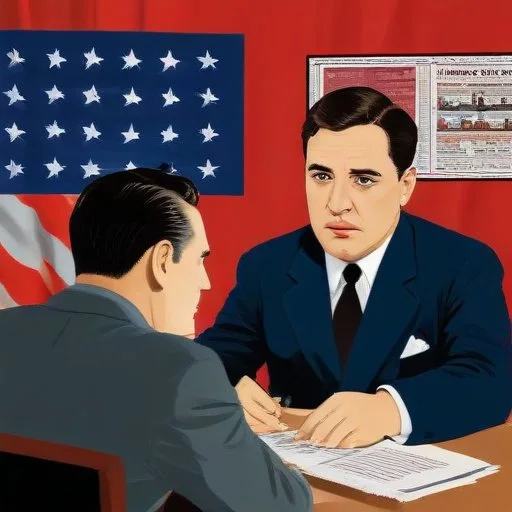
Whittaker Chambers, a complex figure with a troubled past, had once been a devout communist and Soviet spy. However, after defecting to the United States, he became a vocal anti-communist and a prominent figure in American politics. Alger Hiss, on the other hand, was a respected official in the State Department, known for his polished demeanor and impeccable credentials.
During the HUAC hearing, Chambers produced a treasure trove of incriminating evidence, including microfilmed documents and handwritten notes allegedly written by Hiss. The documents, later known as the "Pumpkin Papers," were found hidden in a pumpkin on Chambers' farm, and allegedly proved Hiss' involvement with the Soviet Union.
The repercussions of Chamber's accusation were swift and severe. Hiss, once a respected figure in American politics, was now shunned and reviled. The case sparked a national debate on communist infiltration in the government, and marked a turning point in the Red Scare era.
The Hiss-Chambers case had far-reaching cultural and social implications, inspiring numerous books, films, and plays. The case also sparked a national conversation on the dangers of communism and the role of government in protecting national security.
Chambers' accusation of Hiss marked a personal vendetta between the two men. According to Chambers, Hiss had once been a close friend and confidant, but had betrayed him by revealing his true identity as a Soviet spy. The accusation was seen by many as a revenge plot, rather than a genuine attempt to expose communist infiltration.
The Hiss-Chambers case set a precedent for future espionage cases, and marked a turning point in the Cold War era. The case also led to a renewed focus on national security and counter-intelligence, and inspired a new generation of anti-communist crusaders.
In conclusion, the Hiss-Chambers case remains one of the most infamous espionage cases in American history, a cautionary tale of deception, betrayal, and the dangers of communist infiltration. The case continues to fascinate and captivate, inspiring new generations of historians, writers, and filmmakers to explore the complex and intriguing world of Cold War espionage.
The Hiss-Chambers case was not an isolated incident, but rather a symptom of a larger phenomenon of communist infiltration in the United States. During the 1930s and 1940s, the Soviet Union had made significant inroads in infiltrating the US government, with spies and agents embedded in various departments. This was a time of great upheaval, with the Great Depression and World War II creating an atmosphere of uncertainty and fear.
In this context, the Hiss-Chambers case was a lightning rod for anti-communist sentiment, tapping into deep-seated anxieties about national security and loyalty. The case marked a turning point in the Red Scare era, fueling a wave of paranoia and mistrust that would persist for decades to come.

Whittaker Chambers was a complex and enigmatic figure, with a troubled past that belied his later reputation as a crusading anti-communist. Born in 1901, Chambers grew up in a family of modest means, and was drawn to communism as a young man due to its promise of social justice and equality.
However, as he rose through the ranks of the Communist Party USA, Chambers became disillusioned with the Soviet Union's brutal methods and the party's rigid ideology. After defecting to the United States, Chambers underwent a dramatic transformation, becoming a vocal critic of communism and a tireless advocate for American democracy.
The Hiss-Chambers case had a profound impact on American popular culture, inspiring a wave of films, books, and plays that explored the themes of espionage, betrayal, and loyalty. From classics like "The Manchurian Candidate" to more recent works like "The Americans," the case has continued to fascinate writers and artists, who see in it a cautionary tale about the dangers of communist infiltration.
The case also played a significant role in shaping American attitudes towards communism, fueling a wave of anti-communist sentiment that would persist for decades to come. In this sense, the Hiss-Chambers case was a cultural touchstone, symbolizing the anxieties and fears of a nation in the grip of the Cold War.

The Hiss-Chambers case marked a significant turning point in American politics, fueling a wave of anti-communist sentiment that would shape the country's political landscape for decades to come. The case was a major embarrassment for the Truman administration, which was already reeling from the fall of China to communism in 1949.
In the aftermath of the case, the Republican Party seized on the issue of communist infiltration, using it to attack Democratic administrations and push for a more aggressive anti-communist agenda. This would culminate in the rise of McCarthyism, a period of intense anti-communist paranoia and witch-hunting that would have a profound impact on American politics.
The Hiss-Chambers case was not just a domestic American affair, but also had significant implications for international relations. The case marked a major escalation in the Cold War, fueling tensions between the United States and the Soviet Union that would persist for decades to come.
In the aftermath of the case, the United States launched a series of aggressive anti-communist initiatives, including the establishment of the Central Intelligence Agency (CIA) and the passage of the McCarran Internal Security Act. This marked a significant shift in American foreign policy, as the country began to take a more aggressive stance against communism worldwide.