


The Battle of Tannenberg, fought between August 23 and 30, 1914, is renowned for being one of the most crushing defeats in Russian military history, with over 50,000 casualties and 90,000 prisoners taken by the German army. This decisive victory marked a significant turning point in the war on the Eastern Front, cementing German dominance and forcing Russia to reassess its strategy.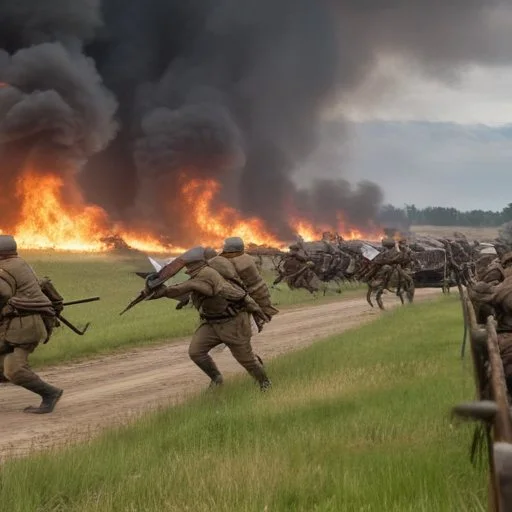
In the tumultuous summer of 1914, Europe was ablaze with nationalist fervor and military mobilization. The complex web of alliances and treaties had drawn Germany, Russia, and Austria-Hungary into a conflict that would soon engulf the continent. As war broke out, Russia, bound by treaty to defend Serbia, began a massive mobilization effort, mobilizing over 3.5 million soldiers to face off against Germany and Austria-Hungary.
The Russian Second Army, led by Samsonov, marched into East Prussia, unaware of the German trap that lay waiting. Hindenburg and Ludendorff had carefully orchestrated a plan to surround the Russian army, using their superior forces and artillery to devastating effect. The Germans successfully lured the Russians into a trap, encircling them and cutting off their escape routes. The Russian army, caught off guard, was decimated by German artillery fire, leading to a rout of epic proportions.
The Battle of Tannenberg serves as a testament to the importance of tactical genius, clever use of intelligence, and the devastating consequences of underestimating one's enemy. The defeat had far-reaching consequences, influencing Russia's military strategy for the remainder of the war. The battle also marked a turning point in the war on the Eastern Front, as Germany's dominance would continue to shape the conflict.
In conclusion, the Battle of Tannenberg stands as a powerful reminder of the importance of military strategy and adaptability. As we reflect on this pivotal moment in history, we are reminded of the devastating human cost of war and the enduring impact of this battle on the course of world events.
As we strive to create a more peaceful and sustainable world, we would do well to remember the lessons of Tannenberg, where military brilliance and cunning proved decisive in shaping the fate of nations.
Pavel Samsonov, the Russian Commander-in-Chief of the Second Army, was a seasoned military officer with a reputation for bravery and tactical prowess. Born in 1869, Samsonov graduated from the Russian General Staff Academy and saw action in the Russo-Japanese War. However, his lack of experience in modern warfare and overreliance on outdated tactics proved disastrous at Tannenberg.
Samsonov's failures can be attributed to his slow response to changing circumstances on the battlefield. As the German army encircled his troops, Samsonov failed to adapt, leading to catastrophic consequences. His defeat was met with widespread criticism, and he took full responsibility, eventually taking his own life on August 29, 1914.

The events leading up to and during the Battle of Tannenberg are well-documented through a series of dispatches exchanged between German and Russian commanders. These dispatches, declassified in the 1920s, provide a unique insight into the minds of the military leaders involved.
One notable example is the dispatch sent by Paul von Hindenburg to Erich Ludendorff on August 24, 1914, in which he outlines the plan to encircle the Russian Second Army. The document showcases the meticulous planning and strategic thinking that defined the German approach at Tannenberg.
These primary sources offer a fascinating glimpse into the decision-making processes that shaped the course of the battle.Historians have long debated the intricacies of the Russian defeat at Tannenberg. Some attribute the loss to the incompetence of Russian commanders, while others argue that the German army's superior training and tactics were the decisive factors.
More recent scholarship has shifted the focus to the role of intelligence gathering and deception in the battle. The German army's use of radio intercepts and double agents to mislead the Russians about their troop movements is seen as a key component of their victory.
By examining the various historiographical perspectives on Tannenberg, we gain a deeper understanding of the complex interplay of factors that contributed to the Russian defeat.
The Battle of Tannenberg took place against the backdrop of a complex web of alliances and nationalist tensions. The Schlieffen Plan, devised by German strategists, aimed to quickly defeat France and then turn attention to Russia.
Russia, bound by treaty to defend Serbia, found itself drawn into a conflict that would soon engulf the continent. The Russian Empire's vast territory and resources made it a formidable opponent, but its military was hampered by outdated tactics and poor communication.
The interplay between national interests, military strategy, and geography set the stage for the devastating defeat at Tannenberg.The Battle of Tannenberg had far-reaching economic consequences for Russia. The loss of a large portion of its military forces and the subsequent withdrawal from East Prussia led to a significant shift in the balance of power on the Eastern Front.
Russia was forced to divert resources away from the Western Front, weakening its ability to respond to German and Austrian aggression. The resulting economic burden contributed to widespread discontent and ultimately, the fall of the Romanov dynasty.
The financial strain of the war effort, exacerbated by the defeat at Tannenberg, had a lasting impact on Russia's economy and its people.