


The Ludendorff Bridge, a strategic passage over the Rhine River in Remagen, Germany, will forever be etched in history as the site of a daring Allied victory during World War II. This pivotal event, which unfolded on March 7, 1945, marked the first time Allied forces had crossed the Rhine, signaling a major turning point in the war's favor.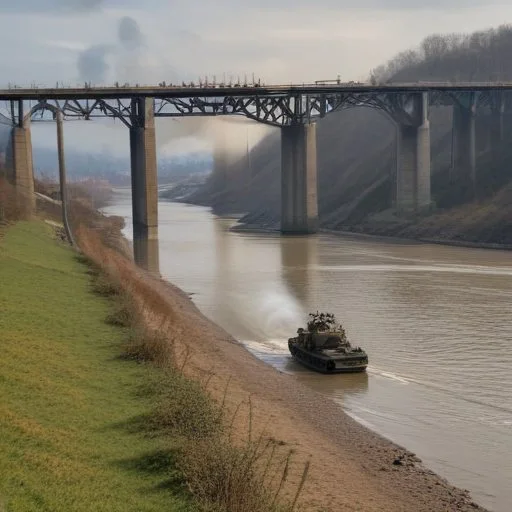
Lt. Karl H. Timmermann, a young American officer, led the charge across the Rhine, defying German forces who were caught off guard by the unexpected push. As the Allies poured onto the eastern bank, the Ludendorff Bridge became a vital lifeline, facilitating the transport of troops, supplies, and equipment into the heart of Germany.
The Ludendorff Bridge, named after the renowned German general Erich Ludendorff, was a testament to German engineering, spanning over 1,000 feet across the Rhine. Built in 1916, the bridge was designed to withstand massive weights, making it an ideal target for Allied forces seeking to breach the German defenses.
On March 7, 1945, the 1st US Army's 27th Armored Infantry Battalion, spearheaded by Lt. Timmermann, advanced on Remagen, intent on capturing the Ludendorff Bridge. Despite being heavily outnumbered, the Americans exploited a brief window of opportunity, as German forces were temporarily distracted by a massive Allied air raid on Cologne.
As the Americans approached the bridge, a frantic race against time ensued. German engineers, realizing their mistake, frantically attempted to demolish the bridge, but their efforts were hindered by the Allies' swift advance. Miraculously, the bridge remained intact, allowing the Americans to secure a vital foothold on the eastern bank.
The capture of the Ludendorff Bridge dealt a severe blow to German morale, as it opened up a direct route into the heart of Germany. Over the following weeks, Allied forces poured across the Rhine, paving the way for the eventual defeat of Nazi Germany. The Remagen bridgehead, as it came to be known, played a crucial role in the war's final push, ultimately contributing to the Allied victory in Europe.
"We were told to take the bridge, and we did. It was a wild, chaotic scene, but we managed to hold on." - Lt. Karl H. Timmermann, 1st US Army
"The Remagen bridgehead was the key to unlocking the German defenses. It was a masterstroke, and we were all proud to be a part of it." - Gen. Omar Bradley, 12th US Army Group
The Ludendorff Bridge, once a symbol of German strength, became a testament to the bravery and determination of Allied forces. Today, the bridge stands as a monument to the turning point in World War II, a reminder of the sacrifices made by those who fought for freedom and democracy.
The capture of the Ludendorff Bridge at Remagen stands as a shining example of bravery, stealth, and strategic genius. As the world marks the anniversary of this pivotal event, we remember the sacrifices made by those who fought for our freedom, and honor the legacy of the Ludendorff Bridge.
The Ludendorff Bridge was not the only Rhine River crossing attempted by the Allies during World War II. In fact, several other bridges were targeted, including the Wesel Bridge, which was captured by British forces in March 1945. However, the Remagen crossing was the most significant, as it provided a direct route into the heart of Germany. The Americans' surprise capture of the bridge caught the Germans off guard, and it took them several days to regroup and launch a counterattack.
The Allies' success at Remagen was also facilitated by the Germans' decision to divert troops to the Eastern Front, leaving their Western Front defenses weakened. This strategic blunder allowed the Allies to capitalize on the unexpected opportunity presented by the undemolished Ludendorff Bridge.

Lt. Karl H. Timmermann, the young American officer who led the charge across the Rhine, was a decorated war hero. Born in 1922, Timmermann grew up in a military family and was commissioned as an officer in 1942. During the war, he saw action in several key battles, including the Battle of the Bulge.
Timmermann's bravery and leadership during the Remagen crossing earned him the Distinguished Service Cross, the second-highest award for valor in action against an enemy of the United States. After the war, he continued to serve in the military, eventually retiring as a colonel.
The capture of the Ludendorff Bridge is often compared to another pivotal event in World War II: the D-Day invasion of Normandy. While both operations were crucial to the Allied victory, they were executed in different ways. The D-Day invasion was a meticulously planned and heavily supported assault, whereas the Remagen crossing was a more opportunistic and improvisational effort.
Despite these differences, both operations demonstrate the ingenuity and adaptability of Allied forces during World War II. They also highlight the importance of seizing unexpected opportunities and exploiting enemy weaknesses in order to gain a strategic advantage.
The Remagen crossing had significant geopolitical implications, as it marked the beginning of the end of Germany's control over Western Europe. The sudden collapse of the Rhine River defenses opened the door to a rapid Allied advance into the heart of Germany.
The capture of the Ludendorff Bridge also sent a powerful signal to the Soviet Union, which was advancing on Germany from the East. The Allies' quick victory at Remagen helped to coordination efforts with the Soviets, paving the way for the eventual defeat of Nazi Germany.
The Ludendorff Bridge was an engineering marvel, with a complex system of girders and piers that allowed it to span over 1,000 feet across the Rhine. The bridge's design was influenced by the work of German engineer Gustav Eiffel, who designed the famous Eiffel Tower in Paris.
Today, several artifacts from the Ludendorff Bridge are on display at the U.S. Army Center of Military History in Fort Lesley J. McNair, Washington, D.C. These include a section of the bridge's guardrail, a German demolition charge, and a U.S. Army engineer's diary from the Remagen crossing.