


June 5, 1940: The German army launches Operation Fall Rot, marking the resumption of their offensive against the French forces along the Somme River.
June 6-8, 1940: German forces break through the French lines, forcing the French to retreat towards the south.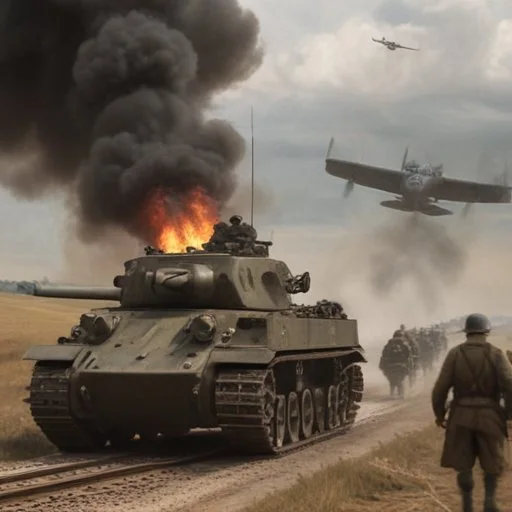
June 10-14, 1940: The German army continues its rapid advance, capturing key cities and towns, including Rouen and Le Havre.
June 17, 1940: The French government requests an armistice, marking the effective end of French resistance.
"Fate has brought us together, and it is for us to decide whether we shall emerge from this struggle as victors or as vanquished." - General Heinz Guderian, June 1940

Operation Fall Rot marked a significant shift in the balance of power in Europe, marking the beginning of a new era of German dominance.
General Heinz Guderian was a German general during World War II, best known for his role in developing the Blitzkrieg tactic that proved decisive in the Battle of France. Born on June 17, 1888, in Kulm, West Prussia, Guderian came from a military family and was commissioned into the German army in 1907.
Guderian's early military career was marked by rapid promotions, and he became a strong advocate for the use of armored warfare. He was appointed as the Chief of Staff of the XVI Army Corps in 1938, where he began to develop his ideas on Blitzkrieg.
Guderian's military strategy was based on rapid mobility and decisive action, which proved highly effective in the Battle of France. His leadership and tactical genius played a crucial role in the German army's rapid advance, and he was hailed as a hero in Germany.

The origins of Operation Fall Rot can be traced back to the German army's failure to capture the city of Dunkirk in May 1940. Despite being vastly outnumbered, the British Expeditionary Force (BEF) managed to evacuate over 338,000 troops from the beaches of Dunkirk, leaving the French army to face the German onslaught alone.
The German high command, realizing that the French army was on the brink of collapse, devised a new plan to deliver a crushing blow to the remaining French forces. Operation Fall Rot was born, with the objective of encircling and destroying the French army south of the Somme River.
The operation was a masterpiece of military strategy, with the German army using its formidable panzer divisions to break through the French lines and encircle the enemy. The French, exhausted and demoralized, were unable to withstand the onslaught, and the operation marked the beginning of the end of France's resistance.
Operation Fall Rot had a profound impact on French culture and society. The defeat marked a period of national shame and humiliation, which would take decades to overcome. The occupation also led to widespread collaboration and resistance, resulting in a complex and often divisive historical legacy.
The French people were forced to come to terms with their defeat, and the occupied zones became a hub of artistic and cultural resistance. Writers, artists, and intellectuals used their work as a form of protest against the Nazi regime, creating a rich cultural landscape that would influence French society for generations to come.
The operation also had a profound impact on the French identity, with many intellectuals and artists questioning the very essence of Frenchness. The defeat led to a period of introspection and soul-searching, as the French people struggled to come to terms with their new reality.

Operation Fall Rot took place against the backdrop of a rapidly changing European geopolitical landscape. The German invasion of Poland in September 1939 had marked the beginning of World War II, and the subsequent Battle of France had left the continent in a state of flux.
The fall of France marked a significant shift in the balance of power in Europe, with Germany emerging as the dominant military power. The operation also marked a turning point in the war, with the German army turning its attention to the Soviet Union and the subsequent battles on the Eastern Front.
The operation had far-reaching implications for the global balance of power, with the Axis powers gaining a significant advantage over the Allied forces. The fall of France also marked a significant blow to British morale, forcing the country to re-evaluate its military strategy and seek new alliances to counter the German threat.
Operation Fall Rot was not just a military operation, but also a complex political maneuver that involved delicate diplomacy and strategic decision-making. The German high command, led by Adolf Hitler, was determined to crush the French army and secure a decisive victory.
The operation was also influenced by the complex web of alliances and rivalries that existed in Europe at the time. The German army's rapid advance was facilitated by the Molotov-Ribbentrop Pact, a non-aggression treaty between Germany and the Soviet Union that allowed the German army to focus its attention on Western Europe.
The operation also marked a significant shift in the French political landscape, with the defeat leading to the collapse of the Third Republic and the establishment of the Vichy government. The new government, led by Marshal Philippe Pétain, was forced to collaborate with the Nazi regime, leading to widespread resistance and protest across France.