


The world held its breath as the clock struck midnight on May 8, 1945, marking the momentous occasion when the German Instrument of Surrender, signed at Berlin-Karlshorst, came into effect. This historic event signaled the long-awaited end of World War II in Europe, bringing an end to six years of devastating conflict that had ravaged the continent.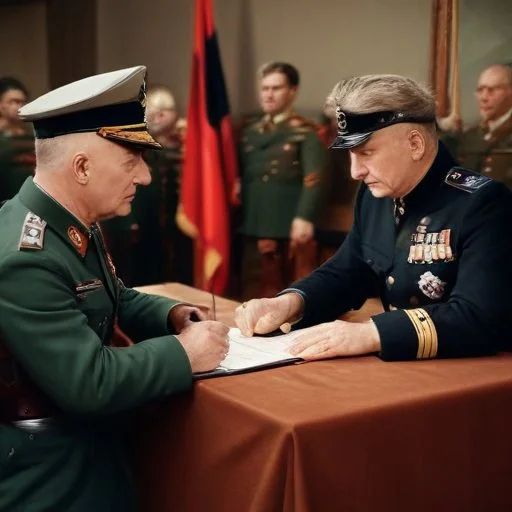
The road to this surrender was paved with the blood, sweat, and tears of millions. The German forces, once seemingly invincible, had been worn down by the relentless pressure of the Allied forces. The Soviet Union's advance on Berlin, coupled with the Western Allies' push into Germany, had finally brought the Nazi regime to its knees.
The Instrument of Surrender was signed by a trio of high-ranking German officials: Colonel-General Hans-Jürgen Stumpff, Admiral Friedeburg, and Field Marshal Wilhelm Keitel. On the Soviet side, the imposing figure of Marshal Georgy Zhukov oversaw the proceedings, his presence a testament to the Soviet Union's pivotal role in the Allied victory.
The surrender paved the way for Allied forces to occupy Germany, and the world breathed a collective sigh of relief as the devastating conflict finally came to a close. The consequences of the war were far-reaching, with millions left to pick up the pieces and rebuild their shattered lives. The Allied powers would go on to reshape the global landscape, establishing the United Nations and laying the groundwork for the Cold War.
The German Instrument of Surrender at Berlin-Karlshorst serves as a poignant reminder of the devastating consequences of war and the importance of diplomatic efforts to prevent such conflicts. The surrender marked a turning point in world history, setting the stage for the European recovery and the rise of new global powers.
"The German people have been deceived, have been lied to, have been betrayed. They have been led into this catastrophe by their former rulers."
– Dwight D. Eisenhower, Supreme Allied Commander of the Allied Expeditionary Force
The German Instrument of Surrender at Berlin-Karlshorst serves as a powerful symbol of the Allied victory and a testament to the enduring spirit of those who fought against tyranny. As we reflect on this pivotal moment in history, we are reminded of the importance of diplomacy, cooperation, and the unwavering commitment to protecting human life and dignity.
The German Instrument of Surrender was a culmination of months of intense diplomacy and military pressure. As early as January 1945, the Allies had begun to sense that the German war machine was on the verge of collapse. The Soviet Union's advance on the Eastern Front had been relentless, and the Western Allies' push into Germany had finally brought the Nazi regime to its knees. The surrender was a testament to the Allied forces' unwavering commitment to defeating the Axis powers.
The actual signing of the instrument of surrender was a somber affair, with the Soviet and German delegations gathered in a former German army engineering school in Berlin-Karlshorst. The atmosphere was tense, with the weight of history hanging heavy in the air. The German delegation, led by Field Marshal Wilhelm Keitel, was aware that they were not only surrendering their military forces but also acknowledging the defeat of the Nazi ideology.
The surrender marked a turning point in world history, paving the way for the Allied occupation of Germany and the eventual division of Europe into Eastern and Western blocs. It also set the stage for the Nuremberg trials, where top Nazi officials would be held accountable for their crimes against humanity.
Field Marshal Wilhelm Keitel was a career military officer who had risen through the ranks of the German army during the interwar period. A loyal Nazi, Keitel had played a key role in the planning and execution of the German war effort. Despite his unwavering commitment to the Nazi regime, Keitel was a pragmatic military leader who recognized the futility of continuing to fight against the overwhelming might of the Allied forces.
As the chief of the German High Command, Keitel had been responsible for coordinating the German military's response to the Allied advance. However, as the war turned against Germany, Keitel found himself increasingly at odds with Adolf Hitler, who refused to accept the reality of the situation. Keitel's decision to sign the instrument of surrender was a rebellious act, one that acknowledged the defeat of the Nazi regime and paved the way for the Allied occupation of Germany.
The German Instrument of Surrender had a profound impact on popular culture, symbolizing the end of the war in Europe and the beginning of a new era. The surrender was marked by jubilant celebrations across the Allied nations, with people taking to the streets to rejoice at the news.
The surrender also had a significant impact on the arts, with many artists, writers, and musicians responding to the news with works that reflected the mood of the time. From the iconic "V-E Day" photograph of a sailor kissing a nurse in Times Square to the poetry of WH Auden, the German Instrument of Surrender became a powerful symbol of hope and renewal.
The German Instrument of Surrender marked the beginning of a new economic era in Europe. The war had left Germany in ruins, with its infrastructure and economy devastated by the conflict. The Allied occupation of Germany led to a massive influx of aid and investment, which helped to stimulate economic growth and reconstruction.
The surrender also paved the way for the Marshall Plan, a massive American aid program that helped to rebuild war-torn Europe. The plan's impact was far-reaching, helping to stabilize the European economy and lay the foundations for the post-war economic boom.
The German Instrument of Surrender was a geopolitical watershed, marking the emergence of the Soviet Union as a superpower and the beginning of the Cold War. The surrender reflected the changing balance of power in Europe, with the Soviet Union now dominant on the continent.
The surrender also highlighted the deepening divisions between the Western Allies and the Soviet Union. As the Allies began to occupy Germany, it became increasingly clear that the two sides had fundamentally different visions for the post-war world. The German Instrument of Surrender marked the beginning of a new era of East-West rivalry, one that would shape global politics for decades to come.