


The Wannsee Conference, held on January 20, 1942, is infamous for being the meeting where senior Nazi German officials concocted the deadly plan to exterminate six million Jews during World War II. This conference, led by Reinhard Heydrich, transformed the Nazi's anti-Semitic rhetoric into a systematic and brutal reality, paving the way for the genocide of the Holocaust.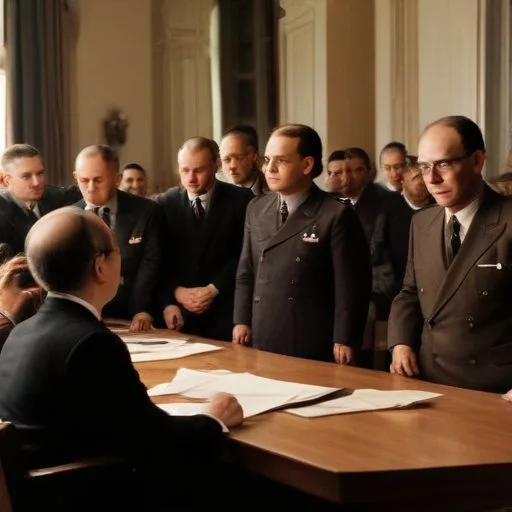
In the aftermath of World War I, Germany was in a state of political and economic turmoil. The Nazi Party, led by Adolf Hitler, capitalized on the nation's discontent and rose to power in the 1930s. As the Nazi regime consolidated its control, anti-Semitism became a cornerstone of their ideology. The Wannsee Conference was the culmination of years of escalating violence and discrimination against Jews, which ultimately led to the implementation of the Final Solution.
December 1941: Heydrich sends out invitations to the Wannsee Conference, initially scheduled for December 9.
January 20, 1942: The conference takes place at the Wannsee Villa in Berlin, with Heydrich presenting the plan for the Final Solution.
1942-1945: The systematic extermination of Jews and other minority groups accelerates, resulting in the deaths of six million Jews and millions of others deemed undesirable by the Nazi regime.
The Wannsee Conference marked a pivotal moment in human history, as it formalized the Nazi's intention to commit genocide on an industrial scale. The outcome of the conference was the creation of a network of concentration camps, extermination camps, and other facilities designed to facilitate the mass murder of Jews and other minority groups.
The Wannsee Conference had a profound impact on Western society, serving as a stark reminder of the dangers of unchecked nationalism, racism, and xenophobia. The conference's horrors have been immortalized in literature, film, and art, ensuring that the lessons of the Holocaust remain etched in our collective consciousness.
The Wannsee Conference is widely regarded as one of the darkest moments in human history, and its legacy continues to evoke strong emotions and debates. The conference's explicit discussion of genocide has made it a byword for evil, and its participants have become synonymous with cruelty and hatred.
"The Final Solution to the Jewish question" - Reinhard Heydrich's chilling phrase, which encapsulated the Nazi's deadly intent.
The Wannsee Conference has been the subject of numerous personal accounts, including those from survivors, liberators, and even perpetrators. These stories serve as a poignant reminder of the human cost of the Holocaust and the importance of remembering its lessons.
The Wannsee Conference has had a lasting impact on international relations, human rights, and our collective understanding of genocide. The conference's horrors have inspired numerous international agreements, treaties, and organizations dedicated to preventing similar atrocities from occurring in the future.
The Wannsee Conference remains a haunting reminder of the dangers of unchecked power, racism, and hatred. As we reflect on this dark chapter in human history, we must recommit ourselves to promoting tolerance, understanding, and human dignity, ensuring that the horrors of the Holocaust are never forgotten or repeated.
The Wannsee Conference was preceded by a series of anti-Semitic policies and violent attacks on Jewish communities, including the Kristallnacht pogrom in 1938. This escalation of violence created an atmosphere of fear and uncertainty, which the Nazi regime exploited to justify the implementation of the Final Solution. The conference itself was a culmination of years of planning and coordination, with Heydrich and Eichmann working behind the scenes to develop a comprehensive plan for the extermination of European Jewry.
In the months leading up to the conference, the Nazi regime had already begun to implement policies aimed at relocating Jewish populations to concentration camps and ghettos. The Wannsee Conference provided a framework for accelerating and expanding these efforts, with a focus on efficiency and scale.
The meeting itself was characterized by a sense of detachment and bureaucratic detachment, with participants discussing the logistics of mass murder as if they were ordinary administrative tasks.
Reinhard Heydrich, the chief architect of the Final Solution, was a complex and enigmatic figure. Born in 1904, Heydrich was a decorated war hero and a talented musician, but he was also ruthless and calculating, with a talent for manipulation and deceit.
As the leader of the SS, Heydrich was responsible for overseeing the implementation of the Nazi's anti-Semitic policies, and he was instrumental in planning and coordinating the Wannsee Conference. Despite his pivotal role in the Holocaust, Heydrich remains a somewhat mysterious figure, with many aspects of his personal life and motivations still shrouded in mystery.
Heydrich's personal style was characterized by a blend of elegance and brutality, and he was feared and respected by his colleagues and underlings alike.The Wannsee Conference has had a profound impact on Western culture, influencing art, literature, and film in profound ways. The conference's theme of bureaucratic detachment and mass murder has been explored in films like "The Pianist" and "Schindler's List," while writers like Primo Levi and Elie Wiesel have drawn on their own experiences of the Holocaust to create powerful and enduring works of literature.
The conference has also influenced the way we think about genocide and mass violence, with the term "Wannsee Conference" becoming a byword for evil and bureaucratic detachment. In popular culture, the conference has been referenced in TV shows and films, from "The Man in the High Castle" to "The Avengers."
The conference's cultural impact extends beyond the realm of entertainment, however, with the Wannsee Conference serving as a cautionary tale about the dangers of unchecked power and racism.
The Wannsee Conference took place against a backdrop of global conflict and geopolitical instability. World War II was raging across Europe, and the Nazi regime was facing increasing pressure from the Allies. The conference was therefore partly a response to these external pressures, with the Nazi regime seeking to exploit the chaos and uncertainty of war to implement its genocidal plans.
The conference also reflects the complex and often fraught relationships between the Nazi regime and other European governments, many of which were complicit in or turned a blind eye to the persecution of Jewish communities. The conference serves as a reminder of the importance of international cooperation and diplomatic pressure in preventing human rights abuses and genocide.
The Wannsee Conference highlights the dangers of appeasement and the importance of standing up to aggression and human rights abuses, even in the face of overwhelming odds.The minutes of the Wannsee Conference, discovered in 1947, provide a chilling insight into the bureaucratic detachment and calculating logic of the Nazi regime. The document is notable for its dry, administrative language, which belies the horror and brutality of the policies being discussed.
The Wannsee Protocol, as it is known, is a remarkable historical artifact, offering a unique window into the mindset of the Nazi regime during a pivotal moment in history. The document has been extensively studied by historians and scholars, who have painstakingly reconstructed the events of the conference and the role played by individual participants.
The Wannsee Protocol serves as a powerful reminder of the importance of documentary evidence in understanding historical events, and the role that artifacts can play in shaping our understanding of the past.