


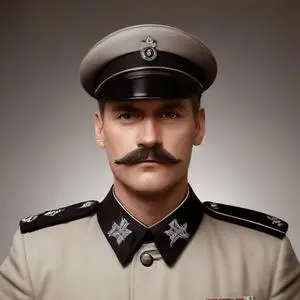
A high-ranking SS officer who oversaw the Gestapo, responsible for enforcing Nazi Germany's brutal policies and atrocities during World War II.
Heinrich Müller is best known as the ruthless chief of the Gestapo, the secret state police of Nazi Germany, responsible for the planning and execution of the Holocaust during World War II. His sinister actions earned him the nickname "Gestapo Müller", distinguishing him from another SS general with the same name.
Müller was born on April 28, 1900, in Munich, Germany, to Catholic parents. His father was a rural police official, which may have inspired Müller's interest in law enforcement. After completing his education, Müller worked as an aircraft mechanic before serving in the Luftstreitkräfte as a pilot during the last year of World War I. He was decorated several times for bravery, including the Iron Cross 1st and 2nd class.
After the war, Müller joined the Bavarian Police in 1919 as an auxiliary worker, eventually rising through the ranks to become head of the Munich Political Police Department. During this time, he developed a strong hatred for communism, which would later fuel his brutal actions against perceived enemies of the Nazi regime.
In 1933, Müller joined the SS and quickly became a trusted ally of Heinrich Himmler, the leader of the SS. Himmler appointed Müller as the chief of the Gestapo in 1939, a position that gave him immense power and control over the Nazi's secret police.
Müller's leadership of the Gestapo was marked by extreme brutality and efficiency. He was instrumental in planning and executing the "Final Solution", the Nazi's plan to exterminate six million Jews during the Holocaust. Müller attended the infamous Wannsee Conference in 1942, where the details of the genocide were formalized.
Müller's fate remains a mystery. He was last seen in the Führerbunker in Berlin on May 1, 1945, as the Soviet Army closed in on the city. Despite rumors of his capture or death, Müller's body was never found, and he remains the most senior figure of the Nazi regime who was never brought to justice.
Today, Müller's name is synonymous with the atrocities committed during the Holocaust. His ruthless efficiency and brutal methods earned him a place in history as one of the most notorious figures of the Nazi regime.
"The Jews are the incarnation of all evil."
"The Gestapo is the instrument of the Fuhrer's will."
Müller's actions during the Holocaust serve as a stark reminder of the dangers of unchecked power and extremism. His legacy serves as a warning to future generations, highlighting the importance of protecting human rights and promoting tolerance and understanding.
Born in 1889
The dictator of Nazi Germany, responsible for the genocide of six million Jews and millions of other people during World War II, and infamous for his extreme nationalist and anti-Semitic ideology.
Born in 1893
A high-ranking Nazi official, he was a decorated World War I fighter pilot and later became a prominent politician, serving as Minister President of Prussia. He's infamous for his role in the Nazi regime and war crimes trials.
Born in 1897
A mastermind of Nazi propaganda, he crafted a persuasive narrative that fueled the Third Reich's rise to power, leaving a lasting impact on the world.
Born in 1900
Leading the SS and Gestapo, he oversaw the Nazi regime's brutal security apparatus and implemented the "Final Solution," orchestrating the genocide of six million Jews during World War II.
Born in 1894
A high-ranking Nazi official who flew to Scotland on a solo mission to negotiate peace with the UK, but was instead arrested and imprisoned.
Born in 1893
A German diplomat who served as the Nazi regime's Foreign Minister, orchestrating key alliances and treaties that led to World War II. He was a close associate of Adolf Hitler and played a crucial role in shaping Nazi foreign policy.
Born in 1891
A German naval commander who led the U-boat fleet during World War II and briefly served as President of Germany after Hitler's death, known for his role in the war and its aftermath.
Born in 1876
A German naval leader who played a key role in the Kriegsmarine during World War II, overseeing the German U-boat fleet and naval operations. He was a close advisor to Adolf Hitler and implemented the German naval strategy during the war.
