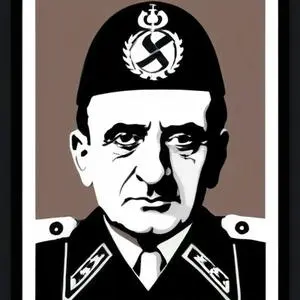
Adolf Eichmann: The Architect of the Holocaust
The Mastermind Behind the Final Solution
Adolf Eichmann is infamous for being one of the primary organizers of the Holocaust, the systematic persecution and extermination of six million Jews during World War II. He played a pivotal role in the implementation of the "Final Solution," the Nazi regime's plan to eliminate Jews from Europe.
Early Life and Career
Born on March 19, 1906, in Solingen, Germany, Eichmann grew up in a middle-class family. His early life was marked by mediocrity, and he struggled in school. After dropping out of technical college, he worked briefly for his father's mining company in Austria before becoming a traveling oil salesman in 1927. It was during this period that he developed an interest in National Socialism, eventually joining the Nazi Party and the SS in 1932.
Rise to Power
Eichmann's rise to power within the Nazi regime was rapid. He became a member of the Sicherheitsdienst (SD), the Security Service, and was appointed head of the department responsible for Jewish affairs, particularly emigration. The Nazis encouraged Jewish emigration through violence and economic pressure, and Eichmann played a crucial role in this process.
The Wannsee Conference and the Final Solution
On January 20, 1942, Eichmann participated in the Wannsee Conference, where the implementation of the Final Solution was planned. He was tasked by SS-Obergruppenführer
Reinhard Heydrich with facilitating and managing the logistics involved in the mass deportation of millions of Jews to Nazi ghettos and extermination camps across German-occupied Europe.
Escape and Captivity
After the war, Eichmann escaped and fled to Argentina, where he lived under an assumed identity. However, in May 1960, he was tracked down and apprehended by Israel's Mossad intelligence agency.
Trial and Execution
Eichmann was put on trial before the Supreme Court of Israel, where he was found guilty of crimes against humanity and the Jewish people. The highly publicized trial lasted from April 11 to December 15, 1961, and on May 31, 1962, Eichmann was executed by hanging in Ramla, Israel.
Legacy and Impact
Adolf Eichmann's role in the Holocaust remains one of the darkest chapters in human history. His crimes against humanity serve as a reminder of the dangers of prejudice, discrimination, and hatred. The Eichmann trial also had a significant impact on modern society, as it brought attention to the atrocities committed during the Holocaust and led to a greater understanding of the importance of human rights and international law.
Quotes and Memorable Sayings
- "I will jump into my grave laughing because the feeling that I have five million human beings on my conscience is for me a source of extraordinary satisfaction."
- "I was not a responsible leader, and I was not responsible for the Holocaust."
Historical Context and Legacy
Eichmann's actions were a product of the Nazi regime's ideology, which was built on a foundation of anti-Semitism and racism. The Holocaust serves as a stark reminder of the dangers of discrimination and persecution, and Eichmann's role in it serves as a warning against the horrors that can result from unchecked hatred and bigotry.
Predictions and Speculations
Many historians and scholars have speculated about what drove Eichmann to commit such atrocities. Some have argued that he was simply a bureaucratic functionary who was following orders, while others have suggested that he was driven by a deep-seated hatred for Jews. Regardless of his motivations, Eichmann's actions had devastating consequences for millions of people, and his legacy serves as a warning against the dangers of prejudice and discrimination.
FAQ
What was Adolf Eichmanns role in the Holocaust?
Adolf Eichmann was a key organizer of the Holocaust, responsible for coordinating the logistics of the mass deportation of Jews to concentration camps. He was a major figure in the Nazi regime and played a crucial role in the extermination of six million Jews during World War II.
What was the trial of Adolf Eichmann?
The trial of Adolf Eichmann was a highly publicized and historic trial that took place in Jerusalem, Israel, from 1961 to 1962. Eichmann was captured by Israeli agents in Argentina and brought to Israel to face trial for his crimes against humanity. The trial showcased the atrocities committed during the Holocaust and led to Eichmanns execution in 1962.
What were Adolf Eichmanns early life and career?
Adolf Eichmann was born in Germany in 1906 and joined the Nazi party in the 1930s. He rose through the ranks, becoming a senior officer in the SS and a key figure in the Gestapo. Eichmanns early life and career were marked by his fanatical devotion to Nazism and his anti-Semitic views.
What was Adolf Eichmanns relationship with Reinhard Heydrich?
Adolf Eichmann worked closely with Reinhard Heydrich, a senior Nazi official and one of the main architects of the Holocaust. Eichmann was responsible for implementing Heydrichs plans for the extermination of Jews, and the two men had a close professional relationship.
What was the impact of Adolf Eichmanns capture on the world?
Adolf Eichmanns capture and trial had a significant impact on the world, serving as a reminder of the atrocities committed during the Holocaust and bringing attention to the importance of justice and accountability for war crimes. The trial also led to increased awareness of the Holocaust and its significance in world history.