


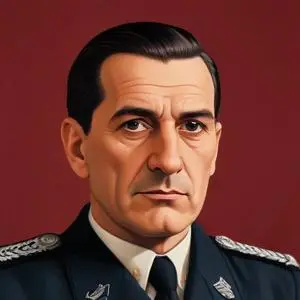
Austrian-German lawyer and general who served as the highest-ranking leader of the Nazi police forces, responsible for overseeing the Gestapo, SS, and concentration camps during World War II. He was a key figure in the Holocaust and other atrocities committed by the Nazi regime.
Ernst Kaltenbrunner, a high-ranking Austrian SS official, is infamous for his instrumental role in orchestrating the Holocaust and Nazi genocide during World War II. As the Chief of the Reich Security Main Office (RSHA) from January 1943 until the end of the war in Europe, he oversaw the coordination of security and law enforcement agencies involved in widespread extermination, suppression of resistance movements, and extensive arrests, deportations, and executions.
Born on October 4, 1903, in Ried im Innkreis, Austria, Kaltenbrunner was raised in a nationalist family and was childhood friends with Adolf Eichmann, another notorious SS officer. He obtained his PhD in law from Graz University in 1926 and worked as a lawyer in Salzburg before joining the Nazi Party in 1930 and the SS in 1931.
After the assassination of Reinhard Heydrich in 1942, Kaltenbrunner was appointed chief of the RSHA, succeeding Heydrich. This appointment marked the beginning of an era of intensified Nazi genocide under his leadership. As the highest-ranking member of the SS, he played a pivotal role in implementing the Nazis' "Final Solution" against European Jews.
Kaltenbrunner's reign of terror came to an end with the defeat of Nazi Germany. He was captured by Allied forces and put on trial at the Nuremberg trials, where he was found guilty of war crimes and crimes against humanity. On October 16, 1946, he was sentenced to death and executed by hanging.
Ernst Kaltenbrunner's legacy is one of unimaginable cruelty and brutality. His role in the Holocaust and Nazi genocide is a stark reminder of the dangers of unchecked power and xenophobia. His actions serve as a warning to future generations, highlighting the importance of promoting tolerance, understanding, and human rights.
| Personal Milestones and Key Life Events |
|---|
| 1903: Born on October 4th in Ried im Innkreis, Austria |
| 1926: Obtained PhD in law from Graz University |
| 1930: Joined the Nazi Party |
| 1931: Joined the SS |
| 1943: Appointed Chief of the RSHA |
| 1946: Executed by hanging on October 16th |
Kaltenbrunner's story serves as a cautionary tale, reminding us of the devastating consequences of hatred, prejudice, and extremism. His legacy is a testament to the importance of promoting human rights, dignity, and respect for all individuals, regardless of their race, religion, or ethnicity.
Born in 1900
Leading the SS and Gestapo, he oversaw the Nazi regime's brutal security apparatus and implemented the "Final Solution," orchestrating the genocide of six million Jews during World War II.
Born in 1906
A high-ranking Nazi officer responsible for organizing the logistics of the Holocaust, overseeing the mass deportation of Jews to concentration camps during World War II.
Born in 1904
A high-ranking Nazi official and chief architect of the Holocaust, responsible for implementing the "Final Solution" that led to the murder of six million Jews and millions of others during World War II.
Born in 1894
A high-ranking Nazi official who flew to Scotland on a solo mission to negotiate peace with the UK, but was instead arrested and imprisoned.
Born in 1893
A German diplomat who served as the Nazi regime's Foreign Minister, orchestrating key alliances and treaties that led to World War II. He was a close associate of Adolf Hitler and played a crucial role in shaping Nazi foreign policy.
Born in 1893
A high-ranking Nazi official, he was a decorated World War I fighter pilot and later became a prominent politician, serving as Minister President of Prussia. He's infamous for his role in the Nazi regime and war crimes trials.
Born in 1897
A mastermind of Nazi propaganda, he crafted a persuasive narrative that fueled the Third Reich's rise to power, leaving a lasting impact on the world.
Born in 1876
A German naval leader who played a key role in the Kriegsmarine during World War II, overseeing the German U-boat fleet and naval operations. He was a close advisor to Adolf Hitler and implemented the German naval strategy during the war.
