


On September 26, 1918, the Meuse-Argonne Offensive roared to life, marking the largest and most brutal battle fought by the United States during World War I. This 47-day campaign would prove to be the decisive blow that would shatter the German army's resolve, ultimately leading to their surrender and the end of the Great War.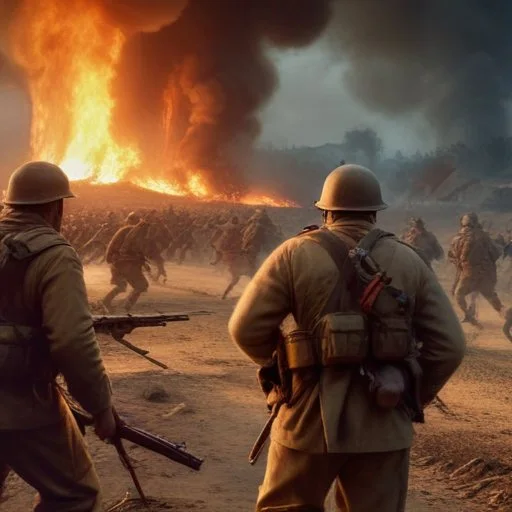
The battle took place in the rolling hills and dense forests of northeastern France, where the American Expeditionary Forces (AEF) clashed with the German army in a maelstrom of mud, blood, and artillery fire. The landscape was a nightmare, with trenches filled with stagnant water, crumbling roads, and endless fields of barbed wire. The very ground itself seemed to swallow men whole, as the rain-soaked terrain turned into a quagmire that sucked the life out of soldiers' boots.
The battle raged on for 47 days, with the AEF making slow but steady gains against the German army. The first day alone saw over 10,000 casualties, as the Americans pushed forward against entrenched German positions. As the days turned into weeks, the fighting only intensified, with both sides suffering staggering losses.
The Meuse-Argonne Offensive was one of the bloodiest battles in American history, with over 28,000 casualties, including 11,000 dead. The destruction was staggering, with entire villages reduced to rubble and the countryside scarred by the relentless pounding of artillery.
The Meuse-Argonne Offensive will always be remembered as a testament to the bravery and sacrifice of the American doughboys who fought and died in the Great War. Their determination and grit in the face of overwhelming odds paved the way for the Allied victory, and their legacy continues to inspire generations of Americans to this day.
"The soldier who complains about the mud complains about his office. The office of the soldier is the front line."
— General John J. Pershing
The Meuse-Argonne Offensive was not just a military campaign, but a logistical nightmare. The American Expeditionary Forces had to transport thousands of troops, tons of ammunition, and heavy artillery through treacherous terrain, often under the cover of darkness. The French railway system, already battered by years of war, struggled to keep up with the demand, leading to delays and shortages that threatened to derail the entire operation.
Despite these challenges, the AEF persevered, relying on innovative solutions like makeshift railways and aerial resupply missions to keep their troops supplied. The success of these efforts was a testament to the ingenuity and determination of the American military.

General Charles Summerall, a lesser-known but crucial figure in the Meuse-Argonne Offensive, played a key role in the battle's success. As commander of the V Corps, Summerall's troops were responsible for breaking through the German lines, and his tactical genius was instrumental in achieving this goal.
Summerall's leadership style was marked by his emphasis on speed and aggression, which earned him the respect and admiration of his men. His ability to adapt to changing circumstances and make quick decisions under pressure proved invaluable in the fast-paced and unpredictable environment of the battlefield.
], {CA
The devastation wrought by the Meuse-Argonne Offensive had a profound impact on the environment of northeastern France. The intense artillery bombardments and trench warfare ravaged the countryside, leaving behind a scarred and barren landscape.
The destruction of forests, fields, and villages led to widespread soil erosion, and the heavy use of chemical warfare agents contaminated the soil and waterways. The long-term effects of the battle on the ecosystem are still being felt today, with many areas remaining uninhabitable due to the residual toxicity.

Historians have long debated the significance of the Meuse-Argonne Offensive in the larger context of World War I. Some argue that the battle was a turning point in the war, marking a decisive shift in favor of the Allies, while others contend that it was merely one of several key battles that contributed to the ultimate Allied victory.
Regardless of one's interpretation, it is clear that the Meuse-Argonne Offensive was a pivotal moment in American military history, marking the emergence of the United States as a major military power and setting the stage for the country's future involvement in global conflicts.