


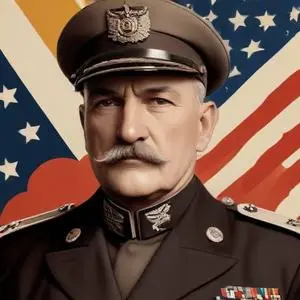
Led the American Expeditionary Forces to victory in World War I, earning the nickname "Black Jack" for his tactical prowess. He's also known for his efforts to modernize the US Army.
John J. Pershing, also known as "Black Jack," is renowned for leading the American Expeditionary Forces (AEF) to victory in World War I from 1917 to 1920. As a senior American United States Army officer, he played a crucial role in shaping the course of modern military history.
Born on September 13, 1860, in Laclede, Missouri, Pershing grew up in a modest family and worked as a teacher before enlisting in the United States Army in 1880. He attended the North Missouri Normal School and later graduated from the United States Military Academy at West Point in 1880.
Pershing's military career spanned over four decades, during which he served in various capacities, including as a commander of the 10th Cavalry Regiment, a predominantly African American unit. This experience earned him the nickname "Black Jack." He also served as a military instructor and commander of the West Point cadet corps.
In 1917, Pershing was appointed as the commander of the American Expeditionary Forces, tasked with leading American troops in World War I. He resisted British and French demands to integrate American forces with their armies, insisting that the AEF operate as a single unit under his command. This decision allowed American troops to maintain their identities and operate independently, contributing significantly to the Allied victory.
Pershing is often credited with mentoring a generation of prominent generals, including George C. Marshall, Dwight D. Eisenhower, Omar Bradley, Lesley J. McNair, George S. Patton, and Douglas MacArthur, who went on to lead the United States Army during World War II. His leadership and tactics had a lasting impact on modern military strategy.
Pershing received numerous awards and honors for his service, including the Medal of Honor, the Distinguished Service Cross, and the Army Distinguished Service Medal. He was also promoted to the rank of General of the Armies, the highest rank in the United States Army.
Pershing married Helen Frances Warren in 1902, and they had four children together. He passed away on July 15, 1948, at the age of 87, and was buried in Arlington National Cemetery.
John J. Pershing's leadership, strategic thinking, and mentorship have left an indelible mark on modern military history. His commitment to maintaining American independence and autonomy on the battlefield continues to inspire military leaders and historians alike.
As a testament to his legacy, the Pershing legacy extends beyond his military service. He is remembered as a dedicated leader, a fiercely independent thinker, and a true patriot who shaped the course of American military history.
Born in 1890
Led the Allied forces to victory in World War II and later served as President, maintaining peace and prosperity during the Cold War era. He's known for his strategic leadership and diplomatic skills.
Born in 1885
A renowned military leader who played a crucial role in World War II, particularly in the Allied victory in Europe, known for his bold tactics and unapologetic style.
Born in 1893
Led the US Army in World War II and became the last five-star general, playing a crucial role in shaping post-war American military strategy. He's also known for his humble and unassuming leadership style.
Born in 1880
A highly decorated war hero and master strategist who led troops to victory in World War I and II, and later became a prominent figure in the occupation of Japan.
Born in 1880
A highly decorated military leader and statesman who played a crucial role in shaping post-WWII foreign policy and was awarded the Nobel Peace Prize for his efforts. He's most known for authoring the Marshall Plan, a massive economic aid program that helped rebuild war-torn Europe.
Born in 1886
Led the United States Army Air Forces during World War II, playing a crucial role in the Allied victory, and later became the first General of the Air Force. He's also known as the "Father of the US Air Force".
Born in 1885
Led the U.S. Pacific Fleet to victory in World War II, playing a crucial role in defeating Japan and ending the war. He was a highly respected and decorated naval leader.
Born in 1891
A renowned World War II military strategist, known for leading the Afrika Korps and earning the respect of both allies and enemies with his tactical genius.
