


The Battle of Mont Saint-Quentin is remembered as one of the most daring and triumphant battles of World War I. On a foggy dawn in August 1918, the Australian Corps, led by the visionary Lieutenant General John Monash, unleashed a bold assault on the heavily fortified German stronghold of Mont Saint-Quentin, marking a pivotal turning point in the Hundred Days Offensive.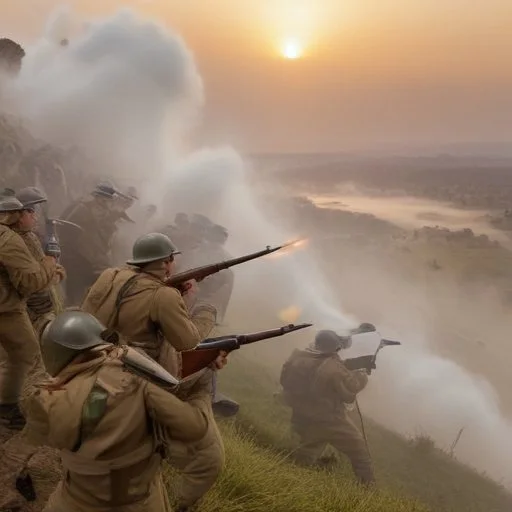
Mont Saint-Quentin, a prominent hill overlooking the French town of Péronne, had been a prized possession of the German army since 1916. The strategic location allowed the Germans to control the surrounding terrain, making it a formidable barrier to the Allied advance. The Australian Corps, determined to break through the impasse, carefully planned a dawn attack to catch the enemy off guard.
The early morning of August 31, 1918, was shrouded in a thick, impenetrable fog. The Australians, undeterred by the poor visibility, moved stealthily into position, utilizing their intimate knowledge of the terrain to navigate the treacherous landscape. As the fog began to clear, the Germans were caught off guard, their defenses breached by the Aussies' swift and decisive attack.
The Australian Corps capitalized on their initial success, rapidly expanding their gains and forcing the Germans into a disorganized retreat. The speed and ferocity of the assault stunned the enemy, who struggled to regroup and respond to the Australian onslaught. As the day wore on, the Germans were pushed further back, their hold on Mont Saint-Quentin finally broken.
The Battle of Mont Saint-Quentin was a shining testament to the bravery, initiative, and tactical prowess of the Australian Corps. Lieutenant General Monash's masterful plan, combined with the unyielding spirit of his troops, had secured a crucial victory, paving the way for the Allied advance on the Western Front.
Australian soldier, Private James Martin, recalled the battle: "We moved forward in the fog, not knowing what lay ahead. Suddenly, we saw the Germans, caught off guard, scrambling to respond. It was a moment of pure chaos, but we held our nerve and took the hill."
The Battle of Mont Saint-Quentin demonstrated the importance of innovative tactics and combined arms warfare, influencing military strategy in the decades to come. The Australian Corps' success also inspired other Allied forces, galvanizing their efforts in the final push to victory.
Lieutenant General John Monash was knighted for his services during the Battle of Mont Saint-Quentin, earning the title of Knight Commander of the Bath.
The Battle of Mont Saint-Quentin was the first time Australian troops had breached a heavily fortified German position, earning them the nickname "The Storming Force of the AIF."
Lieutenant General John Monash, a Melbourne-born engineer and lawyer, is widely regarded as one of the most innovative and successful military commanders of World War I. With a keen intellect and a passion for strategy, Monash rose through the ranks of the Australian Imperial Force (AIF) to become a respected leader and tactician.
Monash's experience in the military began in 1884, when he joined the Australian Garrison Artillery. Over the years, he gained valuable experience in combat, logistics, and leadership, eventually becoming the commander of the 4th Infantry Brigade in 1914. His impressive performance during the Gallipoli Campaign earned him a promotion to Major General, and in 1918, he took command of the Australian Corps.
Under Monash's leadership, the Australian Corps achieved a string of victories, including the Battle of Mont Saint-Quentin. His innovative tactics, combined with his ability to inspire and motivate his troops, earned him the respect and admiration of his peers and soldiers alike.

The Battle of Mont Saint-Quentin was the culmination of a series of successful Allied offensives, starting with the Battle of Amiens on August 8, 1918. As part of the Hundred Days Offensive, the Allied forces sought to break through the German defenses and push the enemy back.
The Battle of Amiens was a turning point in the war, marking the first time the Allies had successfully breached the German lines. The Australian Corps, British tanks, and Canadian infantry forces all played crucial roles in the battle, which resulted in a significant German withdrawal.
The success of Amiens set the stage for the Battle of Mont Saint-Quentin, as the Allies looked to capitalize on their momentum and push deeper into German-occupied territory. Monash's plan to assault Mont Saint-Quentin was a direct response to the German withdrawal, aiming to secure a vital strongpoint and further weaken the enemy's grip on the Western Front.
The Battle of Mont Saint-Quentin shares many parallels with the Battle of Villers-Bretonneux, fought earlier in the year on April 24-25, 1918. Both battles saw Australian forces overcome significant German defenses, securing crucial victories for the Allies.
Like Mont Saint-Quentin, Villers-Bretonneux was a demonstration of Australian military prowess, as the AIF successfully recaptured the town from German forces. The battle showcased the Australians' ability to adapt to changing circumstances, as they countered a German tank attack with innovative tactics and bravery.
While both battles were significant Allied victories, Mont Saint-Quentin marked a more decisive turning point in the war. The capture of Mont Saint-Quentin dealt a greater blow to German morale, and its strategic importance paved the way for the final push to victory.
The war diary of the Australian Corps, maintained during the Battle of Mont Saint-Quentin, provides a unique insight into the events of August 31, 1918. The diary, now housed at the Australian War Memorial, contains detailed records of the battle, including communications, intelligence reports, and situation maps.
The diary reveals the meticulous planning and preparation that went into the battle, as well as the bravery and tenacity of the Australian soldiers. It also highlights the foggy conditions, which posed a significant challenge to the attack, and the desperate German attempts to hold onto the stronghold.
One entry, recorded at 6:30 am on August 31, notes the success of the initial assault: "Enemy positions overrun, artillery and machine guns captured. Our troops consolidating and preparing to push on."
The Battle of Mont Saint-Quentin took place during a critical phase of World War I, as the Allies sought to break through the stalemate on the Western Front. The battle was part of a broader strategy to push the Germans back and create a decisive advantage before the onset of winter.
In the months leading up to Mont Saint-Quentin, the war had entered a new phase, with the introduction of fresh American troops and the consolidation of Allied forces under a unified command. The German army, meanwhile, was struggling to maintain its grip on occupied territory, as its reserves were dwindling and morale was flagging.
The capture of Mont Saint-Quentin was a significant step in the Allied drive to victory, paving the way for further advances and ultimately contributing to the Armistice on November 11, 1918.