


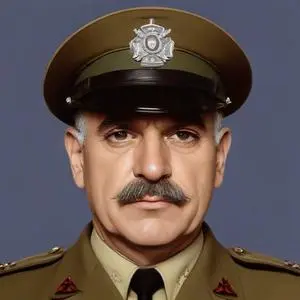
Led a corps of Australian troops to victory in World War I, and later became a prominent engineer, overseeing major infrastructure projects in Melbourne.
John Monash, a name synonymous with tactical genius and military prowess, is widely regarded as one of the most exceptional commanders of World War I. As a civil engineer turned military leader, Monash's innovative approach and unwavering dedication to his troops earned him recognition as the only general of creative originality produced by the war, according to renowned historian A. J. P. Taylor.
Born on June 27, 1865, in West Melbourne, Victoria, Australia, Monash was the first child of Louis and Bertha Monash, Jewish immigrants from Krotoschin, Prussia (now Poland). His family's relocation to Richmond, Victoria, marked the beginning of a journey that would shape his early life and future endeavors. At St. Stephen's School, Monash demonstrated exceptional academic prowess, particularly in English, and a keen interest in drawing.
Monash's military career commenced in 1884, when he joined the Melbourne University Rifles as a lieutenant. Following a series of promotions, he assumed command of the 13th Infantry Brigade in 1913. With the outbreak of World War I, Monash led the 4th Infantry Brigade in Egypt and later in the Gallipoli campaign. His remarkable leadership skills and tactical acumen propelled him to take charge of the newly formed 3rd Division in northwestern France in July 1916. In May 1918, he became the commander of the Australian Corps, the largest corps on the Western Front at the time.
Monash's military prowess is characterized by his innovative approach to warfare, which included the use of combined arms and clever utilization of terrain. His most notable achievements include the successful capture of Hamel in July 1918 and the instrumental role he played in the Battle of Amiens in August 1918, which marked a significant turning point in the war. Monash's military legacy extends beyond his combat prowess, as he was a caring and dedicated leader who prioritized the welfare of his troops.
Monash was a devoted husband to Hannah Victoria Moss and a loving father to their only child, Berthalina. He was also an avid patron of the arts, with a particular fondness for classical music and literature. Throughout his life, Monash remained committed to philanthropic causes, particularly in the realm of education, and played a significant role in the establishment of the University of Melbourne's Faculty of Engineering.
John Monash's remarkable military career, combined with his commitment to education and philanthropy, has left an indelible mark on Australian history. His legacy extends beyond the realm of warfare, inspiring generations of leaders, engineers, and individuals alike. As a testament to his enduring influence, the Royal Military College, Duntroon, has a building named in his honor, and his image appears on the Australian $100 note.
Today, John Monash's remarkable story continues to captivate and inspire, a powerful reminder of the transformative power of visionary leadership, strategic thinking, and unwavering dedication.
Born in 1862
The 5th Prime Minister of Australia, a key figure in the country's early 20th-century politics, known for his role in shaping Australia's social and economic landscape. He played a crucial part in establishing the country's old-age pension and maternity allowance systems.
Born in 1862
A carpenter-turned-politician who served as Australia's 7th Prime Minister, known for his strong leadership during World War I and his role in shaping the country's post-war development.
Born in 1860
The 6th Prime Minister of Australia, a key figure in the country's early 20th-century politics, known for his role in shaping Australia's economy and foreign policy. He played a crucial part in Australia's transition from a British colony to an independent nation.
Born in 1870
Australian carpenter and politician who served as a Senator and Minister in the Australian government, known for his role in shaping the country's labor laws and industrial relations.
Born in 1871
Prolific writer of historical novels and adventure stories, also a talented landscape painter.
Born in 1894
The 12th Prime Minister of Australia, a lawyer-turned-politician who played a crucial role in shaping the country's post-war economy and foreign policy, and is often credited with establishing the modern Australian identity.
Born in 1905
A renowned Australian historian, poet, and politician who served as the 17th Governor-General of Australia, known for his literary works and contributions to the country's cultural heritage.
Born in 1908
The 17th Prime Minister of Australia, a lawyer-turned-politician who mysteriously disappeared while swimming, leaving behind a legacy of economic reform and a nation's unanswered questions.
