


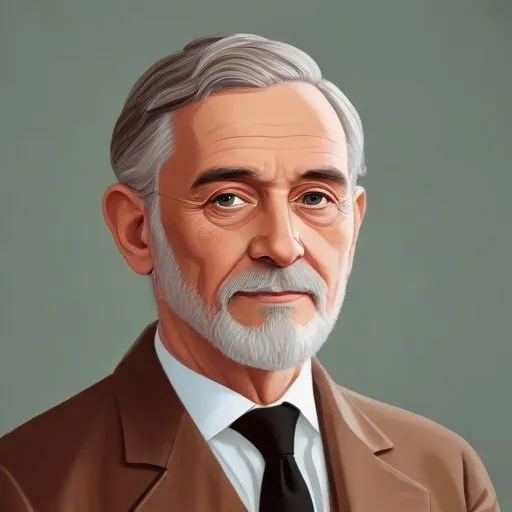
Discovered the freshwater polyp, a small, carnivorous animal that can regenerate lost body parts, and made significant contributions to the field of zoology.
Abraham Trembley was a Swiss naturalist renowned for being the first to study freshwater polyps, also known as hydra, and for developing experimental zoology. His groundbreaking work in the field of biology earned him the title "Father of Biology," and his contributions continue to inspire scientists to this day.
Born on September 3, 1710, in Geneva, Republic of Geneva, Trembley came from an officer's family. His uncle, Charles Bonnet, was a prominent scientist who regularly corresponded with Trembley, exchanging ideas and discussing scientific discoveries.
Trembley's most significant discovery was made while he was tutoring two young boys, the children of Count Willem Bentinck van Rhoon, at the Count's summer residence in Sorgvliet, near The Hague. During lessons, Trembley would often take the boys fishing in the ponds outside the house. It was during one of these fishing trips that he stumbled upon the regenerative powers of the hydra.
Trembley's findings on hydra were published in his groundbreaking book, Mémoires pour servir à l'histoire d'un genre de polypes d'eau douce, in 1744. The book included engraved drawings of his experiments, made by Cornelis Pronk. Although Trembley thought he had discovered a new species, it was later revealed that Antonie van Leeuwenhoek had already published on hydra in 1702, describing them as a type of animalculum.
Trembley's work on hydra led to a deeper understanding of the natural world and the development of experimental zoology. His mastery of the experimental method earned him recognition as one of the founders of modern biology. His discoveries also paved the way for future scientists to explore the wonders of the natural world.
Abraham Trembley's legacy extends far beyond his own lifetime. He inspired a new generation of scientists, including his nephew, Charles Bonnet, and René-Antoine Ferchault de Réaumur. His work on hydra and experimental zoology laid the foundation for modern biology, and his contributions continue to influence scientists today.
Trembley was known to be a devout Christian and wrote on religion and morals. He maintained a strong connection with his family, particularly his uncle, Charles Bonnet, with whom he exchanged letters discussing their shared passion for science.
Trembley's contributions to science were recognized during his lifetime, and he was elected a member of the Royal Society in 1743. His work continues to be celebrated, and he is remembered as one of the most influential scientists of the 18th century.
"The smallest natural history trifles are capable of giving rise to the greatest philosophical truths." - Abraham Trembley
Abraham Trembley's remarkable story is a testament to the power of curiosity and innovation. His groundbreaking work in experimental zoology and biology continues to inspire scientists, and his legacy serves as a reminder of the importance of exploration and discovery.
Born in 1809
Developed the theory of evolution through natural selection, revolutionizing our understanding of life on Earth. This groundbreaking idea transformed the fields of biology, ecology, and beyond.
Born in 1743
Father of modern chemistry, discovered oxygen, and developed a systematic method of chemical nomenclature. He laid the foundation for modern chemistry and paved the way for future scientific discoveries.
Born in 1749
Developed nebular hypothesis of the origin of the solar system and formulated Laplace's equation, a fundamental concept in mathematics and physics. He's considered the founder of celestial mechanics.
Born in 1769
Founded the field of comparative anatomy, establishing extinction as a fact and creating a framework for understanding the natural world through fossil records.
Born in 1744
A French soldier, biologist, and academic who developed a theory of inheritance of acquired characteristics, proposing that organisms adapt to their environment and pass on those traits to their offspring.
Born in 1775
A pioneer in the field of electromagnetism, he formulated fundamental laws that describe the relationship between electric currents and magnetic fields. His work laid the foundation for many modern technologies, including electric motors and generators.
Born in 1786
A mathematician and politician who made significant contributions to the development of electromagnetism and served as Prime Minister of France, advocating for social reform and education.
