


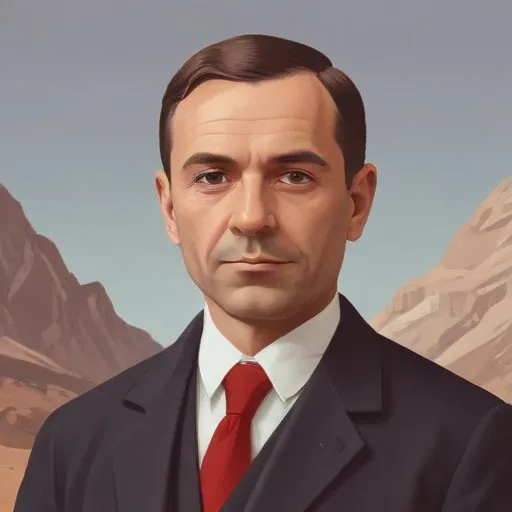
French geologist and mineralogist who pioneered the field of petrography, studying the composition and structure of rocks, and developed a method for determining the proportion of minerals in rocks.
Achille Ernest Oscar Joseph Delesse was a renowned French geologist and mineralogist, best known for his groundbreaking work on the classification of rocks and his discovery of the mineral delesite, which was named after him. Throughout his career, Delesse made significant contributions to the field of geology, shedding light on the mysteries of the Earth's crust and paving the way for future generations of geologists.
Delesse was born on February 3, 1817, in Metz, France. He developed an early interest in natural sciences, particularly geology, which led him to pursue higher education in the field. He studied at the École Polytechnique in Paris, where he earned his degree in 1837.
Delesse's most notable contribution to geology was his development of a new classification system for rocks, which he presented in his seminal work, Recherches sur l'origine des roches (1847). This system, known as the Delesse classification, categorized rocks based on their mineral composition and texture, revolutionizing the field of geology. He also discovered the mineral delesite, a rare mineral found in France and Spain.
Delesse's work was guided by his firm belief in the importance of field observations and empirical evidence in scientific research. He emphasized the need for geologists to study rocks in their natural environment, rather than relying solely on laboratory analysis. This approach earned him the respect of his peers and helped establish him as a leading authority in the field.
Delesse received numerous accolades for his contributions to geology. He was elected as a member of the French Academy of Sciences in 1854 and was later awarded the prestigious Cuvier Prize in 1857. In addition, he served as the president of the Geological Society of France from 1861 to 1863.
Delesse married Marie-Louise Sarda in 1845, and the couple had three children together. He passed away on March 24, 1881, in Paris, leaving behind a legacy that continues to inspire geologists and scientists to this day.
Delesse's work has had a lasting impact on the field of geology, influencing generations of scientists and researchers. His classification system remains an essential tool in the study of rocks and minerals, and his emphasis on field observations has shaped the way scientists approach scientific research. His legacy serves as a testament to the importance of rigorous scientific inquiry and the power of human curiosity to uncover the secrets of the natural world.
Born in 1744
A French soldier, biologist, and academic who developed a theory of inheritance of acquired characteristics, proposing that organisms adapt to their environment and pass on those traits to their offspring.
Born in 1769
Founded the field of comparative anatomy, establishing extinction as a fact and creating a framework for understanding the natural world through fossil records.
Born in 1775
A pioneer in the field of electromagnetism, he formulated fundamental laws that describe the relationship between electric currents and magnetic fields. His work laid the foundation for many modern technologies, including electric motors and generators.
Born in 1749
Developed nebular hypothesis of the origin of the solar system and formulated Laplace's equation, a fundamental concept in mathematics and physics. He's considered the founder of celestial mechanics.
Born in 1786
A mathematician and politician who made significant contributions to the development of electromagnetism and served as Prime Minister of France, advocating for social reform and education.
Born in 1774
A French polymath who made significant contributions to the fields of physics, astronomy, and mathematics, particularly in the discovery of chromatic polarization and the Biot-Savart law.
Born in 1822
Developed vaccines for rabies and anthrax, and pioneered the germ theory of disease, revolutionizing our understanding of microbiology and disease prevention.
Born in 1852
Discovered radioactivity, a fundamental property of atoms, and pioneered research in the field, leading to breakthroughs in medicine, energy, and materials science.
