


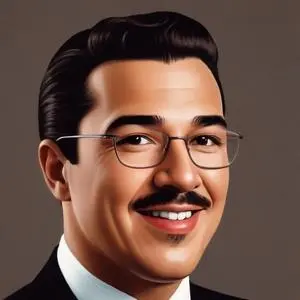
A prominent civil rights leader and congressman who fought for racial equality and social justice, known for his charismatic oratory skills and advocacy for African American rights.
Adam Clayton Powell Jr. was a trailblazing African American Baptist pastor and politician who left an indelible mark on the American political landscape. As the first African American to be elected to Congress from New York, and the first from any state in the Northeast, Powell's legacy is synonymous with unwavering advocacy for civil rights and social justice.
Born on November 29, 1908, in New Haven, Connecticut, Powell was the second child and only son of Adam Clayton Powell Sr. and Mattie Buster Shaffer. His parents, of mixed African, European, and American Indian ancestry, instilled in him a strong sense of social responsibility and justice. Powell's early life was marked by a strong connection to the church, with his father serving as a prominent Baptist minister. He went on to attend Colgate University, where he graduated in 1930, and later earned his master's degree from Columbia University in 1932.
Powell's entry into politics was marked by his election as a member of the New York City Council in 1941. However, it was his election to the United States House of Representatives in 1944 that catapulted him to national prominence. As the first African American to represent Harlem, Powell became a powerful voice for the community, championing causes such as desegregation, fair employment practices, and voting rights.
In 1961, Powell became the chairman of the Education and Labor Committee, the most powerful position held by an African American in Congress at the time. During his tenure, he played a crucial role in the passage of landmark legislation, including the Civil Rights Act of 1964 and the Voting Rights Act of 1965. Powell's leadership also led to significant advancements in education, labor, and healthcare policy.
Despite his many achievements, Powell's career was not without controversy. In 1967, he was accused of corruption and excluded from his seat by the Democratic Party. However, in 1969, the Supreme Court ruled in his favor, and he was reinstated. Powell's unyielding commitment to his constituents and his refusal to back down in the face of adversity earned him a reputation as a champion of the people.
Adam Clayton Powell Jr.'s legacy extends far beyond his electoral victories and legislative achievements. He was a true champion of the marginalized, and his unwavering advocacy for civil rights and social justice continues to inspire generations of leaders and activists. As a symbol of hope and resilience, Powell's story serves as a powerful reminder of the importance of standing up for what is right, even in the face of adversity.
Adam Clayton Powell Jr.'s legacy continues to shape modern society, inspiring generations of leaders and activists to fight for social justice and equality. His unyielding commitment to the marginalized and his refusal to back down in the face of adversity serve as a powerful reminder of the importance of standing up for what is right.
Adam Clayton Powell Jr.'s life and legacy are inextricably linked to the struggle for civil rights and social justice in the United States. His unwavering advocacy for the marginalized and his refusal to back down in the face of adversity have inspired generations of leaders and activists, cementing his place as one of the most important figures in American history.
97 Years Old
A prominent leader in the civil rights movement, advocating for racial equality and social justice through nonviolent means, leaving a lasting impact on American history.
Born in 1925
A prominent figure in the Civil Rights Movement, advocating for African American rights and self-defense, and a powerful orator who inspired a generation.
Born in 1926
A prominent leader in the American Civil Rights Movement, he worked closely with Martin Luther King Jr. to advocate for racial equality and social justice through nonviolent means.
Born in 1912
A pioneering civil rights activist who played a key role in organizing the 1963 March on Washington, where Martin Luther King Jr. delivered his iconic "I Have a Dream" speech.
Born in 1889
Leader of the Brotherhood of Sleeping Car Porters, pioneering the Civil Rights Movement through nonviolent protests and advocacy for African American workers' rights.
Born in 1884
A humanitarian and politician who championed human rights, women's empowerment, and social justice, leaving a lasting impact on American politics and international relations.
Born in 1917
The 35th President of the United States was a charismatic leader who navigated the country through the Cuban Missile Crisis and advocated for civil rights, leaving a lasting legacy in American politics.
Born in 1908
The 36th President of the United States, a skilled politician and leader, played a crucial role in passing landmark civil rights legislation, including the Civil Rights Act and Voting Rights Act.
