


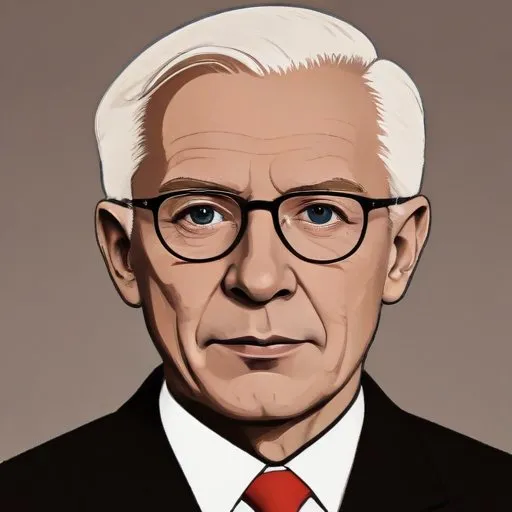
A Dutch journalist and diplomat who played a key role in the formation of the United Nations, serving as the chairman of the UN Committee on Administrative and Budgetary Questions. He's also known for his work as a correspondent and ambassador, promoting international cooperation and peace.
Adriaan Pelt, a Dutch journalist, international civil servant, and diplomat, is renowned for drafting the post-war constitution of Libya, a feat that would shape the country's future and cement his legacy in the annals of history.
As a seasoned diplomat, Pelt's expertise in international relations and his experience in navigating the complexities of global politics made him the ideal candidate to undertake this monumental task.
Born on May 8, 1892, in Koog aan de Zaan, Netherlands, Pelt's early life was marked by a keen interest in international relations and journalism. He pursued his passion for diplomacy at the École Libre des Sciences Politiques in Paris, where he honed his skills and developed a deep understanding of global politics.
In 1949, Pelt was appointed High Commissioner for Libya by the UN, a position that would prove to be the crowning achievement of his illustrious career. Tasked with uniting the country's three regions – Tripolitania, Cyrenaica, and Fezzan – Pelt successfully drafted a constitution that would pave the way for Libya's independence on January 1, 1952.
Through his tireless efforts, Pelt brought together the tribes and peoples of Libya, facilitating the transfer of state power to King Idris and ensuring a smooth transition to independence.
Adriaan Pelt's legacy extends far beyond his role in drafting the Libyan constitution. His contributions to international relations, diplomacy, and the shaping of the United Nations Charter have had a lasting impact on global politics.
As a champion of international cooperation and a visionary diplomat, Pelt's work continues to inspire generations of diplomats, policymakers, and scholars, cementing his place as one of the most influential figures of the 20th century.
In addition to his remarkable professional achievements, Pelt's personal life was marked by a deep commitment to his family and community. He married a Frenchwoman and lived in London and Paris, where he developed a rich cultural understanding that would inform his diplomatic work.
Through his remarkable journey, Adriaan Pelt left an indelible mark on the world, a testament to the power of diplomacy, international cooperation, and visionary leadership.
Born in 1911
A Dutch diplomat who served as the Secretary General of NATO from 1971 to 1984, playing a crucial role in shaping the organization's policies during the Cold War era. He's most known for his efforts to maintain peace and stability in Europe during a tumultuous period.
95 Years Old
A Dutch journalist and politician who served as Deputy Prime Minister of the Netherlands, known for his progressive views and leadership in the Democrats 66 party. He played a key role in shaping the country's social and economic policies.
95 Years Old
A Dutch statesman who served as Prime Minister of the Netherlands from 1977 to 1982, known for his progressive policies and European integration efforts.
Born in 1919
A Dutch journalist, economist, and politician who served as Deputy Prime Minister of the Netherlands, known for his progressive policies and efforts to reduce economic inequality. He played a key role in shaping the country's social and economic landscape.
Born in 1903
A Dutch economist and academic who developed the first national economic model and was awarded the first Nobel Prize in Economics in 1969 for his work on econometrics.
88 Years Old
Led the Netherlands as Prime Minister from 1994 to 2002, implementing significant economic reforms and guiding the country's integration into the European Union. He's also known for his role in shaping the country's social and economic policies.
