


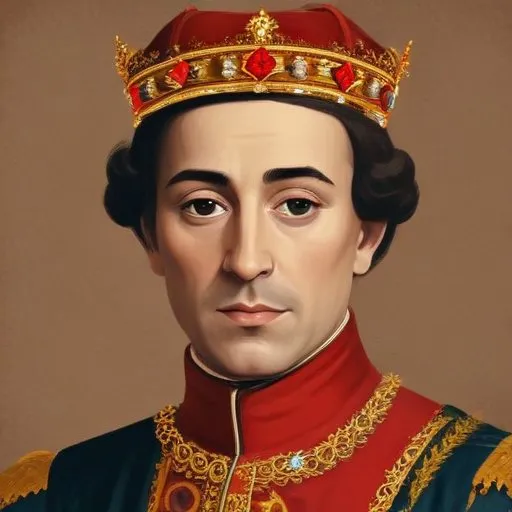
King of Portugal from 1656 to 1683, known for his military campaigns and territorial expansions, particularly in Brazil and Africa.
Afonso VI, also known as the Victorious, was the second king of Portugal from the House of Braganza, reigning from 1656 until his death in 1683. He is remembered for successfully ending the Restoration War and securing Spain's recognition of Portugal's independence, cementing his place in history as a triumphant leader.
Born on August 21, 1643, Afonso was the second of three sons to King John IV and Queen Luisa de Guzmán. Tragedy struck early, as he suffered an illness at the age of three that left him with paralysis on the right side of his body. This condition was believed to have also affected his intellectual abilities, leading to concerns about his fitness to rule.
After the death of his eldest brother, Teodosio, Prince of Brazil, in 1653, Afonso became the heir apparent to the throne and received the crown-princely title 2nd Prince of Brazil. Upon his father's death in 1656, Afonso ascended to the throne at just 13 years old, with his mother, Luisa de Guzmán, serving as regent due to concerns about his mental fitness to govern.
In 1662, Afonso, determined to take control of his kingdom, removed his mother from power and began to rule in his own right, aided by his favorite, Luís de Vasconcelos e Sousa, 3rd Count of Castelo Melhor. During his reign, Afonso negotiated a French alliance through his marriage to Marie Françoise of Savoy-Nemours, resulting in the signing of the Treaty of Lisbon in 1668.
However, Afonso's reign was not without its challenges. His brother, Pedro II, conspired against him, declaring him incapable of ruling and taking supreme de facto power as regent. Afonso's wife, Queen Maria Francisca, received an annulment and subsequently married Pedro, leaving Afonso to spend the remainder of his life in practical imprisonment.
Afonso's legacy is complex, marked by both triumph and turmoil. Despite his difficulties, he played a crucial role in securing Portugal's independence and recognitition from Spain. His reign also saw significant cultural and artistic developments, including the creation of the Royal Academy of Portuguese History.
Afonso's reign serves as a testament to the complex and tumultuous nature of 17th-century European politics. His struggles and triumphs offer a unique insight into the challenges faced by rulers of the time, and his legacy continues to be felt in Portugal to this day.
In comparison to his contemporaries, Afonso's reign was marked by a unique blend of determination and vulnerability. While he faced significant challenges, he also demonstrated a capacity for strategic thinking and diplomacy, as seen in his negotiation of the Treaty of Lisbon.
Afonso's legacy extends beyond the realm of politics, with his reign also having a profound impact on Portuguese culture and society. The cultural and artistic developments that occurred during his reign continue to shape the nation's identity to this day.
Born in 1455
King of Portugal from 1481 to 1495, known for his centralizing policies, establishing a strong monarchy, and sponsoring explorers like Bartolomeu Dias and Vasco da Gama.
Born in 1320
King of Portugal who ruled from 1357 to 1367 and is remembered for his brutal suppression of the nobility and his role in the Portuguese succession crisis. He's also known for his tumultuous personal life, including the murder of his mistress's lover.
Born in 1209
King of Portugal from 1223 to 1248, known for his military campaigns to reconquer territories from the Moors and his conflicts with the Catholic Church.
Born in 1432
King of Portugal who ruled from 1438 to 1481, known for his military conquests in North Africa and the expansion of Portuguese trade and exploration.
Born in 1469
King of Portugal from 1495 to 1521, known for sponsoring Vasco da Gama's voyage to India, establishing trade routes, and promoting the Portuguese Renaissance.
Born in 1394
A Portuguese prince who sponsored and organized numerous expeditions to explore and map the west coast of Africa, leading to the discovery of new trade routes and territories. He played a crucial role in the Age of Exploration.
