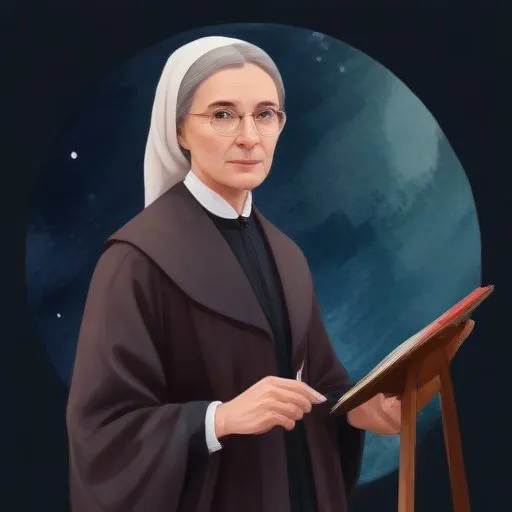
The Celestial Chronicler: Unveiling Agnes Mary Clerke, Ireland's Astronomy Icon
Agnes Mary Clerke, a luminary in the realm of astronomy, left an indelible mark on the field with her groundbreaking writings and contributions. This Irish trailblazer is renowned for her pioneering work in astronomy, having penned seminal biographies of famous scientists and crafting an authoritative article on astronomy for the prestigious Catholic Encyclopedia.
A Stellar Childhood and Education
Born on February 10, 1842, in Skibbereen, County Cork, Ireland, Agnes was the daughter of John William Clerke, a bank manager, and Catherine Mary Deasy, a strong advocate for girls' education. Alongside her siblings, Ellen Mary and Aubrey St. John, Agnes received a home-schooled education, with her mother instilling in her a love for learning. This nurturing environment laid the foundation for Agnes's future achievements.
The Cosmos Beckons
Fascinated by the night sky, Agnes began her astronomical journey at the tender age of 15, using her father's 4-inch telescope to observe the heavens. This curiosity soon blossomed into a passion, as she commenced writing a history of astronomy. Her early start would prove to be a precursor to a life dedicated to exploring the mysteries of the universe.
A Life of Learning and Literary Pursuits
In 1861, Agnes's family relocated to Dublin, and later to Queenstown (present-day Cobh) in 1863. At 25, she traveled to Italy with her elder sister Ellen, where they remained until 1877. This sojourn allowed Agnes to immerse herself in science, languages, and other subjects, laying the groundwork for her future writing career.
A Literary Career Takes Flight
Upon her return to England, Agnes's writing career gained momentum. Her articles, "Brigandage in Sicily" and "Copernicus in Italy," published in the Edinburgh Review, caught the attention of Adam and Charles Black, publishers of the Encyclopædia Britannica. This led to a series of commissions, including the opportunity to write biographies of prominent scientists for the encyclopedia's ninth edition.
Major Works and Contributions
Agnes's most notable works include:
- A Popular History of Astronomy During the Nineteenth Century (1885)
- The System of the Stars (1890)
- The Herschels and Modern Astronomy (1895)
These seminal texts cemented her position as a leading authority on astronomy, offering a unique perspective on the field.
Legacy and Impact
Agnes Mary Clerke's contributions to astronomy have inspired generations of scientists and scholars. Her writings have not only enriched our understanding of the universe but have also paved the way for future women in STEM fields. As a testament to her enduring legacy, Clerke's work continues to captivate audiences, solidifying her position as a true pioneer in the realm of astronomy.
In Memoriam
Agnes Mary Clerke passed away on January 20, 1907, in London, leaving behind a rich tapestry of astronomical knowledge and literary achievements. Her remarkable life serves as a beacon, illuminating the path for future generations of astronomers and writers alike.
FAQ
What was Agnes Mary Clerkes contribution to astronomy?
Agnes Mary Clerke was an Irish astronomer and author who made significant contributions to the field of astronomy, particularly in the areas of stellar spectroscopy and astronomy history.
What is Agnes Mary Clerkes most famous work?
Agnes Mary Clerkes most famous work is her book A Popular History of Astronomy During the Nineteenth Century, which remains a classic in the field of astronomy.
Who was Agnes Mary Clerkes mentor?
Agnes Mary Clerke was mentored by the English astronomer, Robert Ball, who introduced her to the world of astronomy and encouraged her to pursue her research.
Where did Agnes Mary Clerke study astronomy?
Agnes Mary Clerke studied astronomy at the Royal Observatory in Greenwich, London, where she worked alongside some of the leading astronomers of her time.
What awards did Agnes Mary Clerke win?
Agnes Mary Clerke won several awards for her work, including the Actonian Prize in 1893, which recognized her contributions to astronomy and literature.