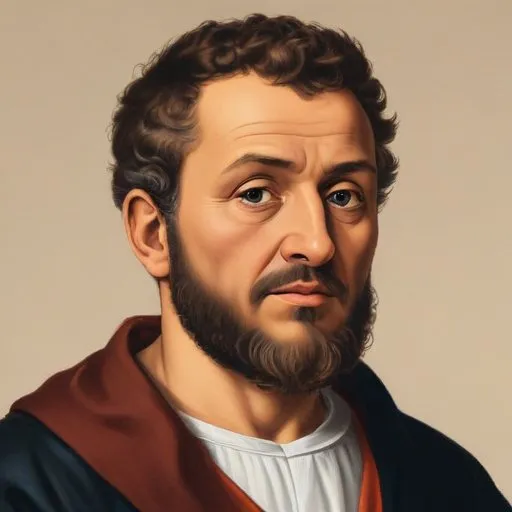
Agostino Carracci: The Pioneer of Baroque Art
The Founder of the Accademia degli Incamminati
Agostino Carracci was a renowned Italian painter, printmaker, tapestry designer, and art teacher who, along with his brother Annibale and cousin Ludovico, founded the Accademia degli Incamminati in Bologna. This academy was a revolutionary institution that aimed to counter the prevailing Mannerist style and paved the way for the development of Baroque art.
A Humble Beginning
Born on August 16, 1557, in Bologna, Italy, Agostino was the son of a tailor. Initially, he trained as a goldsmith, but his artistic inclination soon took over, and he began studying painting under Prospero Fontana and Bartolomeo Passarotti. His encounter with the works of Correggio in Parma had a profound impact on his artistic style.
A Journey of Experimentation and Learning
Accompanied by his brother Annibale, Agostino traveled to Venice, where he honed his skills as an engraver under the tutelage of Cornelis Cort. During this period, he produced several reproductive engravings of 16th-century masters, including Federico Barocci, Tintoretto, Antonio Campi, Veronese, and Correggio. He also created some original prints, including two etchings that showcased his innovative style.
A Master of Fresco Cycles
Agostino's collaborations with his brother and cousin on the fresco cycles in Palazzo Fava (
Histories of Jason and Medea, 1584) and Palazzo Magnani (
Histories of Romulus, 1590-1592) are considered some of his most notable works. These frescoes demonstrated his mastery of color, composition, and narrative.
A Masterpiece of Devotion
One of Agostino's most celebrated works is the
Communion of St. Jerome, painted in 1592 and now housed in the Pinacoteca di Bologna. This masterpiece is a testament to his skill in capturing the subtleties of human emotion and his ability to convey a sense of devotion and spirituality.
A Legacy of Innovation
Agostino's contributions to the development of Baroque art are undeniable. His innovative use of light and shadow, his emphasis on emotional intensity, and his ability to evoke a sense of drama and movement in his works paved the way for future generations of artists.
Awards and Honors
- Agostino's works are housed in some of the most prestigious galleries and museums in the world, including the National Gallery of Parma and the Pinacoteca di Bologna.
- His frescoes in Palazzo Fava and Palazzo Magnani are considered some of the most important examples of Baroque art in Italy.
Influence on Modern Society
Agostino's artistic innovations had a far-reaching impact on modern society. His emphasis on emotional intensity and his ability to evoke a sense of drama and movement in his works inspired generations of artists, from Caravaggio to Rembrandt.
Personal Milestones and Key Life Events
- 1574: Began working as a reproductive engraver, copying works of 16th-century masters.
- 1582: Traveled to Venice to study the works of Correggio.
- 1586: Painted the altarpiece Madonna with Child and Saints for the National Gallery of Parma.
- 1592: Completed the Communion of St. Jerome, considered his masterwork.
- 1598: Joined his brother Annibale in Rome to collaborate on the decoration of the Gallery in Palazzo Farnese.
Timeline of Major Works
- 1584: Histories of Jason and Medea (fresco cycle in Palazzo Fava)
- 1586: Madonna with Child and Saints (altarpiece in the National Gallery of Parma)
- 1590-1592: Histories of Romulus (fresco cycle in Palazzo Magnani)
- 1592: Communion of St. Jerome (painting in the Pinacoteca di Bologna)
Agostino Carracci's contributions to the world of art are a testament to his innovative spirit and his ability to push the boundaries of artistic expression. His legacy continues to inspire artists and art lovers to this day.
FAQ
Who was Agostino Carracci?
Agostino Carracci was an Italian painter, etcher, and printmaker who was active in the late 16th and early 17th centuries.
What is Agostino Carraccis style?
Agostino Carraccis style is characterized by his use of classical motifs, vivid colors, and emotive expressions, which showed a strong influence from Renaissance masters like Michelangelo and Raphael.
What is Agostino Carraccis most famous work?
Agostino Carraccis most famous work is probably the frescoes he painted in the Palazzo Fava in Bologna, which showcase his mastery of Renaissance art.
Did Agostino Carracci have any pupils?
Yes, Agostino Carracci had several pupils, including his cousin, Annibale Carracci, who went on to become a prominent painter in his own right.
What is Agostino Carraccis legacy?
Agostino Carraccis legacy lies in his contributions to the development of Baroque art, as he played a key role in shaping the artistic style of 17th-century Italy.