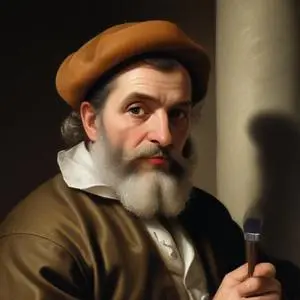
Annibale Carracci: The Baroque Master of Light and Shadow
A Pioneer of Classical Monumentality
Annibale Carracci was an Italian painter and instructor, renowned for being one of the progenitors of the Baroque style, a movement that revolutionized the art world with its dramatic lighting, intense emotions, and sense of movement. Along with his brother Agostino and cousin Ludovico, Annibale founded the Accademia degli Incamminati, a pioneering art school in Bologna that emphasized life drawing and classical techniques, shaping the course of Roman painting for decades to come.
Early Career and Influences
Born in Bologna in 1560, Annibale was initially apprenticed within his family before opening his own studio with his brother and cousin in 1582. The studio, initially called the Academy of the Desiderosi, was later renamed the Incamminati, attracting artists from across Europe who sought to learn from the Carracci brothers' innovative approach. Annibale's early work was influenced by his travels through Italy, where he studied the works of Titian, Raphael, and
Andrea del Sarto, absorbing the lessons of Florentine linearity and Venetian colorism.
The Emergence of the Baroque Style
In the late 1580s, Annibale began to develop his signature style, characterized by a bold use of chiaroscuro, dynamic composition, and a sense of emotional intensity. His frescoes in the Palazzo Fava in Bologna, depicting the story of Jason, showcased his ability to merge classical monumentality with a new sense of drama and movement. This eclecticism, blending the best of northern and southern Italian traditions, became the hallmark of the Baroque Emilian or Bolognese School.
Rome and the Palazzo Farnese
In 1595, Annibale moved to Rome, where he was commissioned to decorate the Palazzo Farnese, one of the city's most prestigious buildings. Over the next several years, he created some of his most celebrated works, including the magnificent frescoes in the Galleria Farnese, which showcased his mastery of light, color, and composition. The Palazzo Farnese became a hub for artists, who came to study and learn from Annibale's innovative techniques.
Legacy and Influence
Annibale Carracci's impact on Western art is immeasurable. He influenced generations of artists, from Caravaggio to Velázquez, and shaped the course of Baroque painting in Rome, Bologna, and beyond. His emphasis on life drawing, classical techniques, and emotional intensity set a new standard for artistic excellence, inspiring artists to experiment with light, color, and composition. Today, Annibale Carracci is recognized as one of the greatest painters of the 17th century, a master of light and shadow who continues to inspire artists, art lovers, and historians alike.
Major Works
- Frescoes in the Galleria Farnese, Palazzo Farnese, Rome (1595-1600)
- Frescoes in the Palazzo Fava, Bologna (1583-1584)
- The Loves of the Gods, Galleria Borghese, Rome (1597-1608)
- The Beaneater, Galleria Colonna, Rome (1580-1590)
Personal Life and Milestones
- 1560: Born in Bologna, Italy
- 1582: Founded the Accademia degli Incamminati with his brother and cousin
- 1585: Completed the altarpiece of the Assumption of the Virgin for the Church of Santa Maria Maggiore, Bologna
- 1595: Moved to Rome and began work on the Palazzo Farnese
- 1609: Died in Rome, Italy
Quotes and Memorable Sayings
- "The goal of art is to represent the beauty of nature, and the beauty of nature is the goal of art." - Annibale Carracci
FAQ
What was Annibale Carraccis profession?
Annibale Carracci was an Italian painter and illustrator, known for his innovative and influential style in the late 16th and early 17th centuries.
What is Annibale Carraccis most famous work?
Annibale Carraccis most famous work is the fresco cycle in the Gallery of Palazzo Farnese in Rome, considered one of the greatest achievements of Baroque art.
Did Annibale Carracci found an art academy?
Yes, Annibale Carracci founded the Accademia degli Incamminati, an art academy in Bologna, which became a hub for artistic innovation and training.
What was Annibale Carraccis influence on subsequent artists?
Annibale Carraccis innovative style and techniques influenced many subsequent artists, including Caravaggio and Rembrandt, and helped shape the development of Baroque art.
What is Annibale Carraccis legacy in the art world?
Annibale Carraccis legacy in the art world lies in his innovative style, his founding of the Accademia degli Incamminati, and his influence on subsequent generations of artists.