


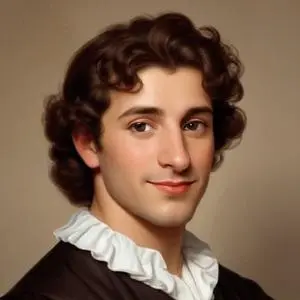
A prominent Baroque painter and illustrator, renowned for his vivid and emotive depictions of mythological and religious scenes. His works are celebrated for their dramatic lighting and intense emotional power.
Guido Reni, an Italian painter of the Baroque period, is renowned for his breathtakingly beautiful and emotionally charged works of art, which continue to inspire and awe art enthusiasts to this day. His elaborate and ornate paintings, characterized by their classical manner, have earned him a place among the greatest artists of his time, alongside Simon Vouet, Nicolas Poussin, and Philippe de Champaigne.
Born on November 4, 1575, in Bologna, Italy, Guido Reni was the only child of Daniele Reni and Ginevra Pozzi, a family of musicians. At the tender age of nine, he was apprenticed to the Bolognese studio of Denis Calvaert, where he was joined by fellow students Albani and Domenichino. This early exposure to art laid the foundation for Reni's future success.
In his late teenage years, Reni, along with his friends, migrated to the Accademia degli Incamminati, led by Ludovico Carracci, where they formed the nucleus of a prolific and successful school of Bolognese painters. This association with the Carracci family would have a profound impact on Reni's artistic style and development.
In 1598, Reni completed his first altarpieces while still in the Carracci academy. However, a disagreement with Ludovico Carracci over unpaid work led to his departure from the academy. This setback did not deter Reni, who instead began to focus on his own artistic endeavors. He created a series of prints commemorating Pope Clement VIII's visit to Bologna in 1598, which earned him recognition and acclaim.
By 1601, Reni had moved to Rome, where he worked alongside Annibale Carracci on the fresco decoration of the Farnese Palace. This collaboration marked the beginning of his rise to prominence in the art world. His independent commission for an altarpiece of the Crucifixion of St. Peter in 1604-05 cemented his position as a leading painter in Rome.
During the papacy of Pope Paul V Borghese (1605-1621), Reni became one of the most sought-after painters in Rome, enjoying the patronage of the powerful Borghese family. His works adorned the walls of several prominent buildings, including the Casino dell'Aurora on the grounds of the Palazzo Pallavicini-Rospigliosi.
Guido Reni's contributions to the world of art are immeasurable. His beautiful and evocative paintings continue to inspire generations of artists, art lovers, and historians. His legacy is a testament to the power of art to transcend time and touch the human spirit.
These masterpieces showcase Reni's exceptional skill, creativity, and attention to detail, solidifying his position as one of the greatest painters of the Baroque period.
Born in 1598
A renowned Baroque master who crafted exquisite sculptures and paintings that captivated 17th-century Rome, leaving an indelible mark on the art world.
Born in 1599
A Baroque mastermind who crafted iconic Roman churches, blending dramatic curves and geometric precision to create awe-inspiring spaces.
Born in 1596
A prominent Baroque painter who created elaborate, dramatic, and emotive works that adorned the ceilings of Roman palaces and churches, influencing the development of 17th-century art.
Born in 1581
A prominent painter of the Baroque period, known for his vivid and emotive depictions of mythological and biblical scenes, which greatly influenced the development of 17th-century art.
Born in 1582
A prominent Baroque painter, renowned for his dramatic use of light and color in grand, sweeping frescoes that adorned the ceilings of Italian churches. His work continues to inspire artists and architects today.
Born in 1642
A 17th-century Jesuit Brother who excelled as an architect and painter, creating stunning Baroque trompe l'oeil ceilings that seemed to defy gravity. His works continue to inspire artists and architects today.
Born in 1560
A pioneering figure in the Baroque style, known for dramatic lighting, intense emotions, and classical influences in his works, which revitalized Italian art in the late 16th century.
